MiG-15 Fagot vs Mystère IV
MiG-15 Fagot vs Mystère IV at a glance — top speed 1,075 vs 1,120 km/h, range 2,520 vs 915 km, max takeoff weight 6,105 vs 10,320 kg, built 17,310 vs 411 units.
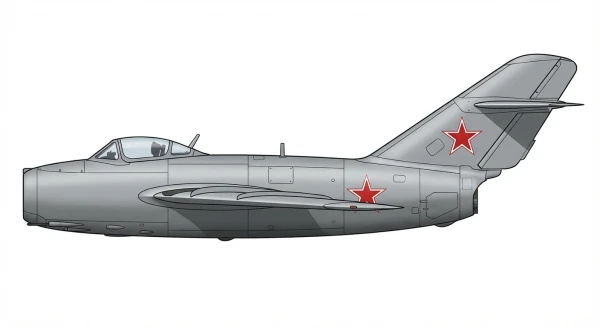
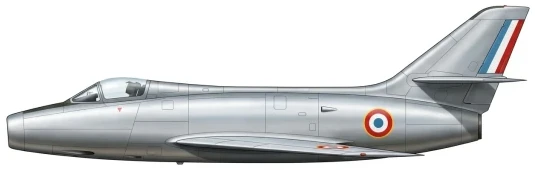
| MiG-15 Fagot | Mystère IV | |
|---|---|---|
| Origin country | 🇷🇺 Ex-USSR | 🇫🇷 France |
| Category | Combat Aircraft | Combat Aircraft |
| Manufacturer | Mikoyan-Gurevich | Dassault |
| First flight | 19 December 1947 | 28 September 1952 |
| Year introduced | 1949 | 1954 |
| Number produced | 17310 units | 411 units |
| Average unit price | $200K | $1.5 million |
| Wing area | 20.6 m² | 32.0 m² |
| Wingspan | 10.1 m | 11.1 m |
| Height | 3.7 m | 4.6 m |
| Length | 10.1 m | 14.8 m |
| Maximum speed | 1075 km/h | 1120 km/h |
| Operational range | 2,520 km | 915 km |
| Service ceiling | 15,500 m | 13,700 m |
| Max. takeoff weight | 6,105 kg | 10,320 kg |
| Empty weight | 3,580 kg | 7,140 kg |
| Total thrust | 1 x 2,700 kgf | 1 x 3,334 kgf |
Detailed Comparison
The Mikoyan-Gurevitch MiG-15 and Dassault Mystère IV illustrate the rapid evolution of jet technology between the late 1940s and mid-1950s. While the MiG-15 was a dedicated high-altitude interceptor designed to counter heavy bombers, the Mystère IV emerged several years later as a heavier, transonic fighter-bomber. The disparity in production scale is significant, with the Soviet airframe exceeding 17,000 units compared to the specialized production run of 411 French aircraft.
Development and Design
The MiG-15 was a first-generation swept-wing fighter, utilizing aluminum alloys to approach Mach 1. Its design prioritized a high thrust-to-weight ratio for interception, centered around the centrifugal Klimov VK-1 engine. It was built for simplicity and mass production to meet Soviet strategic needs. Conversely, the Mystère IV was an aerodynamic evolution of the earlier Mystère II, featuring a new fuselage and tail surfaces specifically tailored for transonic stability. While the MiG-15 was a lightweight air superiority fighter, the Mystère IV was a more robust platform. This is evident in the mass difference: the Mystère IV had a maximum takeoff weight of 10,320 kg, nearly double the MiG-15's 6,105 kg.
Specifications and Performances
Performance data reflects the divergence in design eras and roles. The Mystère IV, benefitting from later aerodynamic innovations and a powerful engine (3334 kgf thrust), achieves a higher maximum speed of 1120 km/h compared to the MiG-15's 1075 km/h. The French aircraft also demonstrates superior climb performance at 95.0 m/s versus 50.0 m/s for the MiG.
However, the MiG-15 retains specific advantages characteristic of a pure interceptor:
- Service Ceiling: The MiG-15 operates up to 15,500 m, significantly higher than the Mystère IV's 13,700 m, allowing it to dictate engagements against high-altitude bombers.
- Range: The Soviet aircraft boasts an impressive range of 2520 km, whereas the Mystère IV is limited to 915 km, restricting the latter's deep-strike capabilities without external fuel tanks.
Deployment and Usage
The MiG-15 is defined by its role in the Korean War, where it challenged UN air superiority in "MiG Alley." Its armament, consisting of one 37mm and two 23mm cannons, was optimized for destroying bombers, though it proved lethal against fighters like the F-80 and F-84.
The Mystère IV saw combat in the Suez Crisis, the Six-Day War, and the Indo-Pakistani War of 1965. Unlike the MiG's primary focus on interception, the Mystère IV proved highly effective as a fighter-bomber. It leveraged a 1,000 kg payload capacity on four hardpoints for rockets and bombs, alongside two 30mm DEFA cannons. Indian and Israeli pilots utilized the platform successfully for both ground attack sorties and air-to-air combat.
Conclusion
The MiG-15 represents a triumph of specific utility and mass mobilization, offering a lightweight, high-altitude platform that forced a tactical shift in Western air doctrines during the early Cold War. The Mystère IV represents a more mature, transonic design philosophy. While the MiG-15 secured its legacy through sheer volume and high-altitude dominance, the Mystère IV demonstrated superior aerodynamic refinement and versatility as a multi-role strike fighter in complex regional conflicts.