F-80 Shooting Star
American straight-wing jet fighter first flown in 1944, the first jet in USAAF operational service, flown in the Korean War as a fighter-bomber and reconnaissance aircraft. Key figures: top speed 956 km/h, range 1,328 km, service ceiling 14,265 m, max takeoff weight 7,646 kg, unit price $0.1M, built 1,715.
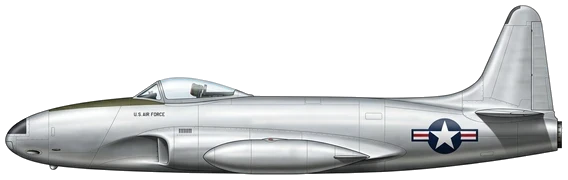
| Crew | 1 |
| Length | 10.5 m (34.4 ft) |
| Wingspan | 11.8 m (38.7 ft) |
| Height | 3.4 m (11.3 ft) |
| Wing area | 22.1 m² (237.6 sqft) |
| Empty weight | 3,819 kg (8,419 lbs) |
| Max. takeoff weight | 7,646 kg (16,857 lbs) |
| Powerplant | 1 × turbojet Allison J33-A-35 2,449 kgf each |
| Maximum speed | 956 km/h (594 mph) |
| Operational range | 1,328 km (825 mi) |
| Service ceiling | 14,265 m (46,801 ft) |
| Climb rate | 34.9 m/s (114.5 ft/s) |
- 2 × 1,000 lb (454 kg) unguided bombs
- 8 × 127 mm HVAR unguided rockets
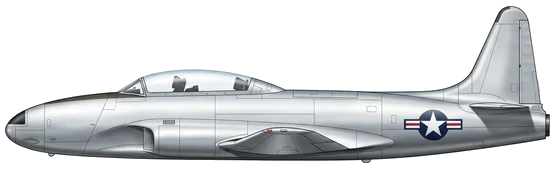
Description
The Lockheed P-80 Shooting Star, redesignated F-80 in 1948, is a single-seat, single-engine jet fighter designed and built by Lockheed in the United States. It was the first jet aircraft used operationally by the United States Army Air Forces (USAAF), with pre-production aircraft entering service in late 1944. It flew fighter, ground-attack and photo-reconnaissance missions in the Korean War and was the basis for the T-33 trainer and F-94 Starfire.
Development
The USAAF rejected Lockheed's 1939 L-133 study in favour of the Bell P-59, which proved only marginally faster than piston-engined fighters. After Allied intelligence identified the Me 262 in spring 1943, Wright Field tasked Lockheed with designing an airframe around the British Halford H-1B Goblin turbojet. A team of 128 engineers under Clarence L. "Kelly" Johnson began work in May 1943 in a tent-covered building that became known as the Skunk Works. The first prototype was completed on day 139. The XP-80 Lulu-Belle first flew on 8 January 1944 and reached 502 mph (808 km/h). Fuel pump failures killed Lockheed's chief test pilot in October 1944 and America's top-scoring ace in August 1945. An initial order for 1,000 P-80As followed in February 1945. Production ended in 1950 with 1,714 single-seat aircraft, 927 of them F-80Cs.
Design
The P-80 has a conventional all-metal airframe with a straight low wing, tricycle landing gear and a pressurised cockpit under a bubble canopy. It was the first operational jet fighter with its engine buried in the fuselage and the first aircraft fitted with wingtip tanks. The P-80B added an ejection seat, thinner wings with thicker skin and a stainless steel armoured engine compartment. The F-80C uses an Allison J33-A-35 turbojet rated at 4,600 lbf (20 kN), or 5,400 lbf (24 kN) with water injection. It reaches 594 mph (956 km/h) at sea level and has a service ceiling of 46,800 ft (14,300 m).
Armament
Six 0.50 in (12.7 mm) M3 Browning machine guns with 300 rounds per gun are mounted in the nose. The F-80C can also carry eight 127 mm HVAR unguided rockets or two 1,000 lb (450 kg) bombs.
Operational History
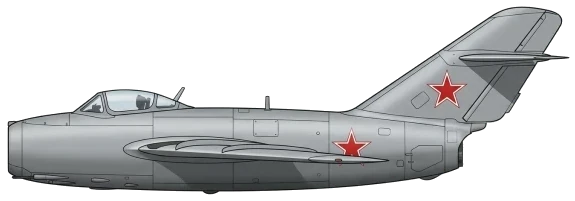
Two YP-80As flew reconnaissance missions in Italy in February and March 1945 but saw no combat. On 19 June 1947, the P-80R set a world airspeed record of 623.73 mph (1,004.2 km/h). During the Berlin Blockade, the 56th Fighter Group made the first west-to-east Atlantic crossing by single-engine jets in July 1948. The US Navy received 50 F-80Cs in 1949 as TO-1/TV-1 trainers. At the start of the Korean War, the F-80 made up about half of USAF fighter strength, and F-80Cs eventually equipped 10 squadrons. Faster MiG-15s led the F-86 Sabre to replace it in the air superiority role, and the F-80 then flew ground-attack missions. Of 368 F-80s lost in Korea, 277 were lost on combat missions. The USAF credits the F-80 with 17 aircraft destroyed in the air and 24 on the ground. US service ended in 1959. Brazil, Chile, Colombia, Ecuador, Peru and Uruguay received F-80Cs from 1957, and Chile retired the last examples in 1974.
Variants
- XP-80: Halford H-1B-powered prototype, one built, first flown 8 January 1944.
- P-80A/F-80A: Initial production model, 524 built, fitted with 225 US gal tip tanks.
- P-80B/F-80B: 240 built with an ejection seat, underwing rocket launchers and an improved J33 engine.
- F-80C: Main production version with the J33-A-35 engine and 260 US gal tip tanks, including 128 converted F-80As.
- RF-80A: Photo-reconnaissance version used in Korea by the 8th (later 15th) Tactical Reconnaissance Squadron.
Frequently Asked Questions
What type of aircraft is the F-80 Shooting Star?
What is the maximum speed of the F-80 Shooting Star?
What is the range of the F-80 Shooting Star?
When did the F-80 Shooting Star first fly?
How many F-80 Shooting Star have been built?
Which countries operate the F-80 Shooting Star?
How much does a F-80 Shooting Star cost?
What is the service ceiling of the F-80 Shooting Star?
- OCT 192026 Created Page created: F-80 Shooting Star