MiG-17 Fresco vs MiG-19 Farmer
MiG-17 Fresco vs MiG-19 Farmer at a glance — top speed 1,145 vs 1,455 km/h, range 2,020 vs 2,200 km, max takeoff weight 6,069 vs 8,832 kg, built 10,649 vs 2,172 units.
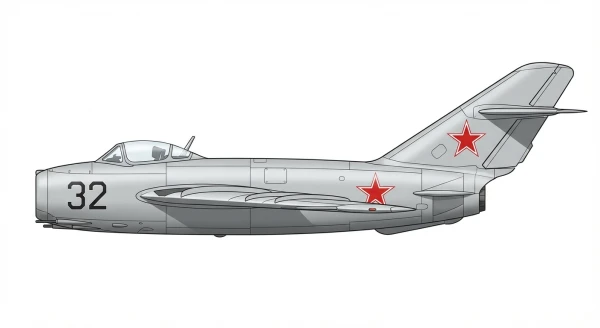
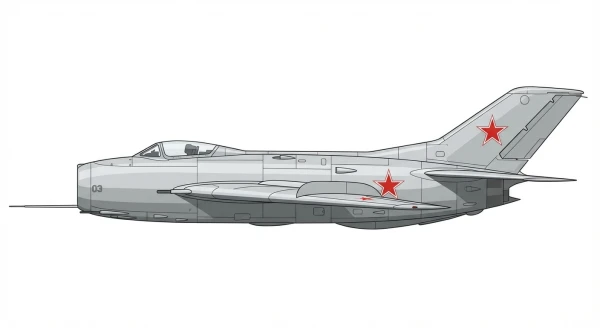
| MiG-17 Fresco | MiG-19 Farmer | |
|---|---|---|
| Origin country | 🇷🇺 Ex-USSR | 🇷🇺 Ex-USSR |
| Category | Combat Aircraft | Combat Aircraft |
| Manufacturer | Mikoyan-Gurevich | Mikoyan-Gurevich |
| First flight | 14 January 1950 | 18 September 1953 |
| Year introduced | 1952 | 1955 |
| Number produced | 10649 units | 2172 units |
| Average unit price | $600K | $2 million |
| Wing area | 22.6 m² | 25.2 m² |
| Wingspan | 9.6 m | 9.2 m |
| Height | 3.8 m | 3.9 m |
| Length | 11.3 m | 12.5 m |
| Maximum speed | 1145 km/h | 1455 km/h |
| Operational range | 2,020 km | 2,200 km |
| Service ceiling | 16,600 m | 17,500 m |
| Max. takeoff weight | 6,069 kg | 8,832 kg |
| Empty weight | 3,919 kg | 5,447 kg |
| Total thrust | 1 x 3,447 kgf | 2 x 3,243 kgf |
Detailed Comparison
The MiG-17 Fresco marks the pinnacle of Soviet subsonic gun-fighter design, evolving directly from the MiG-15 to correct high-speed instability, whereas the MiG-19 Farmer represents a radical operational shift as the Soviet Union's first production aircraft capable of supersonic speeds in level flight. While the Fresco relied on aerodynamic refinement of an existing platform, the Farmer introduced a twin-engine configuration to push the flight envelope, achieving speed at the cost of initial reliability.
Development and Design
The development of the MiG-17 was driven by the necessity to stabilize the MiG-15's performance near Mach 1. Designers utilized a sharper wing sweep (45 degrees near the fuselage) and a stiffened wing structure. It retained the single-engine layout, utilizing the robust Klimov VK-1, prioritizing agility and durability.
In contrast, the MiG-19 was purpose-built to break the sound barrier. To generate the necessary thrust, Mikoyan-Gurevich utilized a twin-engine layout with Tumansky RD-9B turbojets. While aerodynamically superior, the MiG-19 suffered from a rushed development cycle. Early units were plagued by poor thermal insulation causing fuel tank explosions and treacherous handling at supersonic speeds. The MiG-17 was structurally simpler and lacked advanced avionics, while the MiG-19 attempted to integrate radar systems (Izumrud) early on, often compromising cockpit visibility and weight distribution.
Specifications and Performances
The performance disparity illustrates the jump from the first to the second generation of jet fighters. The MiG-19 offers a distinct kinetic advantage, reaching a maximum speed of 1,455 km/h compared to the MiG-17’s 1,193 km/h. The Farmer also dominates the vertical flight regime, with a service ceiling of 17,500 m and a climb rate of 180 m/s, attributes essential for intercepting high-altitude bombers.
However, the MiG-17 possesses superior endurance, boasting a range of 2,020 km versus the MiG-19's limited 1,390 km. In terms of armament, both heavily relied on large-caliber cannons (23mm and 37mm for the MiG-17; 23mm or 30mm for the MiG-19), though the MiG-19 was better adapted for early air-to-air missiles like the K-13 (AA-2 Atoll).
Deployment and Usage
Operational history paradoxically favors the older platform. The MiG-17 proved exceptionally effective during the Vietnam War, utilizing its low-speed turn rate to ambush faster, heavier US fighters like the F-105 and F-4 Phantom II. Its simplicity allowed for widespread export to over 20 nations, seeing extensive service in the Middle East and Africa.
The MiG-19 also saw combat in Vietnam and the Indo-Pakistani wars but was quickly phased out of Soviet service due to its poor safety record and the arrival of the MiG-21. However, the airframe found longevity through Chinese production; the Shenyang J-6 (license-built MiG-19) was produced in far greater numbers than the Soviet original and exported widely.
Conclusion
The MiG-17 stands as a highly reliable, agile dogfighter that remained operationally relevant through asymmetric tactics long after its technological obsolescence. The MiG-19, conversely, served as a transitional bridge; it delivered necessary supersonic capabilities but was hampered by the immaturity of its propulsion and airframe integration. While the Farmer was faster, the Fresco was a far more successful combat asset relative to its design era.