MiG-17 Fresco vs Mystère IV
MiG-17 Fresco vs Mystère IV at a glance — top speed 1,145 vs 1,120 km/h, range 2,020 vs 915 km, max takeoff weight 6,069 vs 10,320 kg, built 10,649 vs 411 units.
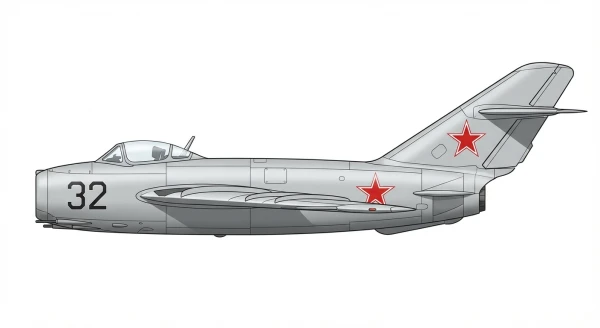
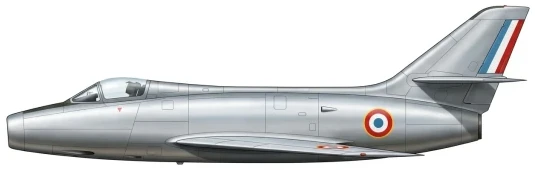
| MiG-17 Fresco | Mystère IV | |
|---|---|---|
| Origin country | 🇷🇺 Ex-USSR | 🇫🇷 France |
| Category | Combat Aircraft | Combat Aircraft |
| Manufacturer | Mikoyan-Gurevich | Dassault |
| First flight | 14 January 1950 | 28 September 1952 |
| Year introduced | 1952 | 1954 |
| Number produced | 10649 units | 411 units |
| Average unit price | $600K | $1.5 million |
| Wing area | 22.6 m² | 32.0 m² |
| Wingspan | 9.6 m | 11.1 m |
| Height | 3.8 m | 4.6 m |
| Length | 11.3 m | 14.8 m |
| Maximum speed | 1145 km/h | 1120 km/h |
| Operational range | 2,020 km | 915 km |
| Service ceiling | 16,600 m | 13,700 m |
| Max. takeoff weight | 6,069 kg | 10,320 kg |
| Empty weight | 3,919 kg | 7,140 kg |
| Total thrust | 1 x 3,447 kgf | 1 x 3,334 kgf |
Detailed Comparison
The Soviet MiG-17 Fresco and the French Dassault Mystère IV emerged in the early 1950s as second-generation transonic jet fighters designed to bridge the gap between early jet technology and supersonic flight. While the MiG-17 was an evolutionary refinement of the combat-proven MiG-15 intended for high-altitude interception, the Mystère IV represented a clean-sheet aerodynamic overhaul of the Mystère II to achieve transonic capabilities. Both aircraft featured swept-wing designs and heavy cannon armament, yet they diverged significantly in their operational doctrine and export success.
Development and Design
The MiG-17 was developed specifically to address the control issues of the MiG-15 at high Mach numbers. By introducing a thinner, more heavily swept wing and a lengthened fuselage, Mikoyan-Gurevich created a stable gun platform. The design prioritized aerodynamic efficiency and high thrust-to-weight ratios using the Klimov VK-1 engine, though it relied on robust, simple avionics which limited all-weather capabilities.
Conversely, the Mystère IV was designed with a focus on structural robustness for transonic flight. It featured a completely new oval-section fuselage and an all-flying tail. Powered by the Hispano-Suiza Verdon or Rolls-Royce Tay, the Mystère IV was built as a multi-role platform from the outset. Unlike the MiG-17, which had limited external stores, the Mystère incorporated four hardpoints and a stronger airframe, reflecting a philosophy that balanced air combat with strike utility.
Specifications and Performance
The MiG-17 holds a distinct advantage in kinematic performance regarding interception. With a service ceiling of 15,600 m and a top speed of 1193 km/h, it outperforms the Mystère IV, which reaches 1120 km/h with a ceiling of 13,700 m. The MiG's significantly lower empty weight (3,705 kg versus the Mystère's 7,140 kg) grants it superior agility and energy retention in vertical maneuvers.
However, the Mystère IV offers greater operational versatility through its payload capacity. Its maximum takeoff weight of 10,320 kg allows for a payload of 1,000 kg, far exceeding the MiG-17’s limited capacity for underwing ordnance. While the MiG-17 relied on a mix of 37mm and 23mm cannons with low rates of fire, the Mystère utilized two 30mm DEFA cannons and an internal rocket pack, providing a higher volume of fire suitable for both dogfighting and strafing.
Deployment and Usage
Operational history highlights the MiG-17's efficacy in asymmetric warfare, particularly during the Vietnam War, where its agility allowed it to challenge advanced American fighters like the F-4 Phantom. It served extensively across the Warsaw Pact, Middle East, and Africa, often utilized as a pure interceptor.
The Mystère IV saw concentrated usage with France, Israel, and India. In the Six-Day War and the Indo-Pakistani War of 1965, both aircraft operated in the same theaters. While the MiG-17 was feared in the air-to-air arena, the Mystère IV proved highly effective in ground-attack sorties, leveraging its stability and payload. Israel employed the Mystère IV successfully in both roles, though it eventually transitioned to a dedicated ground-attack asset as Mach 2 fighters entered service.
Conclusion
Ultimately, the MiG-17 Fresco was the superior air superiority fighter of its generation, offering exceptional maneuverability and cost-efficiency that kept it relevant for decades. The Mystère IV, while heavier and slightly slower, demonstrated greater utility as a rugged fighter-bomber capable of delivering significant ordnance. The disparity in production—over 10,000 MiG-17s versus 411 Mystère IVs—reflects the Soviet doctrine of mass deployment of specialized interceptors versus the French requirement for a durable, multi-role platform.