MiG-19 Farmer vs MiG-21 Fishbed
MiG-19 Farmer vs MiG-21 Fishbed at a glance — top speed 1,455 vs 2,125 km/h, range 2,200 vs 660 km, max takeoff weight 8,832 vs 8,625 kg, built 2,172 vs 11,496 units.
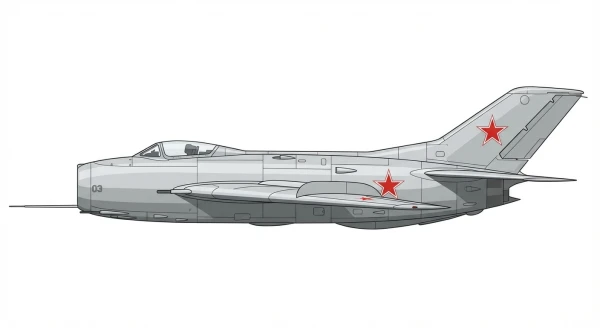
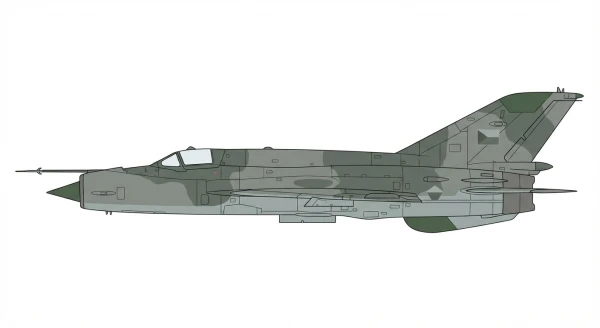
| MiG-19 Farmer | MiG-21 Fishbed | |
|---|---|---|
| Origin country | 🇷🇺 Ex-USSR | 🇷🇺 Ex-USSR |
| Category | Combat Aircraft | Combat Aircraft |
| Manufacturer | Mikoyan-Gurevich | Mikoyan-Gurevich |
| First flight | 18 September 1953 | 16 June 1955 |
| Year introduced | 1955 | 1958 |
| Number produced | 2172 units | 11496 units |
| Average unit price | $2 million | $2 million |
| Wing area | 25.2 m² | 23.0 m² |
| Wingspan | 9.2 m | 7.2 m |
| Height | 3.9 m | 4.1 m |
| Length | 12.5 m | 13.5 m |
| Maximum speed | 1455 km/h | 2125 km/h |
| Operational range | 2,200 km | 660 km |
| Service ceiling | 17,500 m | 19,000 m |
| Max. takeoff weight | 8,832 kg | 8,625 kg |
| Empty weight | 5,447 kg | 4,871 kg |
| Total thrust | 2 x 3,243 kgf | 1 x 4,689 kgf |
Detailed Comparison
The MiG-19 Farmer marks the Soviet Union's transition into supersonic flight, acting as a twin-engine bridge between sub-sonic designs and the Mach 2 era, while the MiG-21 Fishbed represents the maturation of this concept into a definitive light interceptor. While the MiG-19 prioritized raw power through dual engines to breach the sound barrier, the MiG-21 utilized a refined delta-wing configuration to achieve superior speed and altitude capabilities, ultimately eclipsing its predecessor in production volume and operational longevity.
Development and Design
Development of the MiG-19 focused on achieving sustained horizontal supersonic speeds, resulting in a twin-engine layout with swept wings. However, this pioneering effort was plagued by reliability issues, including poor fuel tank insulation leading to mid-air explosions and aerodynamic instability. In contrast, the MiG-21 was designed to counter Western fighters like the F-104, prioritizing high-altitude interception and minimal drag. Its delta-wing configuration and single afterburning turbojet allowed for significant weight reduction. While the MiG-19 suffered from a treacherous landing profile and cockpit limitations—exacerbated by the installation of the "Izumrud" radar in the P variant—the MiG-21 faced its own trade-offs, specifically limited fuel capacity and restricted visibility, though it solved many of the aerodynamic stability problems inherent in the Farmer.
Specifications and Performances
Performance metrics highlight the rapid advancement of propulsion technology in the 1950s. The MiG-21 is lighter (4871 kg empty) yet capable of reaching 2125 km/h, significantly outstripping the heavier (5447 kg) MiG-19's 1455 km/h limit. The Fishbed also offers a superior service ceiling of 19,000 meters compared to the Farmer's 17,500 meters, a critical advantage for interception roles. However, the MiG-19 holds a distinct advantage in operational range (1390 km) versus the notoriously short-legged MiG-21 (660 km), reflecting the Fishbed's compromise of endurance for speed and climb performance.
Deployment and Usage
Both aircraft saw combat in the Vietnam War, utilizing early AA-2 Atoll missiles. The MiG-19 relied heavily on its highly effective NR-23/30 cannons for close-range engagements, while the MiG-21 served primarily as a high-speed interceptor, utilizing "hit-and-run" tactics against American formations. The MiG-21's versatile hardpoints allowed it to evolve from a pure interceptor into a multi-role platform capable of ground attack using guided munitions in later variants like the MiG-21-93. While the MiG-19 was quickly phased out by Soviet forces due to poor pilot reception, it found extended life via Chinese production (J-6). Conversely, the MiG-21 became the most-produced supersonic jet in history (over 11,000 units), with extensive modernization programs keeping it relevant in over 60 countries.
Conclusion
The MiG-19 appears analytically as a transitional platform: a necessary step that proved supersonic flight was possible but operationally difficult due to reliability and handling flaws. The MiG-21 represents the successful optimization of that capability, balancing cost, simplicity, and performance. While the Farmer is noted for its heavy cannon armament and turning ability, the Fishbed's adaptability, speed, and massive production scale establish it as the superior combat system and the definitive Soviet light fighter of the Cold War.