MiG-23 Flogger vs MiG-27 Flogger
MiG-23 Flogger vs MiG-27 Flogger at a glance — top speed 2,500 vs 1,885 km/h, range 2,360 vs 2,500 km, max takeoff weight 17,800 vs 20,670 kg, built 5,047 vs 1,075 units.
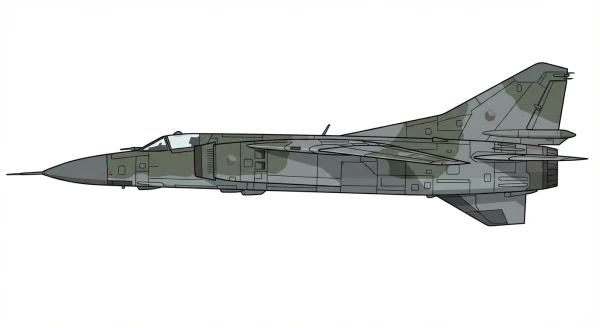
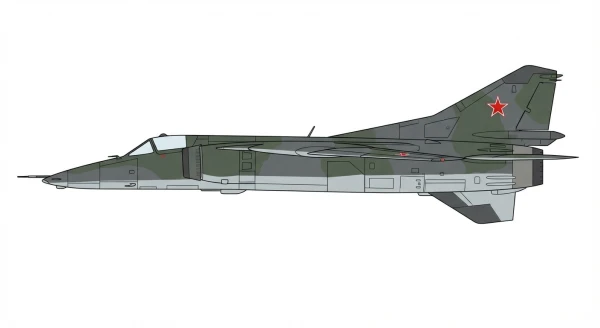
| MiG-23 Flogger | MiG-27 Flogger | |
|---|---|---|
| Origin country | 🇷🇺 Ex-USSR | 🇷🇺 Ex-USSR |
| Category | Combat Aircraft | Combat Aircraft |
| Manufacturer | Mikoyan-Gurevich | Mikoyan-Gurevich |
| First flight | 10 June 1967 | 17 November 1972 |
| Year introduced | 1970 | 1975 |
| Number produced | 5047 units | 1075 units |
| Average unit price | $4 million | $5 million |
| Wing area | 37.0 m² | 37.4 m² |
| Wingspan | 14.0 m | 14.0 m |
| Height | 4.8 m | 5.0 m |
| Length | 16.7 m | 17.1 m |
| Maximum speed | 2500 km/h | 1885 km/h |
| Operational range | 2,360 km | 2,500 km |
| Service ceiling | 18,000 m | 14,000 m |
| Max. takeoff weight | 17,800 kg | 20,670 kg |
| Empty weight | 10,230 kg | 11,908 kg |
| Total thrust | 1 x 12,996 kgf | 1 x 11,502 kgf |
Detailed Comparison
The Mikoyan-Gurevich MiG-23 and MiG-27, while sharing the "Flogger" designation and a common variable-geometry airframe, represent a divergence in mission focus from a multirole interceptor to a dedicated ground-attack aircraft. The MiG-23 was developed as a versatile fighter to succeed the MiG-21, emphasizing speed and air-to-air capability. The MiG-27 is a direct, simplified derivative of the MiG-23 airframe, optimized specifically for battlefield interdiction and close air support.
Development and Design
The MiG-23's design was driven by the need for an interceptor with performance superior to its predecessors. Its core innovation was the variable-sweep wing, allowing it to optimize its aerodynamic profile for both high-speed supersonic flight and low-speed takeoff, landing, and maneuverability. Its powerful Tumansky R-35F-300 engine, capable of producing 12,996 kgf of thrust, and advanced radar systems were tailored for its primary air combat role.
Conversely, the MiG-27's development involved stripping down the MiG-23 to its essential components for the ground-attack mission. This process mirrored the development of aircraft like the Dassault Mirage 5 from the Mirage III. Key modifications included:
- Simplified engine and intakes: The MiG-27 uses the less powerful Khatchaturov R-29B-300 (8,006 kgf thrust), optimized for low-altitude flight rather than high-Mach intercepts.
- Strengthened airframe: The cockpit was fitted with armor, and the landing gear was reinforced for operations from austere or unprepared airstrips.
- Specialized avionics: Later variants incorporated advanced navigation and attack systems, including laser designators for precision-guided munitions.
Specifications and Performances
The differing roles are clearly reflected in their performance metrics. The MiG-23 is substantially faster at 2,500 km/h with a higher service ceiling of 18,000 m, befitting its interceptor design. The MiG-27 is slower (1,885 km/h) and operates at lower altitudes (14,000 m ceiling), consistent with its ground-attack profile. The MiG-27 has a higher empty weight (11,908 kg vs. 10,230 kg) and a greater maximum takeoff weight (20,670 kg vs. 17,800 kg), accommodating its reinforced structure and larger ordnance load of up to 4,000 kg. This specialization, however, came at the cost of range; the MiG-27's combat radius was notably limited, a significant tactical constraint.
Deployment and usage
In service, the MiG-23 was deployed as a primary interceptor and multirole fighter by the Soviet Union and numerous export clients. Its armament, including the medium-range R-23 (AA-7 Apex) missile, gave it a beyond-visual-range capability that was a significant advancement for Soviet-aligned air forces.
The MiG-27 was deployed as a dedicated strike platform, replacing older aircraft like the Su-7. Its purpose was to provide close air support to ground forces. Its weapon loadout reflects this, featuring a heavy internal cannon and a wide array of air-to-surface munitions, such as the Kh-29 (AS-14 Kedge) missile and KAB-500 guided bombs. While retired by Russia, it saw extensive service with Warsaw Pact nations and notably with India, which license-produced and upgraded the type as the Bahadur.
Conclusion
The MiG-23 and MiG-27 illustrate a pragmatic Soviet design philosophy of adapting a single successful, if complex, airframe for divergent operational requirements. The MiG-23 was a capable, high-performance interceptor that addressed the technological demands of its era. The MiG-27 was its rugged, specialized ground-attack counterpart, sacrificing air combat performance for payload and survivability in the low-altitude environment. Both aircraft were noted for challenging maintenance requirements, but they formed the backbone of many air forces for decades, demonstrating the utility of role-specific adaptation from a common platform.