F-4 Phantom II vs MiG-23 Flogger
F-4 Phantom II vs MiG-23 Flogger at a glance — top speed 2,370 vs 2,500 km/h, range 2,699 vs 2,360 km, max takeoff weight 28,030 vs 17,800 kg, built 5,195 vs 5,047 units.
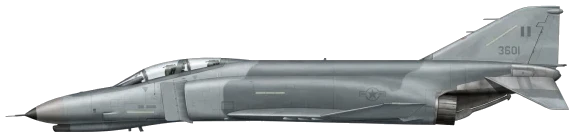
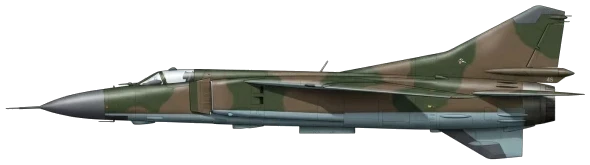
| F-4 Phantom II | MiG-23 Flogger | |
|---|---|---|
| Origin country | 🇺🇸 United States | 🇷🇺 Ex-USSR |
| Category | Combat Aircraft | Combat Aircraft |
| Manufacturer | McDonnell | Mikoyan-Gurevich |
| First flight | 27 May 1958 | 10 June 1967 |
| Year introduced | 1962 | 1970 |
| Number produced | 5195 units | 5047 units |
| Average unit price | $2.4 million | $4 million |
| Wing area | 49.2 m² | 37.0 m² |
| Wingspan | 11.7 m | 14.0 m |
| Height | 5.0 m | 4.8 m |
| Length | 19.0 m | 16.7 m |
| Maximum speed | 2370 km/h | 2500 km/h |
| Operational range | 2,699 km | 2,360 km |
| Service ceiling | 18,288 m | 18,000 m |
| Max. takeoff weight | 28,030 kg | 17,800 kg |
| Empty weight | 13,757 kg | 10,230 kg |
| Total thrust | 2 x 8,094 kgf | 1 x 12,996 kgf |
Detailed Comparison
The McDonnell F-4 Phantom II and the Mikoyan-Gurevich MiG-23 emerged as definitive third-generation fighters, though separated by nearly a decade in initial flight. While the F-4 was a heavy, twin-engine, two-seat multirole platform designed for US Navy fleet defense, the MiG-23 was a single-engine, variable-geometry interceptor intended to replace the MiG-21 with enhanced range and sensor capabilities. Both prioritized speed and beyond-visual-range (BVR) combat, yet their engineering solutions diverged significantly regarding aerodynamics and crew composition.
Development and Design
The Phantom II followed a philosophy of brute force, utilizing two powerful General Electric J79 turbojets to push a large, brick-like airframe capable of carrying massive ordnance loads. Its two-man crew concept acknowledged the complexity of operating early BVR radar systems like the Westinghouse APQ-72. Conversely, the MiG-23 "Flogger" introduced variable-geometry wings to the Soviet inventory, addressing the poor field performance of the MiG-21. This "swing-wing" design allowed for shorter takeoffs (450 m vs 1370 m for the F-4) and optimized high-speed aerodynamics. However, the MiG-23 retained a single-pilot cockpit, placing a heavy workload on the aviator to manage the complex avionics and sweep settings without a Weapon Systems Officer (WSO).
Specifications and Performance
Performance metrics highlight different tactical priorities. The Flogger boasts superior raw kinematic performance, with a top speed of 2500 km/h and a climb rate of 240 m/s, surpassing the Phantom's 2370 km/h and 210 m/s. This advantage is derived from the massive thrust of the Tumansky R-35 engine relative to its lighter airframe (17,800 kg max takeoff weight vs the F-4's 28,030 kg). However, the F-4 excels in payload and sustainability. It serves as a heavy hauler, capable of lifting 18,650 lbs of ordnance across nine hardpoints, whereas the MiG-23's loadout is comparatively limited. The Phantom's twin-engine redundancy also offered higher survivability in combat zones compared to the single-engine Soviet fighter.
Deployment and Usage
The F-4 saw extensive combat as the primary US air superiority fighter in Vietnam, later evolving into a premier ground-attack and Wild Weasel (SEAD) platform. It was the only aircraft flown by both the US Air Force and Navy demonstration teams, underscoring its versatility. Globally, it served 12 nations, with Israeli Phantoms seeing heavy action and Iranian F-4s fighting in the Iran-Iraq War. The MiG-23 served as a frontline Soviet interceptor and was widely exported. It saw combat in the Middle East, often engaging Israeli Phantoms, and in the Soviet-Afghan War. While the F-4 proved adaptable to asymmetric warfare, the MiG-23 remained primarily a high-speed interceptor, though later variants improved its dogfighting capabilities.
Conclusion
Ultimately, the F-4 Phantom II proved to be the more enduring design. Despite being older and aerodynamically less sophisticated than the variable-geometry MiG-23, its large airframe, two-man crew, and massive payload capacity allowed for continuous upgrades, keeping it relevant in modern air forces like Turkey and Greece long after the Flogger retired from major service. The MiG-23 represents the peak of Soviet single-engine interceptor performance, while the F-4 defines the successful implementation of the heavy multirole fighter concept.


