Su-24 Fencer vs Su-25 Frogfoot
Su-24 Fencer vs Su-25 Frogfoot at a glance — top speed 1,654 vs 970 km/h, range 2,775 vs 1,000 km, max takeoff weight 43,755 vs 17,600 kg, built 1,400 vs 1,000 units.
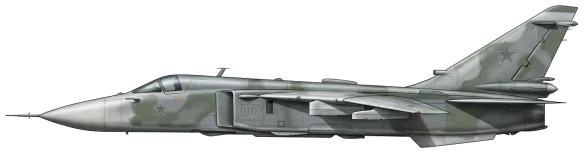
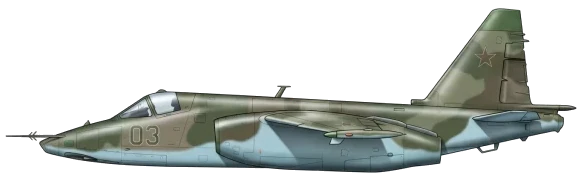
| Su-24 Fencer | Su-25 Frogfoot | |
|---|---|---|
| Origin country | 🇷🇺 Ex-USSR | 🇷🇺 Ex-USSR |
| Category | Combat Aircraft | Combat Aircraft |
| Manufacturer | Sukhoi | Sukhoi |
| First flight | 2 July 1967 | 22 February 1975 |
| Year introduced | 1974 | 1981 |
| Number produced | 1400 units | 1000 units |
| Average unit price | $25 million | $11 million |
| Wing area | 46.4 m² | 30.1 m² |
| Wingspan | 17.6 m | 14.4 m |
| Height | 6.2 m | 4.8 m |
| Length | 24.5 m | 15.5 m |
| Maximum speed | 1654 km/h | 970 km/h |
| Operational range | 2,775 km | 1,000 km |
| Service ceiling | 11,000 m | 7,000 m |
| Max. takeoff weight | 43,755 kg | 17,600 kg |
| Empty weight | 22,320 kg | 9,500 kg |
| Total thrust | 2 x 11,196 kgf | 2 x 4,505 kgf |
Detailed Comparison
The Sukhoi Su-24 Fencer and Su-25 Frogfoot are both ground-attack aircraft from the same manufacturer but embody fundamentally different operational philosophies. The Su-24 is a supersonic, all-weather, deep-strike platform, while the Su-25 is a subsonic, heavily armored aircraft designed exclusively for close air support (CAS). This distinction is evident in their crew configuration: the Su-24 utilizes a two-person crew (pilot and Weapons Systems Officer) to manage its complex avionics for long-range, precision missions, whereas the Su-25 has a single pilot focused on direct engagement with battlefield targets.
Development and Design
The development of these aircraft was driven by disparate Soviet military requirements. The Su-24 was conceived in the 1960s as a response to Western strike aircraft like the F-111, necessitating a platform capable of penetrating enemy airspace at high speed and low altitude in any weather. Its most defining feature is its variable-sweep wing, which allows it to optimize its aerodynamic profile for both high-speed dashes and low-speed handling during takeoff and landing. Conversely, the Su-25 was designed for a brutish, low-altitude battlefield role. Its design prioritizes survivability and ruggedness, featuring a heavily armored cockpit often called a "titanium bathtub," redundant flight control systems, and a simple, fixed-wing configuration optimized for maneuverability at low speeds.
Specifications and Performances
Performance metrics clearly reflect their distinct roles. The Su-24 is substantially faster, with a maximum speed of 1,450 km/h compared to the Su-25's 970 km/h. Its service ceiling of 16,500 m and combat range of over 3,000 km (further extended by in-flight refueling on M-variants) enable deep penetration missions. The Su-25 operates in a different envelope, with a service ceiling of just 7,000 m and a much shorter range of 750 km, confining it to operations near the front lines. The Su-24 is a much larger aircraft, with a max takeoff weight of 39,700 kg versus the Su-25's 17,600 kg. This allows the Fencer to carry a heavier and more sophisticated payload, including long-range cruise missiles like the Kh-59, while the Frogfoot's payload is centered on its powerful internal 30mm cannon, unguided rockets, and bombs for direct assault.
Deployment and usage
In combat, their usage aligns with their designs. The Su-24 has been employed as a tactical bomber and interdictor in conflicts from Afghanistan to Syria, striking high-value targets such as command posts, airfields, and infrastructure far behind enemy lines. The Su-25 has served as a workhorse CAS platform, providing direct fire support to ground troops in conflicts in Chechnya, Georgia, and Ukraine. Its operational history is characterized by low-altitude attacks against armor and fortified positions, where its resilience to ground fire is critical. Its ability to operate from short, austere airstrips (550 m takeoff run) makes it a valuable tactical asset.
Conclusion
The Su-24 Fencer and Su-25 Frogfoot are complementary, not competitive, platforms. The Fencer is an operational-level asset, a complex, supersonic strike aircraft designed for deep interdiction missions where speed, range, and all-weather capability are paramount. The Frogfoot is a purely tactical asset, a subsonic, heavily protected aircraft built to absorb punishment and deliver ordnance in direct support of ground forces. They represent a clear bifurcation in Soviet-era ground-attack doctrine, separating the mission of deep strike from that of close air support, a distinction that remains relevant in their continued use today.


-
 Russia
183
-
 Belarus
55
-
 North Korea
34
- All 19 operators →