Su-27 Flanker vs Su-33 Flanker-D
Su-27 Flanker vs Su-33 Flanker-D at a glance — top speed 2,500 vs 2,300 km/h, range 3,530 vs 3,000 km, max takeoff weight 33,000 vs 33,000 kg, built 680 vs 22 units.
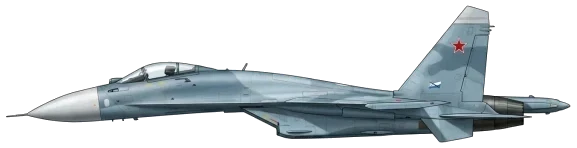
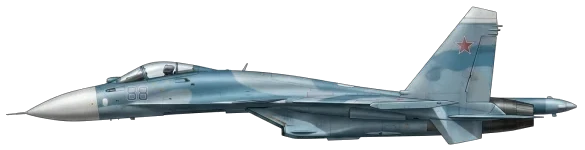
| Su-27 Flanker | Su-33 Flanker-D | |
|---|---|---|
| Origin country | 🇷🇺 Ex-USSR | 🇷🇺 Ex-USSR |
| Category | Combat Aircraft | Combat Aircraft |
| Manufacturer | Sukhoi | Sukhoi |
| First flight | 20 May 1977 | 17 August 1987 |
| Year introduced | 1985 | 1998 |
| Number produced | 680 units | 22 units |
| Average unit price | $30 million | $45 million |
| Wing area | 62.0 m² | -- m² |
| Wingspan | 14.7 m | 15.0 m |
| Height | 5.9 m | 6.0 m |
| Length | 21.9 m | 22.0 m |
| Maximum speed | 2500 km/h | 2300 km/h |
| Operational range | 3,530 km | 3,000 km |
| Service ceiling | 18,500 m | 18,000 m |
| Max. takeoff weight | 33,000 kg | 33,000 kg |
| Empty weight | 16,300 kg | 14,800 kg |
| Total thrust | 2 x 12,502 kgf | 2 x 12,797 kgf |
Detailed Comparison
Comparing the baseline Sukhoi Su-27 with its navalized derivative, the Su-33, exposes the kinematic and payload penalties incurred when adapting a heavy land-based fighter for STOBAR (Short Take-Off But Arrested Recovery) carrier operations. The Su-27, with 680 units built, established the aerodynamic foundation for modern Russian and Chinese tactical aviation. The Su-33 production run halted at 22 units, restricting the airframe to the mechanical and logistical constraints of Russia's single aircraft carrier, the Admiral Kuznetsov.
Development and Design
The Su-27 emerged in the late 1960s to counter the American F-15, entering Soviet service in 1985. Sukhoi utilized a blended wing-body and leading-edge root extensions to maximize internal fuel capacity and aerodynamic instability, managed by an analog fly-by-wire system. This created a long-range interceptor that eliminated the drag penalty of external drop tanks.
The Su-33, initiated in the 1980s as the Su-27K, adapted this airframe for carrier operations. Navalization dictated structural reinforcements, heavy-duty landing gear, folding wings, and an arrestor hook. To compensate for the center of gravity shift and to generate the required low-speed lift for carrier approaches, Sukhoi integrated canards into the forward fuselage.
Specifications and Performances
The physical modifications imposed a kinematic tax on the naval variant.
- Top speed drops from Mach 2.35 (2,500 km/h) in the Su-27 to Mach 2.17 (2,300 km/h) in the Su-33.
- Range decreases from 3,530 km in the Su-27 to 3,000 km in the Su-33, a direct result of increased drag and navalized weight penalties.
- Takeoff weight limitations on the Kuznetsov's ski-jump strictly cap the Su-33’s practical payload.
While theoretically capable of carrying 6.5 tons on 12 hardpoints, a Su-33 cannot physically launch from a STOBAR deck with full internal fuel and maximum ordnance. The land-based Su-27 operates unconstrained by runway length, utilizing its 30,000 kg maximum takeoff weight to carry full combat loads of R-27 and R-73 air-to-air missiles.
Deployment and usage
The Su-27 validated its air superiority doctrine during the 1998-2000 Eritrea-Ethiopia War, where Ethiopian Flankers defeated Eritrean MiG-29s in multiple beyond-visual-range and dogfight engagements. In the Russo-Ukrainian War, both sides employ Su-27s for combat air patrols and low-level strike missions, taking heavy attrition against modern ground-based air defenses.
The Su-33’s combat record is confined to the Kuznetsov. During the 2016 Russian intervention in Syria, Su-33s conducted ground strikes using unguided munitions. The deployment exposed logistical flaws, resulting in the loss of an Su-33 when an arresting cable snapped, forcing the Russian Navy to temporarily transfer flight operations to land bases at Khmeimim.
Conclusion
The Su-27 has a clear edge in air superiority, payload delivery, and overall operational viability. It dictates the terms of engagement unencumbered by the thrust-to-weight limitations that cripple STOBAR carrier aircraft. The Su-33 is a compromised airframe; it sacrificed the Flanker's inherent kinematic advantages to operate from a ship that rarely leaves port. Consequently, the Russian Navy halted Su-33 procurement in favor of the lighter MiG-29K, rendering the Su-33 an evolutionary dead-end, while the Su-27 airframe continues to evolve in modern iterations like the Su-35.


