MiG-29 Fulcrum vs Su-27 Flanker
MiG-29 Fulcrum vs Su-27 Flanker at a glance — top speed 2,450 vs 2,500 km/h, range 2,100 vs 3,530 km, max takeoff weight 18,000 vs 30,000 kg, built 1,600 vs 680 units.
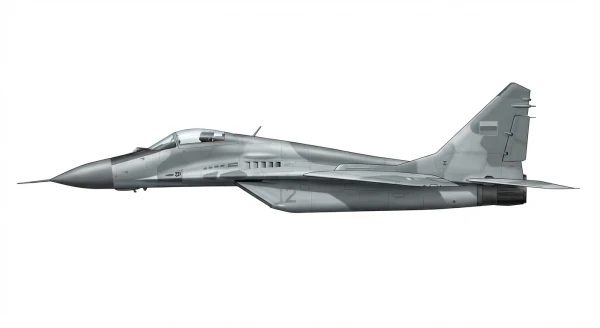
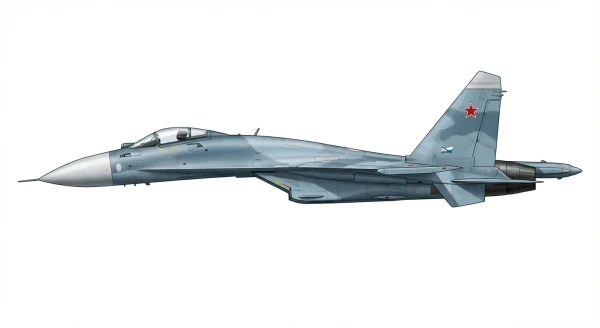
| MiG-29 Fulcrum | Su-27 Flanker | |
|---|---|---|
| Origin country | 🇷🇺 Ex-USSR | 🇷🇺 Ex-USSR |
| Category | Combat Aircraft | Combat Aircraft |
| Manufacturer | Mikoyan | Sukhoi |
| First flight | 6 October 1977 | 20 May 1977 |
| Year introduced | 1983 | 1985 |
| Number produced | 1600 units | 680 units |
| Average unit price | $25 million | $30 million |
| Wing area | 38.0 m² | 62.0 m² |
| Wingspan | 11.4 m | 14.7 m |
| Height | 4.7 m | 5.9 m |
| Length | 17.3 m | 21.9 m |
| Maximum speed | 2450 km/h | 2500 km/h |
| Operational range | 2,100 km | 3,530 km |
| Service ceiling | 18,000 m | 18,500 m |
| Max. takeoff weight | 18,000 kg | 30,000 kg |
| Empty weight | 11,000 kg | 16,300 kg |
| Total thrust | 2 x 8,319 kgf | 2 x 12,502 kgf |
Detailed Comparison
The Mikoyan MiG-29 and Sukhoi Su-27 were developed concurrently by the Soviet Union to counter a new generation of American fighters, but they embody distinct operational concepts. The MiG-29 was conceived as a relatively lightweight, numerous, and agile tactical fighter for achieving air superiority over the battlefield, while the larger Su-27 was designed as a long-range air dominance fighter and interceptor to control vast areas of airspace.
Development and Design
The MiG-29 was engineered for high maneuverability and operation from austere, forward airfields. Its design features robust landing gear and air intakes protected by louvers to prevent foreign object debris ingestion on the ground, underscoring its role as a frontline asset. Early models were equipped with the N-019 "Rubin" radar and a passive Infrared Search and Track (IRST) system, providing a secondary targeting method that reduces radar emissions.
The Su-27, in contrast, was built around the need for range and endurance. Its large, blended wing-body design maximizes aerodynamic efficiency and internal fuel volume. While also highly agile, capable of post-stall maneuvers like the "Pugachev's Cobra," its design prioritizes retaining energy in high-G turns over the extended flight profiles required for long-range interception and combat air patrols.
Specifications and Performances
A comparison of specifications reveals the divergent roles. The Su-27 is substantially larger and possesses a far greater operational range of 3,700 km, more than double the MiG-29's 1,500 km. This is a direct result of its larger airframe (62.04 m² wing area vs. 43.0 m²) and higher maximum takeoff weight (30,000 kg vs. 24,000 kg), allowing for a much larger fuel load. The Su-27 also holds an advantage in speed (2,500 km/h vs. 2,200 km/h) and service ceiling (18,500 m vs. 17,500 m). While both aircraft are powered by two engines, the MiG-29's lighter airframe provides it with an excellent thrust-to-weight ratio, making it a formidable opponent in a close-range visual engagement.
Deployment and usage
The MiG-29 was widely exported and has a more varied combat history, seeing action with numerous air forces in conflicts such as the Kosovo War, the Eritrean-Ethiopian War, and the Syrian Civil War. Its performance has often been constrained by the specific variant's avionics and the operator's training and support infrastructure. Later variants like the MiG-29SMT and MiG-35 have significantly enhanced its multirole capabilities. The Su-27 has served primarily with the Soviet/Russian forces and a smaller number of export customers, typically as a high-end air superiority asset. Its combat use has been more limited, primarily in roles like air patrol and long-range escort. However, its airframe has proven to be an exceptionally successful foundation for a family of advanced derivatives, including the Su-30, Su-34, and Su-35, which form the core of Russia's modern combat fleet.
Conclusion
The MiG-29 Fulcrum is a capable tactical fighter, optimized for point defense and air superiority in a high-intensity battlefield. The Su-27 Flanker, however, is a strategic asset designed for air dominance over large territories. While the MiG-29 achieved wider initial distribution, the Su-27's design proved more adaptable and scalable. The Flanker's lineage of advanced, multi-role variants has ensured its continued relevance and strategic importance, arguably making it the more significant and enduring of the two platforms.