F-111 Aardvark vs Tornado
F-111 Aardvark vs Tornado at a glance — top speed 2,655 vs 2,420 km/h, range 5,940 vs 3,890 km, max takeoff weight 45,359 vs 28,000 kg, built 563 vs 990 units.
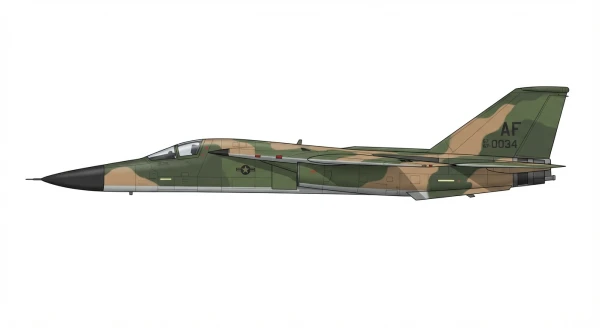
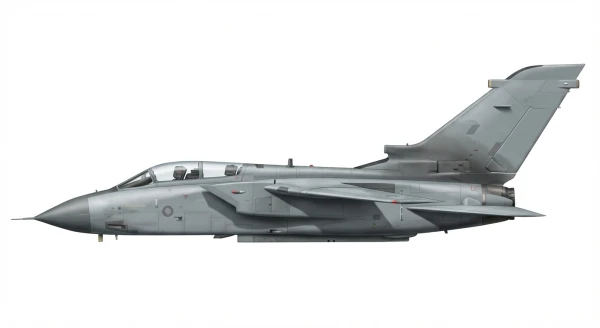
| F-111 Aardvark | Tornado | |
|---|---|---|
| Origin country | 🇺🇸 United States | 🇩🇪 Germany🇬🇧 United Kingdom🇮🇹 Italy |
| Category | Combat Aircraft | Combat Aircraft |
| Manufacturer | General Dynamics | Panavia |
| First flight | 21 December 1964 | 14 August 1974 |
| Year introduced | 1967 | 1980 |
| Number produced | 563 units | 990 units |
| Average unit price | $15 million | $35 million |
| Wing area | 61.1 m² | 26.6 m² |
| Wingspan | 19.2 m | 13.9 m |
| Height | 5.0 m | 6.0 m |
| Length | 22.4 m | 16.7 m |
| Maximum speed | 2655 km/h | 2420 km/h |
| Operational range | 5,940 km | 3,890 km |
| Service ceiling | 20,117 m | 15,240 m |
| Max. takeoff weight | 45,359 kg | 28,000 kg |
| Empty weight | 21,400 kg | 13,890 kg |
| Total thrust | 2 x 11,385 kgf | 2 x 7,831 kgf |
Detailed Comparison
General Dynamics designed the F-111 Aardvark as a 45-ton interdictor, driven by Robert McNamara’s TFX joint-procurement mandate. A decade later, the Panavia consortium produced the Tornado, a 28-ton variable-geometry aircraft tailored to the dense geography and distributed basing requirements of the European theater. Both utilized swing-wing aerodynamics and terrain-following radar (TFR) to execute low-altitude, all-weather strikes, but their disparate mass and propulsion defined their operational limits.
Development and Design
The F-111 pioneered automated TFR, allowing hands-off contour flying at night and in zero-visibility conditions. Its design demanded a complex escape capsule rather than standard ejection seats. The resulting airframe was massive, optimized for TF30 turbofans that initially suffered from compressor stalls during high angle-of-attack maneuvers. Panavia engineers built the Tornado around the compact Turbo-Union RB.199 turbofans, prioritizing short-field performance for European airfields. The Tornado integrated early fly-by-wire controls and standard Martin-Baker Mk 10 ejection seats, bypassing the weight penalty of the F-111's capsule. The Tornado’s modular design allowed distinct variants: the IDS for strike, ECR for suppression of enemy air defenses (SEAD), and the ADV interceptor.
Specifications and Performances
The F-111 is a structurally heavier platform. With a maximum takeoff weight of 45,359 kg, it carries an 11-ton payload. The Tornado maxes out at 28,000 kg.
The Aardvark exceeds the Tornado in baseline kinematic metrics:
- Maximum speed: 2,655 km/h (F-111) versus 2,420 km/h (Tornado)
- Climb rate: 131.5 m/s (F-111) versus 76.7 m/s (Tornado)
- Range: 5,940 km (F-111) versus 3,148 km (Tornado)
This range disparity dictates their employment. The F-111 operates independently across oceans, whereas the Tornado requires dense aerial refueling networks for out-of-area operations.
Deployment and usage
The USAF deployed the F-111 to Vietnam in 1968. Early TFR anomalies caused fatal crashes, but by 1972, the aircraft executed night strikes without electronic warfare support. During the 1986 Operation El Dorado Canyon, F-111Fs flew from the UK to Libya—requiring six aerial refuelings—demonstrating extreme unescorted reach. In Desert Storm, F-111s destroyed Iraqi armor using Pave Tack targeting pods. Conversely, European air forces employed Tornado IDSs in Desert Storm for low-level airfield denial using JP-233 cluster munitions. This tactic exposed them to dense anti-aircraft artillery, resulting in six combat losses and forcing a shift to medium-altitude bombing. The Tornado later adapted to medium-altitude precision strikes in Kosovo, Libya, and Syria.
Conclusion
For deep interdiction and heavy strike, the F-111 is the superior airframe. Its 5,940 km range and 11-ton payload capacity allow it to execute standalone theatre-level strikes that the Tornado cannot reach without heavy tanker support. However, for theater multirole operations, the Tornado holds the edge. Its smaller footprint, standard maintainability, and adaptability to SEAD and air defense roles made it a more practical asset for NATO air forces operating within the confined geography of Europe.