2S3 Akatsiya vs PzH 2000
2S3 Akatsiya vs PzH 2000 at a glance — weight 27,500 vs 55,800 kg, top speed 60 vs 60 km/h, range 500 vs 420 km, crew 4-6 (commander, driver, gunner, loader, 2 ammunition bearers) vs 5 (commander, driver, gunner, and two loaders).
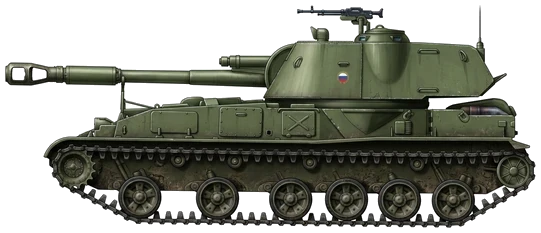
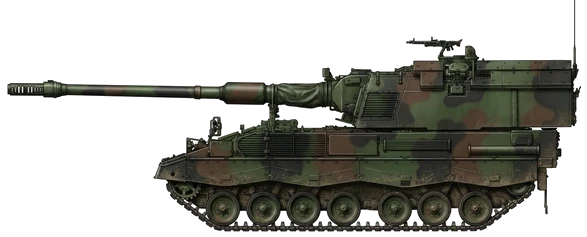
| 2S3 Akatsiya | PzH 2000 | |
|---|---|---|
| Origin country | 🇷🇺 Russia | 🇩🇪 Germany |
| Category | Self-Propelled Artillery | Self-Propelled Artillery |
| Type | Self-Propelled Howitzer | Self-Propelled Howitzer |
| Manufacturer | Uraltransmash | Krauss-Maffei Wegmann / Rheinmetall |
| Number produced | 4,000 units | 362 units |
| Estimated unit price | $-- million | $4.5 million |
| Combat weight | 27.5 tons | 55.8 tons |
| Maximum speed | 60 km/h | 60 km/h |
| Operational range | 500 km | 420 km |
| Length | 7.77 m | 11.67 m |
| Width | 3.25 m | 3.58 m |
| Height | 3.05 m | 3.06 m |
| Crew | 4-6 (commander, driver, gunner, loader, 2 ammunition bearers) | 5 (commander, driver, gunner, and two loaders) |
| 2S3 Akatsiya | PzH 2000 | |
|---|---|---|
| Main armament | 152mm 2A33 howitzer | 155mm L/52 rifled howitzer |
| Secondary weapon | 7.62mm PKT machine gun | 7.62mm MG3 machine gun |
| Engine | V-59 12-cylinder diesel, 520 hp | MTU 881 Ka-500 V8 diesel, 1,000 hp |
Detailed Comparison
The 27.5-ton 2S3 Akatsiya mounts a 152.4mm L/28 howitzer capable of reaching 18.5 km, designed to support Soviet motor rifle and tank divisions through massed area fire. The 55.8-ton PzH 2000 utilizes a 155mm L/52 gun firing beyond 40 km, engineered to win counter-battery duels via automation, high burst rates, and strict crew survivability.
Development and Design
Designed by Uraltransmash in 1967 to counter the American M109, the 2S3 is built on the Object 303 tracked chassis. Over 4,000 units were manufactured, prioritizing low-cost production, mechanical simplicity, and ease of operation for conscript armies. Conversely, the KNDS/Rheinmetall PzH 2000 emerged in 1998 after the collapse of the SP70 program. Adhering to the Joint Ballistic Memorandum of Understanding (JBMOU), it integrates Leopard 2 chassis components with a digitized architecture and an automated ammunition handling system, reflecting NATO's shift toward fewer, networked platforms capable of independent operation.
Protection and Firepower
The PzH 2000 outranges and outfires the 2S3. Its 155mm L/52 chromium-lined barrel and autoloader deliver 10 rounds per minute, supporting multiple round simultaneous impact (MRSI) missions of up to five shells. Using base-bleed or M982 Excalibur munitions, it engages targets at 40 km. The five-man crew operates isolated from the 60-round magazine. The 2S3 relies on a 152.4mm 2A33 howitzer limited to 18.5 km (24 km with rocket-assisted projectiles). Loading is manual, restricting the fire rate to 3-4 rounds per minute. The turret stores 46 rounds without blast separation; hull penetration by loitering munitions or counter-battery fire routinely results in catastrophic ammunition detonations.
Mobility and Logistics
Both vehicles top out at 60 km/h, but present opposite logistical footprints. The 2S3 exerts low ground pressure, crossing marginal terrain and 30-ton weight-limit bridges common in Eastern Europe. Its 520-hp V-59 diesel requires minimal specialized support. The 55.8-ton PzH 2000 requires heavy recovery assets and armored vehicle-launched bridges (AVLB) for gap crossings. Its autoloader demands high maintenance; in Ukraine, firing rates exceeding 100 rounds daily caused mechanical failures, forcing the systems out of the theater to hubs in Lithuania for depot-level repair.
Deployment and Combat Record
The 2S3 has fought in nearly every post-Soviet conflict. In Ukraine, it forms the bulk of Russian divisional artillery but suffers heavy attrition against precision fires. The PzH 2000 saw initial combat in Afghanistan, but the war in Ukraine tested its high-intensity limits. Ukrainian data indicates PzH 2000 barrels have endured up to 20,000 rounds—more than four times the manufacturer's 4,500-round limit.
Conclusion
The PzH 2000 holds a definitive edge in conventional warfare. Its 40 km range, MRSI capability, and automated fire control allow it to execute missions and displace before the 2S3 can maneuver into range. While the 2S3's 27-ton mass and mechanical simplicity provide higher operational availability in degraded logistical environments, its 18.5 km range consigns it to a static attritional role, where its lack of ammunition compartmentalization proves fatal against modern radar-directed counter-battery fire and drones.