PzH 2000
The PzH 2000 is a German self-propelled howitzer introduced in 1998 that features an automated loading system capable of multiple round simultaneous impact fire. Key figures: weight 55.8 t, top speed 60 km/h, range 420 km, unit cost $4.5M, built 362. In service with 9 armies — Germany (134), Italy (64), Netherlands (46) and 6 others.
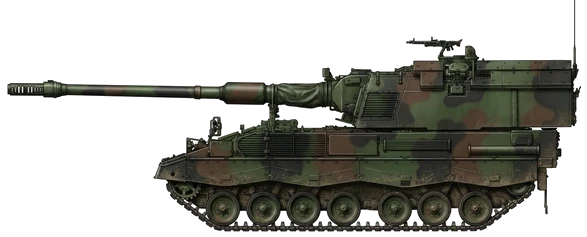
| Sub-type | Self-Propelled Howitzer |
| Crew | 5 (commander, driver, gunner, and two loaders) personnels |
| Range | 420 km |
| Mass | 55.8 tons |
| Height | 3.06 m (10.0 ft) |
| Width | 3.58 m (11.7 ft) |
| Length | 11.67 m (38.3 ft) |
| Max. speed | 60 km/h (37 mph) |
| Engine | MTU 881 Ka-500 V8 diesel, 1,000 hp |
| Weapon 1 | 155mm L/52 rifled howitzer |
| Weapon 2 | 7.62mm MG3 machine gun |
Description
The PzH 2000 was developed in the 1980s and 1990s by KNDS Deutschland and Rheinmetall for the German Army. The project began following the 1986 termination of the PzH 155-1 (SP70) program, a joint development by Italy, the United Kingdom, and West Germany that was canceled due to reliability issues and design defects. German industry was subsequently requested to submit proposals for a new system conforming to the Joint Ballistic Memorandum of Understanding (JBMOU); the design from Wegmann was selected.
The vehicle is equipped with a 155 mm 52-calibre rifled gun featuring a chromium-lined barrel and a muzzle brake. The armament is compatible with various munitions, including DM121 boat-tail, base bleed, and rocket-assisted projectiles, as well as SMArt 155 and M982 Excalibur shells. The system utilizes an automated loading and replenishment mechanism, allowing two operators to load 60 shells and charges in under 12 minutes. It supports multiple round simultaneous impact (MRSI) for up to five rounds. Fire control is assisted by a phased array radar on the front glacis to measure muzzle velocity, with laying data provided via encrypted radio. The chassis shares components with the Leopard 2 and uses continuous tracks. Passive protection includes armor against counter-fire, and some units have been modified with additional roof armor for protection against mortar rounds.
Standard variants have undergone several modifications. The A1 version improved the barrel laying and navigation systems, while the A2 introduced an auxiliary power unit and charge cooling. The A4 variant replaced analogue components with a digital architecture and a new fire control computer. A mid-life update, designated A5, focuses on a fully digital architecture and improvements to the ammunition autoloader.
The PzH 2000 is operated by several countries, including Germany, Italy, the Netherlands, Greece, Lithuania, Hungary, Croatia, Qatar, and Ukraine. It saw initial combat use in 2006 with the Royal Netherlands Army in Kandahar Province, Afghanistan, during Operation Medusa and the Battle of Chora. The German Bundeswehr first utilized the system in combat in 2010 during the Good Friday Battle near Kunduz and subsequently during Operation Halmazag.
In 2022, several units were transferred to Ukraine during the Russian invasion. Operational data from this conflict indicated that high-intensity use, frequently exceeding 100 rounds per day, caused mechanical stress on the loading mechanisms. Repairs for these systems were conducted at facilities in Lithuania and Slovakia. Despite manufacturer expectations of a 4,500-shot barrel life, some units in Ukraine recorded up to 20,000 shots. One Ukrainian unit was confirmed destroyed in Kherson Oblast in October 2022.
Frequently Asked Questions
What type of vehicle is the PzH 2000?
What is the weight of the PzH 2000?
What is the maximum speed of the PzH 2000?
What is the operational range of the PzH 2000?
How many crew members does the PzH 2000 require?
How many PzH 2000 have been built?
What weapons does the PzH 2000 carry?
- MAR 252026 Created Page created: PzH 2000