BMP-3 vs M2 Bradley
BMP-3 vs M2 Bradley at a glance — weight 18,700 vs 22,940 kg, top speed 72 vs 66 km/h, range 600 vs 483 km, crew 3 (commander, gunner, driver) + 7 troopers (+ 2 additional seats) vs 3.
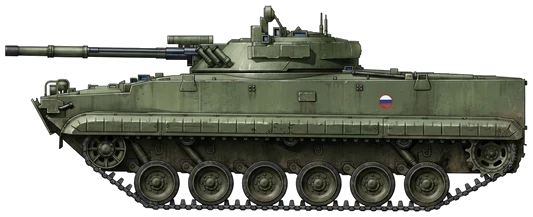
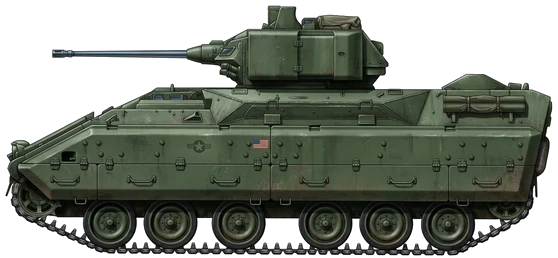
| BMP-3 | M2 Bradley | |
|---|---|---|
| Origin country | 🇷🇺 Russia | 🇺🇸 United States |
| Category | Infantry Fighting Vehicle | Infantry Fighting Vehicle |
| Type | Infantry fighting vehicle | Infantry Fighting Vehicle |
| Manufacturer | Kurganmashzavod | FMC |
| Number produced | 2,000 units | 6,800 units |
| Estimated unit price | $3.2 million | $4.4 million |
| Combat weight | 18.7 tons | 22.9 tons |
| Maximum speed | 72 km/h | 66 km/h |
| Operational range | 600 km | 483 km |
| Length | 7.14 m | 6.55 m |
| Width | 3.20 m | 3.60 m |
| Height | 2.40 m | 2.57 m |
| Crew | 3 (commander, gunner, driver) + 7 troopers (+ 2 additional seats) | 3 |
| BMP-3 | M2 Bradley | |
|---|---|---|
| Main armament | 100 mm 2A70 cannon | 1 M242 Bushmaster 25mm gun |
| Secondary weapon | 30 mm 2A72 autocannon | 1 TOW 2 double anti-tank launcher |
| Engine | UTD-29M diesel 500 hp (375 kW) | Cummins VTA-903T V8 Turbo-Diesel Engine with 500 hp |
Detailed Comparison
The Russian BMP-3 and American M2 Bradley exemplify divergent priorities in mechanized warfare doctrine: the former emphasizes overwhelming multi-spectral firepower and amphibious mobility, while the latter prioritizes crew survivability and integration with main battle tanks. Developed during the Cold War's final decade, both platforms evolved from infantry support roles into primary combatants, though their architectural layouts fundamentally differ.
Development and Design
Originating from the Obyekt 685 light tank prototype, the BMP-3 features an unconventional rear-engine layout. This design, chosen to balance the vehicle for amphibious operations, forces infantry to dismount over the engine compartment, complicating egress. The chassis is constructed from high-strength aluminum alloy. Conversely, the M2 Bradley was designed specifically to counter the Soviet BMP series and maintain formation with the M1 Abrams. It utilizes a welded aluminum monocoque chassis, but unlike the BMP-3, later variants (M2A2/A3) incorporated heavy steel applique armor and Kevlar spall liners. The Bradley's digital architecture, particularly in the A3 variants, integrates second-generation thermal sensors, emphasizing situational awareness over the BMP-3’s raw kinematic performance.
Protection and Firepower
The BMP-3 boasts arguably the heaviest armament in its class, integrating a 100mm 2A70 rifled gun capable of firing HE shells and 9M117 Bastion ATGMs, paired with a coaxial 30mm 2A72 autocannon. This configuration allows for indirect fire support and engagement of hardened targets at range. The Bradley relies on the M242 25mm chain gun and a twin TOW II missile launcher. While the BMP-3 offers higher raw explosive output, the Bradley holds a decisive advantage in fire control; the Commander’s Independent Viewer enables "hunter-killer" target acquisition independent of the gunner. In terms of protection, the Bradley's composite and reactive armor packages have proven superior to the BMP-3's aluminum alloy hull in sustaining hits from shaped charges and autocannons, despite the BMP-3’s inclusion of active protection options like Shtora-1.
Mobility and Logistics
Weighing 18.7 tons, the BMP-3 utilizes UTD-29 series diesel engines and water-jets for full amphibious capability, offering a higher top speed of 72 km/h and an operational range of 600 km. The Bradley is significantly heavier at 22.94 tons, limiting its maximum speed to 66 km/h and range to 483 km. While the BMP-3 offers superior strategic mobility across water obstacles, the Bradley’s suspension and drivetrain (upgraded in the M2A4) provide stability for accurate fire on the move and robust off-road performance in conjunction with heavy armor formations.
Deployment and Combat Record
The BMP-3 has seen extensive service in Chechnya, Yemen, and Ukraine. While effective in indirect fire roles, the conflict in Ukraine has exposed vulnerabilities in its internal layout and armor, with substantial losses confirmed. The Bradley demonstrated high lethality during the Gulf War, destroying more Iraqi armor than M1 tanks. In the Russo-Ukrainian War, the Bradley has successfully engaged modern T-90M tanks and is highly regarded for survivability; combat reports indicate the vehicle frequently protects personnel from strikes that would be catastrophic to Soviet-pattern IFVs.
Conclusion
The BMP-3 excels in maneuver warfare requiring amphibious capabilities and high-volume suppression, effectively serving as an amphibious light tank. However, the M2 Bradley proves superior in high-intensity, direct-fire engagements where crew survival and optic superiority are paramount. The Bradley’s proven combat resilience makes it the preferred platform for force preservation, whereas the BMP-3 offers flexible, aggressive firepower at the cost of increased vulnerability.