BRDM-2 vs BTR-60
BRDM-2 vs BTR-60 at a glance — weight 6,900 vs 10,300 kg, top speed 100 vs 80 km/h, range 750 vs 500 km, crew 3 (commander, driver, gunner) vs 3 crew + 14 passengers.
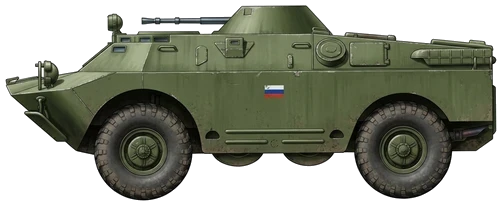
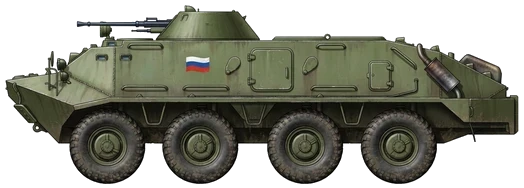
| BRDM-2 | BTR-60 | |
|---|---|---|
| Origin country | 🇷🇺 Russia | 🇷🇺 Russia |
| Category | Light Armoured Vehicle | Armored Personnel Carrier |
| Type | Amphibious armoured scout car | Armoured personnel carrier |
| Manufacturer | Gorky Automobile Plant (GAZ) | GAZ |
| Number produced | 7,200 units | 25,000 units |
| Estimated unit price | $-- million | $-- million |
| Combat weight | 6.9 tons | 10.3 tons |
| Maximum speed | 100 km/h | 80 km/h |
| Operational range | 750 km | 500 km |
| Length | 6.29 m | 7.56 m |
| Width | 2.43 m | 2.83 m |
| Height | 2.43 m | 2.31 m |
| Crew | 3 (commander, driver, gunner) | 3 crew + 14 passengers |
Detailed Comparison
Developed in the late 1950s and early 1960s, the GAZ-designed BRDM-2 scout car and BTR-60 armored personnel carrier share common automotive DNA, identical armament configurations in their definitive variants, and similar vulnerabilities. The 6.9-ton BRDM-2 was built for four-man reconnaissance detachments utilizing high road speeds and long endurance, while the 10.3-ton BTR-60 was designed to mechanize Soviet motor rifle divisions, transporting up to 14 dismounts alongside its three-man crew.
Development and Design
Both vehicles originated from the Soviet requirement for amphibious, enclosed platforms with collective NBC protection, replacing open-topped predecessors like the BTR-40 and BTR-152. The BTR-60 utilized an eight-wheel drive layout with a rear-mounted twin-engine configuration—two 90 hp GAZ-49B gasoline engines driving separate axles. This complex arrangement was chosen for redundancy but created persistent synchronization and maintenance burdens. The BRDM-2 adopted a simpler four-wheel layout powered by a single rear-mounted 140 hp GAZ-41 gasoline V8, incorporating chain-driven deployable belly wheels to bridge trenches up to 1.2 meters wide. Both designs prioritized frontal sloping and waterborne capability over crew ergonomics, trapping personnel behind restrictive roof hatches in early production blocks.
Protection and Firepower
Armor on both platforms is limited to 14 mm of welded steel at the thickest points, stopping 7.62 mm ball ammunition and light shell fragments but failing against 12.7 mm rounds, modern infantry anti-tank weapons, or artillery proximity bursts. Firepower is identical in the BRDM-2 and the BTR-60PB variant: a conical BPU-1 turret mounting a 14.5 mm KPVT heavy machine gun and a coaxial 7.62 mm PKT. The KPVT penetrates 30 mm of armor at 500 meters, adequate for engaging light armor. However, the manual turret lacks stabilization, preventing accurate fire on the move, and its +30 degree elevation limit proved fatal during close-quarter ambushes in mountainous and urban terrain.
Mobility and Logistics
The BRDM-2 reaches 100 km/h on paved roads with a 1,500 km operational range, outperforming the heavier BTR-60, which manages 80 km/h and requires refueling after 500 km.
Both vehicles suffer from shared logistical constraints:
- Gasoline engines present a severe fire hazard when penetrated by shaped charges.
- The BTR-60's twin-engine setup requires duplicate parts and complex mechanical linkages.
- Both platforms experience sharp power degradation in high-altitude environments.
Deployment and Combat Record
Combat feedback from the Sino-Soviet border, the Soviet-Afghan War, and Angola exposed baseline survivability defects in both vehicles. In Afghanistan, troops routinely rode on top of BTR-60s to avoid being trapped inside by mine blasts and gasoline fires. The BRDM-2's lack of side hatches made emergency egress nearly impossible under fire. In the Russo-Ukrainian War, unmodified hulls are largely relegated to rear-area roles. Frontline utility now depends on deep modernization; Polish BRDM-2 Żbik and Ukrainian BTR-60 Khorunzhyi programs uniformly replace the gasoline engines with diesels and cut side or rear doors into the hull to bypass original ergonomic flaws.
Conclusion
The BRDM-2 is the superior engineering solution for its intended role. Its single-engine architecture reduces maintenance downtime, and its 1,500 km range enables sustained screening operations without a tethered logistics train. The BTR-60's twin-engine layout was a developmental dead-end that compounded mechanical failures without yielding proportionate survivability gains. For mechanized infantry transport, the BTR-60's internal volume was entirely negated by the fatal ergonomics of its roof-hatch exit, forcing Soviet designers to rapidly iterate toward the side-doored BTR-70 and BTR-80 to correct the BTR-60's architectural baseline.