BTR-152
The BTR-152 is a Soviet wheeled armored personnel carrier introduced in 1950, primarily used for troop transport, distinguished by its open-topped, unarmored crew compartment. Key figures: weight 9.91 t, top speed 75 km/h, range 650 km, built 8,600. In service with 3 armies — Cuba (100), Tanzania (55), Sudan (10).
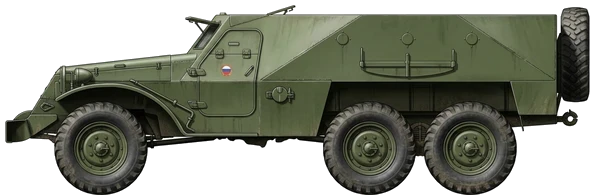
| Sub-type | Armoured personnel carrier |
| Crew | 2 + 18 passengers personnels |
| Range | 650 km |
| Mass | 9.9 tons |
| Height | 2.04 m (6.7 ft) |
| Width | 2.32 m (7.6 ft) |
| Length | 6.55 m (21.5 ft) |
| Max. speed | 75 km/h (47 mph) |
| Engine | ZIL-137K six-cylinder in-line water-cooled petrol engine |
| Weapon 1 | 7.62mm SGMB (SG-43 Goryunov) machine gun |
| Weapon 2 | 12.7mm DShK or 14.5mm KPV heavy machine gun |
| Weapon 3 | Twin 14.5mm KPVT in ZPTU-2 anti-aircraft mount (BTR-152A/D/E) |
| Weapon 4 | Quadruple 12.7mm DShK M53 mount (Egyptian variant) |
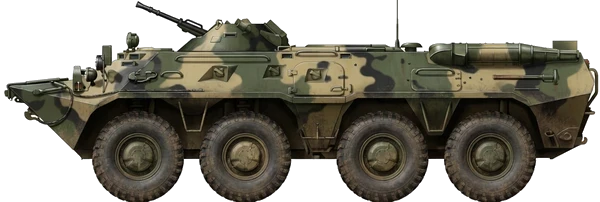
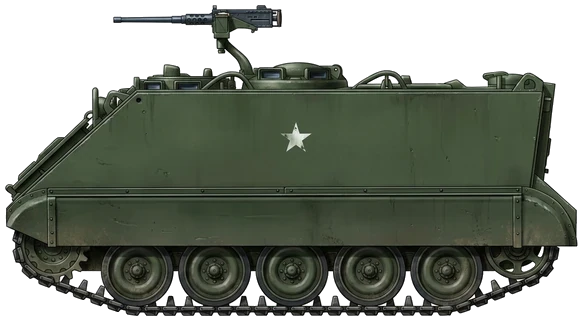
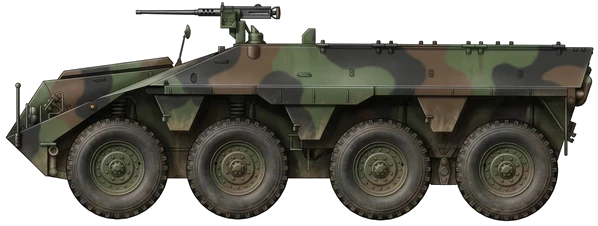
Description
The BTR-152 is a six-wheeled Soviet armoured personnel carrier built on the chassis and drive train of the ZIS-151 utility truck. Wartime experience with Lend-Lease M3 half-tracks and M3 scout cars, which replaced the earlier practice of tank desant, convinced the Red Army general staff that infantry required wheeled armoured transport able to keep pace with tank formations. After the GAZ-designed Izdeliye 141 (BTR-40) proved too small for the troop-carrying role, a requirement was issued for a vehicle seating 15 to 20 passengers and armed with a heavy machine gun. Design work was undertaken at the Zavod imeni Stalina plant in Moscow under Boris Mikhailovich Fitterman, with K. M. Androsov, A. P. Petrenko, V. F. Rodionov and P. P. Chernyaev; captured German Sd.Kfz. 251s and American half-tracks were examined as references. The prototype was trialled in December 1949 and accepted as the BTR-152, with serial production under the factory code ZIS-152 beginning around mid-1950, making it the first mass-produced Soviet APC.
The hull is of welded steel plate, with vertical sides and rear and corners sloped inwards to deflect fragments. Protection covers small arms fire, shell fragments, grenades and anti-personnel mines, but not heavy machine gun fire. The troop compartment is open-topped, with firing ports on each side and two rear doors. Driver and radio operator are seated behind individual windscreens covered in combat by armoured shutters with vision blocks. Armament was initially a pintle-mounted 7.62mm SGMB behind the driving position, with 12.7mm DShK or 14.5mm KPV heavy machine guns fitted on some vehicles. The BTR-152A carried twin KPVs in a ZPU-2 mount. Later production used ZIL-157 automotive components, giving more power and single larger tyres, though serviceability and reliability remained low. The BTR-152K and K1 of the late 1950s introduced an enclosed roof, heating and an NBC overpressure system. Command variants (BTR-152S, BTR-152U) had a raised roofline and additional radios. Soviet vehicles also served as artillery tractors, minelayers, ambulances and engineer vehicles.
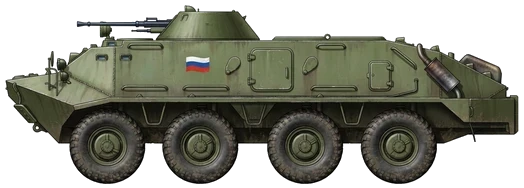
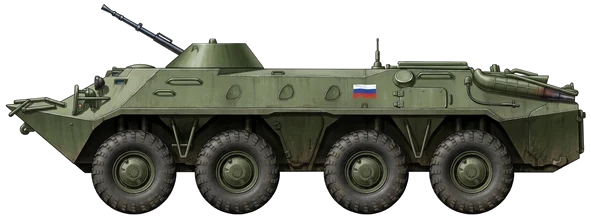
Approximately 8,600 were built in the Soviet Union between 1950 and 1959, with unlicensed Chinese copies produced as the Type 56. The type formed the mainstay of Soviet motor rifle battalions until the amphibious BTR-60, whose eight-wheeled configuration was adopted after the BTR-152's six wheels were judged inadequate for cross-country performance.
The BTR-152 first saw combat in the Hungarian Revolution of 1956 with the 12th Motorized Brigade of the Soviet Internal Troops in Budapest and along the Austrian border, where insurgents destroyed several by throwing Molotov cocktails into the open troop compartments or setting the tyres alight. Egypt was the first large export customer outside Eastern Europe, ordering vehicles in 1954 and receiving second-hand batches through the 1960s; Syria received deliveries in 1966 and 1969 and employed them as firing platforms during the Six-Day War. Israel captured over a thousand from Arab armies in the Six-Day and Yom Kippur Wars, converting some to the TCM-20 air defence configuration. FROLINAT used them in the assault on Salal in April 1978, where French Foreign Legion AML-90s destroyed several, and Libyan mechanized battalions employed them in Chad. Both Somali and Ethiopian forces fielded the type during the Ogaden War. Mozambican vehicles fought Rhodesian cross-border raids and RENAMO. Lebanese militias and the Syrian Army used them during the Lebanese Civil War. The type remains in service in Africa, Southeast Asia and Latin America.
Frequently Asked Questions
What type of vehicle is the BTR-152?
What is the weight of the BTR-152?
What is the maximum speed of the BTR-152?
What is the operational range of the BTR-152?
How many crew members does the BTR-152 require?
How many BTR-152 have been built?
What weapons does the BTR-152 carry?
- SEP 42026 Verified Weight verified against the published specifications
- AUG 152026 Created BTR-152 page created (specifications, overview, 49 operators)