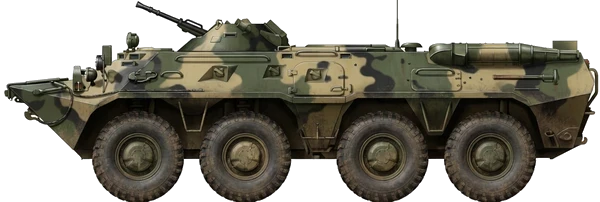
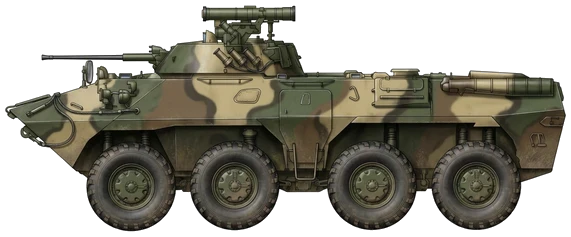
The Russian military's transition from the 13.6-ton BTR-80 to the aborted 20.9-ton BTR-90 illustrates a structural shift in mechanized infantry doctrine, moving from lightweight battle taxis to heavily armed wheeled infantry fighting vehicles (IFVs). The BTR-80 remains one of the most prolific APCs globally with 5,000 units built. The BTR-90 represents a failed procurement experiment, abandoned in 2011 for modular platforms like the VPK-7829 Bumerang.
Development and Design
Adopted in 1985 to resolve the twin-engine synchronization failures of the BTR-60 and BTR-70, the BTR-80 consolidated propulsion into a single 260-hp KamAZ-7403 diesel. The design retained the side-hatch dismount method, forcing infantry to exit between the wheels. Conceptualized in the 1990s, the BTR-90 expanded the hull to accommodate a BMP-2 turret and an onboard information control system (OICS). The Russian Ministry of Defence rejected the BTR-90 in 2011, prioritizing the BTR-82A stopgap while awaiting next-generation designs.
Protection and Firepower
Armor and armament define the operational divergence between the two platforms:
BTR-80: Protected by 9mm steel on the frontal arc, leaving it vulnerable to .50 caliber fire and artillery fragmentation. The 14.5mm KPVT machine gun provides basic infantry suppression but cannot defeat enemy armor.
BTR-90: Frontal armor stops 14.5mm AP projectiles, with structural support for explosive reactive armor (ERA). Firepower matches tracked IFVs, integrating a 30mm 2A42 autocannon, an AGS-17D grenade launcher, and 9M113 Konkurs ATGMs for anti-tank engagements.
Mobility and Logistics
The BTR-90 offsets its 20.9-ton mass with a 510-hp engine, achieving a power-to-weight ratio of 24.4 hp/ton compared to the BTR-80's 19.1 hp/ton. This pushes the BTR-90 to 100 km/h on roads. Its reversible hydro-mechanical transmission permits differential track-style steering, reducing the turning radius. Both maintain amphibious capability via hydrojets, but the BTR-80's lighter weight and mechanical simplicity translate to higher operational readiness rates and lower sustainment burdens across poorly equipped formations.
Deployment and Combat Record
The BTR-80 series is a fixture in modern conflicts. In Chechnya, Syria, and Ukraine, the baseline BTR-80 suffered high catastrophic kill rates from IEDs and RPGs, forcing troops to ride on top of the hull to survive mine blasts. The BTR-90 saw no mass deployment. A handful of pre-production BTR-90s were pulled from storage and deployed by Russian forces near Avdiivka in late 2023, where open-source intelligence confirmed at least one destroyed by Ukrainian fire in December 2023.
Conclusion
The BTR-80 is the more practical option for mass mobilization and export to developing militaries, driven by its low production cost, mechanical simplicity, and parts commonality. In high-intensity mechanized warfare, however, the baseline BTR-80 is obsolete. The BTR-90 provides a strict advantage in firepower and frontal survivability against peer threats. Ultimately, the BTR-90 failed because it retained the vulnerable side-door dismount design of its predecessors; Russian doctrine shifted toward vehicles with rear-exit ramps, making the BTR-90 a developmental dead-end despite its heavy armament.