JLTV vs M-ATV
JLTV vs M-ATV at a glance — weight 10,200 vs 12,700 kg, top speed 110 vs 105 km/h, range 480 vs 510 km, crew 1 + 3 in individual seats + optional gunner vs 5 (2 crew + 3 passengers).
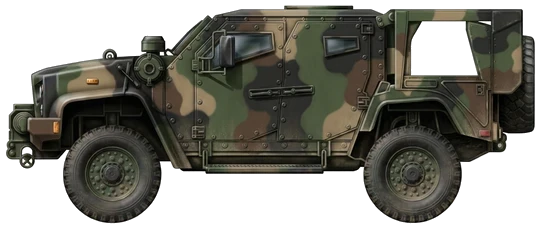
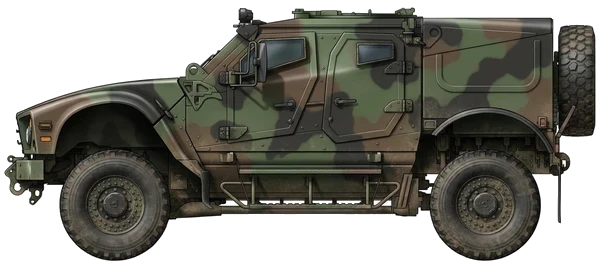
| JLTV | M-ATV | |
|---|---|---|
| Origin country | 🇺🇸 United States | 🇺🇸 United States |
| Category | Protected Mobility Vehicle | Protected Mobility Vehicle |
| Type | Light utility/combat multi-role vehicle | MRAP Vehicle |
| Manufacturer | AM General | Oshkosh Defense |
| Number produced | 20,000 units | 8,722 units |
| Estimated unit price | $0.4 million | $0.5 million |
| Combat weight | 10.2 tons | 12.7 tons |
| Maximum speed | 110 km/h | 105 km/h |
| Operational range | 480 km | 510 km |
| Length | 6.20 m | 6.27 m |
| Width | 2.50 m | 2.49 m |
| Height | 2.60 m | 2.70 m |
| Crew | 1 + 3 in individual seats + optional gunner | 5 (2 crew + 3 passengers) |
| JLTV | M-ATV | |
|---|---|---|
| Main armament | M2 Browning .50 Caliber heavy machine gun | M2HB .50 cal machine gun |
| Secondary weapon | M153 CROWS II remote weapon system | Mk 19 grenade launcher |
| Engine | 6.6 L Gale Banks Engineering 866T V8 (based on General Motors Duramax L5P) | Caterpillar C7 7.2L diesel 370 hp |
Detailed Comparison
Emerging from the improvised explosive device (IED) saturated environments of Iraq and Afghanistan, the 12.7-ton M-ATV and the 10.2-ton JLTV define the U.S. military’s baseline for protected mobility. The M-ATV was a rapid acquisition program to scale down MRAP bulk for Afghan terrain, while the JLTV was a deliberate, decade-long effort to institutionalize blast protection into a fleet-wide HMMWV replacement, though an April 2025 Department of Defense procurement halt indicates shifting Pentagon priorities.
Development and Design
Oshkosh built the M-ATV in 2009 by mating a Plasan armored capsule to a modified Medium Tactical Vehicle Replacement (MTVR) chassis. It was a localized solution for Afghanistan's unpaved roads, where heavier MaxxPro and Caiman MRAPs suffered roll-overs and mobility kills. The JLTV, entering service in 2019, sought to fuse M-ATV-level survivability with HMMWV-like deployability. It utilizes a modular A-kit/B-kit armor system to shed weight during transport, resolving the MRAP class's primary strategic limitation: airlift footprint.
Protection and Firepower
Both vehicles rely on V-shaped hulls to deflect blast energy, but their weight differential dictates different survivability ceilings. The M-ATV’s heavier mass and fixed Plasan armor provide a higher baseline against explosively formed penetrators (EFPs) and buried IEDs. The JLTV offsets its lower weight with the CORE 1080 system—floating floors and blast-attenuating seats—trading raw mass for energy absorption. Firepower is identical, with both fielding M2 .50 caliber machine guns, Mk 19 grenade launchers, or TOW missiles via M153 CROWS. The JLTV’s lower center of gravity makes it a more stable firing platform for heavier integrations like the Marine Air Defense Integrated System (MADIS).
Mobility and Logistics
The JLTV holds the mobility advantage. Its TAK-4i independent suspension and 10.2-ton weight generate specific transport benefits:
- Sling-load compatibility with CH-47 and CH-53E helicopters.
- Adjustable ride height for loading into amphibious assault ships.
- Lower center of gravity, reducing the rollover risk endemic to the MRAP class.
The taller, 12.7-ton M-ATV is restricted primarily to C-17 strategic airlift or sealift. At $0.399 million per unit versus the M-ATV's $0.47 million, the JLTV requires less financial and logistical overhead.
Deployment and Combat Record
The M-ATV absorbed the brunt of the Afghan surge and saw urban combat with Iraqi Special Operations Forces in Mosul, surviving multiple underbody blasts. In Ukraine, M-ATVs supplied in 2023 routinely trigger TM-62 anti-tank mines; crews frequently survive, though the vehicles suffer catastrophic mobility kills. The JLTV’s combat record includes recent deployment with the Israel Defense Forces in Gaza. Export markets strongly favor the JLTV, with 20,000 built compared to the M-ATV’s 8,722, rapidly replacing Soviet-era UAZ and BRDM platforms across Eastern Europe.
Conclusion
For route clearance and static base defense in high-IED threat environments like Iraq or Syria, the M-ATV remains the required standard; its sheer mass and dedicated MRAP design absorb blasts that structurally destroy lighter platforms. For maneuver warfare and expeditionary operations, the JLTV holds the absolute advantage. Combat in Ukraine proves that mobility and low visual signatures dictate survival against artillery and FPV drone strikes. The JLTV’s lower silhouette, underslung airlift capability, and superior cross-country agility make it the definitive choice for conventional mechanized infantry support.