K2 Black Panther vs M1A1 Abrams
K2 Black Panther vs M1A1 Abrams at a glance — weight 55,000 vs 63,000 kg, top speed 70 vs 66 km/h, range 430 vs 465 km, crew 3 vs 4.
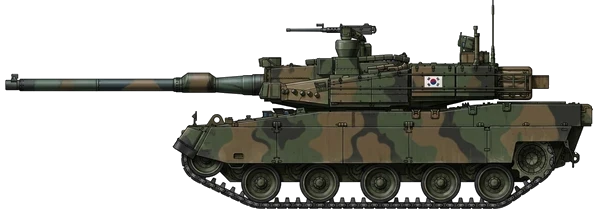
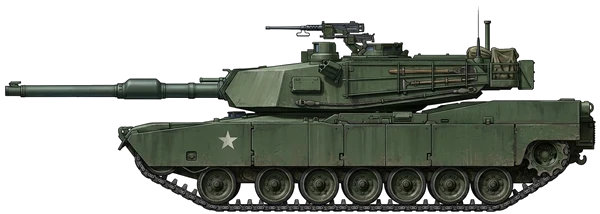
| K2 Black Panther | M1A1 Abrams | |
|---|---|---|
| Origin country | 🇰🇷 South Korea | 🇺🇸 United States |
| Category | Main Battle Tank | Main Battle Tank |
| Type | Heavy Main Battle Tank | Heavy Main Battle Tank |
| Manufacturer | Hyundai Precision / Sangyong Heavy Industries | General Dynamics Corp. |
| Number produced | 440 units | 9,200 units |
| Estimated unit price | $8.5 million | $4.3 million |
| Combat weight | 55.0 tons | 63.0 tons |
| Maximum speed | 70 km/h | 66 km/h |
| Operational range | 430 km | 465 km |
| Length | 10.80 m | 9.83 m |
| Width | 3.60 m | 3.65 m |
| Height | 2.40 m | 2.43 m |
| Crew | 3 | 4 |
| K2 Black Panther | M1A1 Abrams | |
|---|---|---|
| Main armament | 1 120mm gun | 1 M256 120mm smoothbore barrel (40 shells) gun |
| Secondary weapon | K-6 12.7mm machine gun | 1 M-2HB 12.7mm machine gun (1000 rounds) |
| Engine | Diesel Engine with 1500 hp | AGT-1500 Turbine with 1500 hp |
Detailed Comparison
The 55-ton South Korean K2 Black Panther entered service in 2014 to navigate mountainous terrain using hydro-pneumatic suspension, while the 63-ton American M1A1 Abrams was fielded in 1986 to defeat Soviet armor on the flat plains of Western Europe. Poland's concurrent procurement of both platforms provides a direct comparative baseline, pitting clean-sheet 21st-century engineering against heavily upgraded Cold War architecture.
Development and Design
General Dynamics designed the M1A1 to replace the M60, prioritizing frontal armor and crew survivability. Its four-man crew necessitates a manual loader, adding internal volume and weight. Hyundai Rotem developed the K2 to replace the M48, utilizing a bustle-mounted autoloader that reduces the crew to three and lowers the vehicle's silhouette. The K2 integrates network-centric datalinks natively, whereas the M1A1 relies on retrofitted situational awareness packages like the FBCB2.
Protection and Firepower
The vehicles diverge sharply in their defensive and offensive arrays:
- The M1A1 integrates depleted uranium mesh within its Chobham armor, maximizing frontal density against kinetic penetrators. Its isolated ammunition compartment with blowout panels dictates post-penetration crew survivability.
- The K2 utilizes a lighter composite matrix of MIL-12560H steel, silicon carbide ceramics, and explosive reactive armor (ERA). It compensates for lower mass with a soft-kill active protection system (APS) linked to radar warning receivers.
Offensively, the K2 mounts a CN08 120mm L/55 smoothbore gun, generating higher muzzle velocity than the M1A1’s L/44-based M256. The K2 also fires the KSTAM fire-and-forget top-attack munition, bypassing heavy frontal armor—a capability absent from the Abrams' direct-fire inventory.
Mobility and Logistics
At 63 tons, the M1A1 taxes bridging and recovery infrastructure. Its 1500 hp AGT1500 gas turbine consumes fuel at high rates, requiring a dense logistical tail. The 55-ton K2 achieves higher operational mobility. Powered by a 1500 hp diesel engine, it reaches 70 km/h. The K2’s in-arm suspension unit (ISU) allows the tank to kneel or lean, depressing its main gun to engage targets in deep valleys—a mechanical impossibility for the Abrams’ standard torsion bars.
Deployment and Combat Record
The M1A1 destroyed hundreds of Iraqi T-72s during Operation Desert Storm in 1991 without a single loss to enemy tank fire. However, recent deployments in Yemen and Ukraine exposed its vulnerability to top-attack munitions and FPV drones, resulting in hull losses when operating without infantry screens or drone jammers. The K2 lacks combat data. Its current momentum lies in export penetration; Poland ordered 1,000 units with localized production clauses, bypassing the industrial bottlenecks that restrict Abrams deliveries.
Conclusion
The K2 Black Panther holds the operational edge for modern maneuver warfare. The M1A1 offers unmatched post-penetration crew survivability, making it optimal for deliberate breaches against static defenses. However, combat operations in Ukraine demonstrate that 60-plus-ton weight classes and gas turbine fuel consumption severely restrict sustained maneuverability. The K2’s lighter footprint, L/55 gun, organic top-attack capability, and autoloader provide the required lethality without outstripping the supply chain.