M109 Paladin
The M109 is a United States 155mm self-propelled howitzer introduced in 1963, serving as the primary indirect fire support weapon for Western armored and mechanized divisions. Key figures: weight 38 t, top speed 61 km/h, range 300 km, unit cost $14M, built 7,000. In service with 24 armies — South Korea (1,040), United States (670), Pakistan (438) and 21 others.
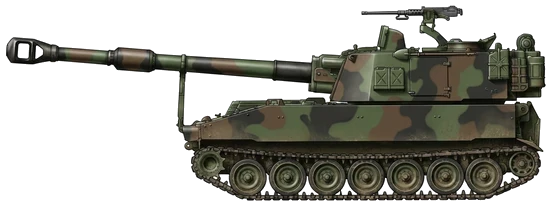
| Sub-type | Self-propelled howitzer |
| Crew | 4 (section chief/commander, driver, gunner, ammunition handler/loader) personnels |
| Range | 300 km |
| Mass | 38.0 tons |
| Height | 3.25 m (10.7 ft) |
| Width | 3.15 m (10.3 ft) |
| Length | 9.75 m (32.0 ft) |
| Max. speed | 61 km/h (38 mph) |
| Engine | Detroit Diesel 8V71T diesel, 440 hp |
| Weapon 1 | 155 mm M284 Cannon |
| Weapon 2 | .50 caliber (12.7 mm) M2 machine gun |
| Weapon 3 | Mk 19 Mod 3 40 mm Automatic Grenade Launcher |
| Weapon 4 | 7.62 mm M60, M240 machine gun or L4 machine gun |
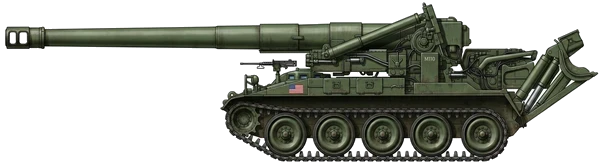
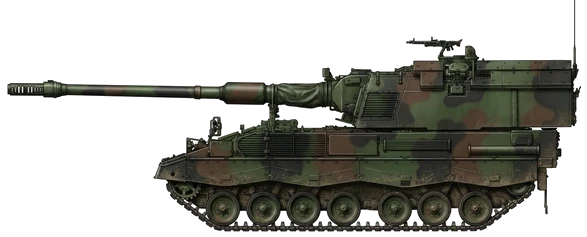
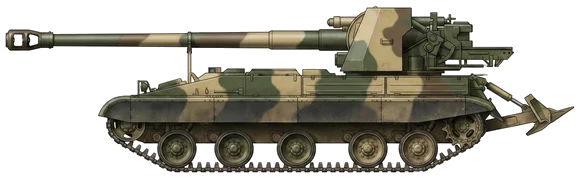
Description
The M109 is an American 155 mm turreted self-propelled howitzer developed by the Ground System Division of United Defense LP to replace the M44 and M52. Introduced in the early 1960s, the vehicle was the medium variant of a U.S. program to establish a common chassis for self-propelled artillery. It serves as the primary indirect-fire support weapon for maneuver brigades within armored and mechanized infantry divisions.
The howitzer debuted in combat in 1966 during the Vietnam War. Mechanical malfunctions led to a 1967 recall for modifications, resulting in the M109A1. Subsequent development produced the M109A2/A3 and the M109A6 Paladin. The M109A6 integrated an inertial navigation system and encrypted digital communications, enabling the vehicle to fire within 30 seconds of halting. The current M109A7 variant utilizes Bradley Fighting Vehicle chassis components, including the engine and tracks, to improve commonality. It features a 600-volt onboard power system and electric turret drives.
Primary armament is a 155 mm cannon, with models including the M126, M185, and M284. The system is capable of firing guided projectiles, rocket-assisted rounds, and scatterable mines. Secondary weapons include .50 caliber machine guns or 40 mm automatic grenade launchers. The vehicle is powered by an 8-cylinder water-cooled diesel engine, while the A7 version includes an automatic gun rammer for consistent firing velocities. The A2 variant introduced ballistic protection for the panoramic telescope, while the A6 version featured increased armor and a redesigned internal arrangement for safer ammunition storage.
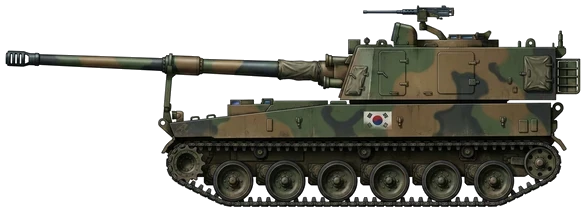
The M109 family is widely exported and remains in service with numerous nations, including Israel, Greece, Egypt, and Morocco. South Korea produced the K55 variant under license, subsequently upgrading its fleet to the K55A1 standard. Combat history includes the Yom Kippur War, the Iran-Iraq War, the 1991 Gulf War, and the Iraq War. During the Russian invasion of Ukraine, Western countries donated various M109 models for Ukrainian use. Several dozen units have been documented as destroyed or damaged during the conflict. While several European nations have replaced their units with the PzH 2000 or AS-90, the M109 remains the primary self-propelled howitzer for the U.S. Army following the cancellation of successor programs such as the Crusader and M1299.
Frequently Asked Questions
What type of vehicle is the M109 Paladin?
What is the weight of the M109 Paladin?
What is the maximum speed of the M109 Paladin?
What is the operational range of the M109 Paladin?
How many crew members does the M109 Paladin require?
How many M109 Paladin have been built?
What weapons does the M109 Paladin carry?
- APR 72026 Updated Type updated
- MAR 242026 Created Page created: M109 Paladin