K9 Thunder vs PzH 2000
K9 Thunder vs PzH 2000 at a glance — weight 48,500 vs 55,800 kg, top speed 67 vs 60 km/h, crew 3 (2 in emergency) vs 5 (commander, driver, gunner, and two loaders).
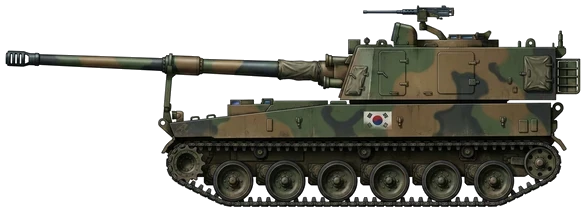
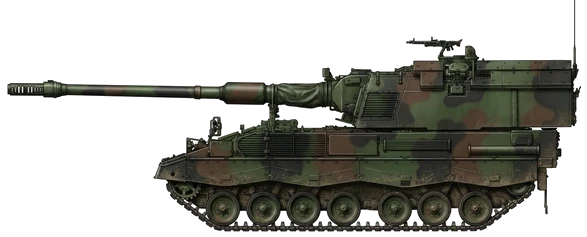
| K9 Thunder | PzH 2000 | |
|---|---|---|
| Origin country | 🇰🇷 South Korea | 🇩🇪 Germany |
| Category | Self-Propelled Artillery | Self-Propelled Artillery |
| Type | 155 mm self-propelled howitzer | Self-Propelled Howitzer |
| Manufacturer | Hanwha Aerospace | Krauss-Maffei Wegmann / Rheinmetall |
| Number produced | 1,136 units | 362 units |
| Estimated unit price | $3.1 million | $4.5 million |
| Combat weight | 48.5 tons | 55.8 tons |
| Maximum speed | 67 km/h | 60 km/h |
| Operational range | -- km | 420 km |
| Length | -- m | 11.67 m |
| Width | -- m | 3.58 m |
| Height | -- m | 3.06 m |
| Crew | 3 (2 in emergency) | 5 (commander, driver, gunner, and two loaders) |
| K9 Thunder | PzH 2000 | |
|---|---|---|
| Main armament | CN98 155 mm, 52-calibre artillery gun | 155mm L/52 rifled howitzer |
| Secondary weapon | Remote controlled weapon station (RCWS) | 7.62mm MG3 machine gun |
| Engine | 1,000 hp STX Engine SMV1000 diesel engine | MTU 881 Ka-500 V8 diesel, 1,000 hp |
Detailed Comparison
South Korea’s Hanwha Aerospace has manufactured over 1,136 K9 Thunder units at $3.1 million each, dominating the global self-propelled howitzer export market. In contrast, Germany’s Krauss-Maffei Wegmann and Rheinmetall produced 362 PzH 2000s, costing approximately $4.5 million per unit. Both systems utilize a 155 mm 52-caliber gun, yet their engineering priorities diverge directly: the K9 is designed for mass production, continuous iteration, and mechanical availability, while the PzH 2000 maximizes burst firing rates and automation at the cost of structural complexity.
Development and Design
The PzH 2000 emerged from the 1986 collapse of the tri-national SP70 program. German industry pursued a design utilizing continuous tracks and Leopard 2 chassis components, integrating an automated loading mechanism to minimize crew fatigue. South Korea developed the K9 in the late 1980s specifically to outrange North Korean artillery. Guided by the Agency for Defense Development, the project focused on domestic supply chains and a hydropneumatic suspension tailored for mountainous environments. The K9's modular chassis subsequently spawned localized variants, including Turkey's T-155 Fırtına and Poland's AHS Krab.
Protection and Firepower
Both platforms fire NATO-standard 155 mm ammunition, but their feeding mechanisms dictate firing cadences:
- The PzH 2000 utilizes an automated loading system allowing two operators to load 60 shells in 12 minutes, achieving Multiple Rounds Simultaneous Impact (MRSI) of up to five rounds, aided by a muzzle-velocity radar.
- The base K9 employs a semi-automatic system, requiring manual charge handling, yielding a burst rate of three rounds in 15 seconds. The in-development K9A2 variant shifts to a fully automated loader to reduce the baseline three-person crew requirement.
- The 55.8-ton PzH 2000 integrates base armor against counter-battery fire and optional roof armor for top-attack mortar threats.
- The 48.5-ton K9 uses MIL-12560H steel rated against 152 mm fragments and 14.5 mm armor-piercing rounds.
Mobility and Logistics
The K9 maintains a mobility advantage due to its lower combat weight (48.5 tons versus 55.8 tons) while sharing a 1,000-horsepower engine class (STX SMV1000 and MTU 881 Ka-500). This yields a power-to-weight ratio of 20.6 hp/ton for the K9 compared to the PzH 2000’s 17.9 hp/ton, resulting in a higher maximum speed (67 km/h vs 60 km/h). Logistically, the PzH 2000 requires specialized depot-level maintenance for its autoloader, whereas the K9’s simpler mechanical layout enables faster field repairs.
Deployment and Combat Record
The PzH 2000 deployed to Afghanistan with Dutch and German forces in 2006 and 2010. Its deployment to Ukraine in 2022 exposed mechanical limitations under conventional warfare conditions. Firing rates exceeding 100 rounds daily caused autoloader failures, necessitating extraction to repair hubs in Lithuania and Slovakia. Barrels rated for 4,500 shots were pushed to 20,000, accelerating wear. The K9 saw combat during the 2010 bombardment of Yeonpyeong, executing counter-battery fire against North Korean positions.
Conclusion
The PzH 2000 holds the tactical edge in initial burst firepower and MRSI applications, suited for armies operating in brief, localized engagements with secure supply lines. However, the K9 Thunder is the superior platform for sustained, high-attrition conventional warfare. Its lower acquisition cost, simpler semi-automatic mechanics that resist fouling under heavy volume, and lighter weight make it structurally better aligned with the demands of protracted artillery conflicts.