Leopard 1 vs T-72
Leopard 1 vs T-72 at a glance — weight 42,400 vs 44,500 kg, top speed 65 vs 60 km/h, range 600 vs 500 km, crew 4 (commander, driver, gunner, radio operator/loader) vs 3 (commander, gunner, driver).
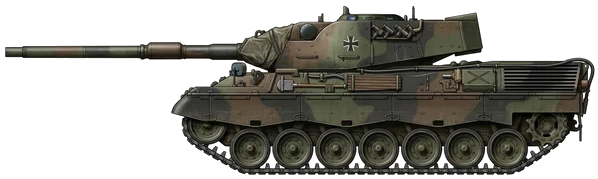
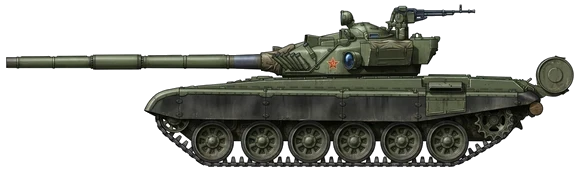
| Leopard 1 | T-72 | |
|---|---|---|
| Origin country | 🇩🇪 Germany | 🇷🇺 Ex-USSR |
| Category | Main Battle Tank | Main Battle Tank |
| Type | Medium Main Battle Tank | Medium Main Battle Tank |
| Manufacturer | Krauss-Maffei | Malyshev HMB Plant |
| Number produced | 6,565 units | 25,000 units |
| Estimated unit price | $0.3 million | $2 million |
| Combat weight | 42.4 tons | 44.5 tons |
| Maximum speed | 65 km/h | 60 km/h |
| Operational range | 600 km | 500 km |
| Length | 9.54 m | 9.73 m |
| Width | 3.37 m | 3.59 m |
| Height | 2.70 m | 2.23 m |
| Crew | 4 (commander, driver, gunner, radio operator/loader) | 3 (commander, gunner, driver) |
Detailed Comparison
The West German Leopard 1 and Soviet T-72 reflect opposing Cold War engineering mandates. The 42.4-ton Leopard 1 relies on mobility and first-hit probability, omitting heavy armor in response to the proliferation of HEAT projectiles. The 44.5-ton T-72 pursues a low silhouette, an automated loader, and thicker armor arrays to mass-produce a high-firepower platform for mechanized assaults.
Development and Design
Krauss-Maffei initiated Leopard 1 production in 1964 to replace American M47/M48s. Designers accepted that steel armor could not stop contemporary anti-tank munitions, shifting the mass budget entirely toward agility and target acquisition. Uralvagonzavod conceived the T-72 in 1967 as Object 172, a cheaper, mechanically simpler alternative to the complex T-64. By eliminating the fourth crew member with a mechanical autoloader, engineers reduced the T-72's height to 2.23 meters, compared to the Leopard 1's 2.7 meters.
Protection and Firepower
The T-72 outguns and out-armors the base Leopard 1. The Soviet tank mounts a 125 mm 2A46 smoothbore gun, whereas the German vehicle uses the 105 mm Royal Ordnance L7 rifled gun. Early T-72s used cast steel; later variants integrated composite layers and explosive reactive armor (ERA). The Leopard 1 relies on rolled homogenous steel, vulnerable to modern 30 mm autocannons. However, the T-72's carousel autoloader stores 22 rounds directly beneath the turret. Penetrating hits routinely trigger secondary ammunition detonations, killing the crew. The Leopard 1 stores its ammunition in the hull and turret, relying on a manual loader.
Mobility and Logistics
Both tanks operate in the 40-45 ton weight class, allowing them to cross bridges and utilize infrastructure that restricts 70-ton modern Western MBTs. Baseline mobility specifications include:
- Leopard 1: MTU MB 838 MTCA (830 hp), 65.0 km/h max speed, 600 km range
- T-72 (Modernized B3): V-92S2F (1,130 hp), 60.0 km/h max speed, 500 km range
The T-72's logistics chain is supported by 25,000 produced units, ensuring localized part availability globally, while Leopard 1 production ceased at 6,565 units.
Deployment and Combat Record
The T-72 operates in over 40 nations. It took heavy losses against Western tanks in the 1991 Gulf War and 2003 Iraq invasion due to inferior optics and the autoloader vulnerability. In the Russo-Ukrainian War, both sides deploy thousands of T-72s; catastrophic turret losses are heavily documented. The Leopard 1 deployed to Afghanistan, the Yugoslav Wars, and currently Ukraine. Combat feedback in Ukraine indicates Leopard 1A5s require strict deployment as mobile fire support rather than frontline assault vehicles due to their thin armor.
Conclusion
The T-72 holds the edge in high-intensity mechanized warfare. The Leopard 1's 105 mm gun cannot reliably penetrate modern frontal armor, and its steel chassis cannot survive the saturation of ATGMs, drones, and artillery in contemporary conflicts. While the T-72 suffers from fatal crew survivability flaws regarding its ammunition storage, its 125 mm gun, upgradeable composite/ERA protection, and low profile provide the necessary baseline for frontline armored combat. The Leopard 1 is functionally restricted to secondary fire-support roles.