BMP-2 vs M2 Bradley
BMP-2 vs M2 Bradley at a glance — weight 14,300 vs 22,940 kg, top speed 65 vs 66 km/h, range 600 vs 483 km, crew — vs 3.
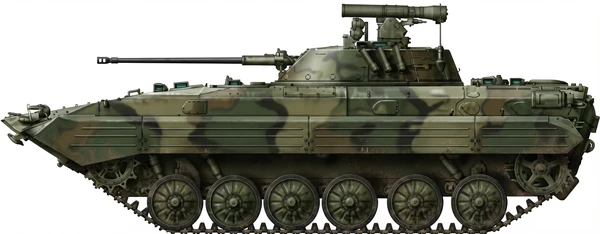
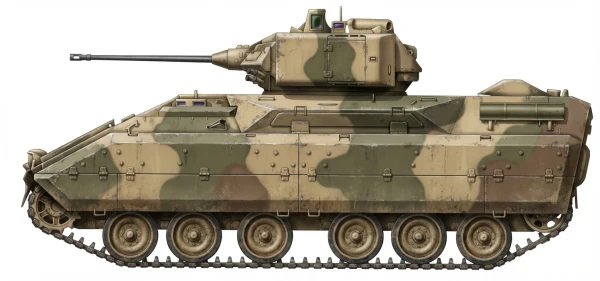
| BMP-2 | M2 Bradley | |
|---|---|---|
| Origin country | 🇷🇺 Russia | 🇺🇸 United States |
| Category | Infantry Fighting Vehicle | Infantry Fighting Vehicle |
| Type | Infantry Fighting Vehicle | Infantry Fighting Vehicle |
| Manufacturer | Kurganmashzavod | FMC |
| Number produced | 20,000 units | 6,800 units |
| Estimated unit price | $-- million | $4.4 million |
| Combat weight | 14.3 tons | 22.9 tons |
| Maximum speed | 65 km/h | 66 km/h |
| Operational range | 600 km | 483 km |
| Length | 6.72 m | 6.55 m |
| Width | 3.15 m | 3.60 m |
| Height | 2.45 m | 2.57 m |
| Crew | 3 (commander, gunner, driver) + 7 troops | 3 |
| BMP-2 | M2 Bradley | |
|---|---|---|
| Main armament | 2A42 30mm autocannon | 1 M242 Bushmaster 25mm gun |
| Secondary weapon | 9P135M ATGM launcher (9M113 Konkurs) | 1 TOW 2 double anti-tank launcher |
| Engine | UTD-23 diesel, 300 hp | Cummins VTA-903T V8 Turbo-Diesel Engine with 500 hp |
Detailed Comparison
The BMP-2 and M2 Bradley emerged in the early 1980s as the baseline infantry fighting vehicles for the Warsaw Pact and NATO. Weighing 14.3 tons, the Soviet BMP-2 prioritized mass production, a low silhouette, and amphibious capability. The American M2 Bradley, entering service at 22.9 tons and scaling heavier in later variants, prioritized crew survivability and sensor integration to operate alongside the M1 Abrams.
Development and Design
Soviet engineers designed the BMP-2 to correct the BMP-1’s deficiencies identified in the 1973 Arab-Israeli War, specifically an inaccurate 73mm gun and vulnerability to .50 caliber machine-gun fire. Kurganmashzavod built 20,000 units based on a welded steel hull. FMC developed the Bradley to replace the M113, initiating service in 1981. The M2 utilizes a welded aluminum monocoque chassis. American designers traded amphibious utility for internal volume, integrating a high-powered turret and spall liners to absorb overmatch impacts.
Protection and Firepower
The baseline BMP-2’s armor stops 23mm rounds on the frontal arc and 7.62mm on the sides. Its stabilized 2A42 30mm autocannon provides a 74-degree elevation angle, paired with a roof-mounted 9P135M launcher for 9M113 Konkurs ATGMs. The Bradley operates the M242 25mm chain gun and a dual TOW missile launcher. Modern Bradleys (M2A2/M2A3) incorporate spaced laminate armor, steel applique, explosive reactive armor brackets, and second-generation forward-looking infrared sensors. The BMP-2 requires the BMP-2M Berezhok upgrade to match these optics and adds Kornet-M missiles, but the base hull remains vulnerable to top-attack munitions and 25mm armor-piercing rounds.
Mobility and Logistics
The 14.3-ton BMP-2 crosses water obstacles using hydrodynamic fairings and achieves 65.0 km/h via a 300 hp UTD-23 diesel engine. Its 600 km range exceeds the Bradley's 483 km limit. The Bradley is powered by a 500 hp Cummins VTA-903T diesel, reaching 66.0 km/h. Later Bradley variants lose amphibious capability due to armor weight penalties. The Bradley's M2A4 suspension upgrades handle this mass, whereas the BMP-2 chassis struggles to accept bolt-on protection without degrading its power-to-weight ratio.
Deployment and Combat Record
The BMP-2 sustained high attrition rates to mines in the Soviet-Afghan War and to anti-tank weapons in Chechnya and Syria. The Bradley destroyed more Iraqi armor than the M1 Abrams during the 1991 Gulf War using TOW missiles. In the Russo-Ukrainian War, post-impact crew survival rates diverge sharply:
- The Bradley’s layered armor and isolated ammunition compartments allow crews to survive 152mm artillery fragments and direct ATGM strikes.
- The BMP-2’s cramped interior and fuel tanks housed in the rear exit doors lead to high fatality rates when the hull is compromised.
Conclusion
The M2 Bradley holds a definitive edge in high-intensity mechanized warfare. Its integrated thermal optics, stabilized fire control, and layered armor architecture result in higher kill ratios and crew survival rates against modern threats. The BMP-2 retains utility only for militaries requiring cheap, mass-produced transport across riverine environments. In direct combat, the Bradley’s capacity to detect, engage, and survive first hits renders the baseline BMP-2 obsolete.