FV510 Warrior vs M2 Bradley
FV510 Warrior vs M2 Bradley at a glance — weight 25,500 vs 22,940 kg, top speed 75 vs 66 km/h, range 600 vs 483 km, crew 3 vs 3.
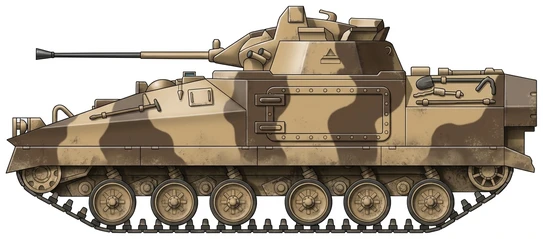
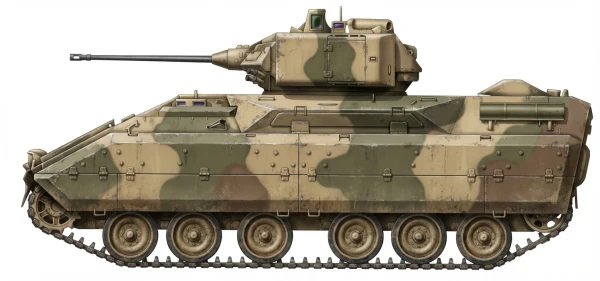
| FV510 Warrior | M2 Bradley | |
|---|---|---|
| Origin country | 🇬🇧 United Kingdom | 🇺🇸 United States |
| Category | Infantry Fighting Vehicle | Infantry Fighting Vehicle |
| Type | Infantry Fighting Vehicle | Infantry Fighting Vehicle |
| Manufacturer | GKN | FMC |
| Number produced | 1,043 units | 6,800 units |
| Estimated unit price | $2.4 million | $4.4 million |
| Combat weight | 25.5 tons | 22.9 tons |
| Maximum speed | 75 km/h | 66 km/h |
| Operational range | 600 km | 483 km |
| Length | 6.37 m | 6.55 m |
| Width | 3.00 m | 3.60 m |
| Height | 2.80 m | 2.57 m |
| Crew | 3 | 3 |
| FV510 Warrior | M2 Bradley | |
|---|---|---|
| Main armament | 1 Rarden 30mm gun | 1 M242 Bushmaster 25mm gun |
| Secondary weapon | 1 MAG 7.62mm machine gun | 1 TOW 2 double anti-tank launcher |
| Engine | Perkins Diesel Engine with 550 hp | Cummins VTA-903T V8 Turbo-Diesel Engine with 500 hp |
Detailed Comparison
The FV510 Warrior and M2/M3 Bradley emerged from parallel Cold War requirements to provide infantry support capable of maneuvering with main battle tanks. While the Warrior was designed primarily as a high-mobility armored personnel carrier with fire support capabilities, the Bradley was conceived as a heavy infantry fighting vehicle (IFV) with integral anti-armor systems to directly engage enemy mechanized forces.
Development and Design
Developing from the MCV-80 project, the Warrior entered service in 1984 using an aluminum hull designed by GKN Sankey. A key doctrinal distinction was the omission of firing ports, reflecting a British preference for deploying infantry for combat rather than fighting from within the vehicle. This design maximizes hull integrity for appliqué armor. Conversely, the M2 Bradley, fielded in 1981 by FMC (now BAE Systems), initially incorporated firing ports and complex spaced laminate armor. The Bradley has evolved significantly through variants like the M2A3 and M2A4, integrating digital battle management systems and the Commander’s Independent Viewer (CIV). In contrast, the Warrior's major sustainment program (WCSP) was cancelled in 2021, halting its modernization trajectory.
Protection and Firepower
The Bradley possesses superior offensive capabilities due to its TOW II anti-tank missile system and stabilized M242 25mm Bushmaster chain gun. These systems allow the Bradley to destroy main battle tanks and engage targets accurately while moving. The Warrior relies on the unstabilized 30mm L21A1 RARDEN cannon, which necessitates halting the vehicle to fire accurately at range, and lacks integral anti-tank guided missiles.
regarding protection, both utilize aluminum armor augmented by appliqué packages. The Warrior has demonstrated resilience against RPGs and mines in theaters like Bosnia. The Bradley's survivability has been battle-tested against modern threats, with the M2A4 variant integrating the Iron Fist active protection system.
Mobility and Logistics
Powered by a 550 hp Perkins V-8, the Warrior holds a distinct mobility edge with a top speed of 75.0 km/h and an operational range of 600 km. This outperforms the Bradley, which utilizes a 500 hp Cummins engine to achieve a top speed of 66.0 km/h and a range of 483 km. The Warrior's automotive simplicity and lighter combat weight (25.5 tons vs 22.94 tons for base Bradley, though up-armored Bradleys are significantly heavier) generally reduce logistical strain during long-range road movements.
Deployment and Combat Record
Both platforms saw extensive use in the Gulf War and Iraq. The Bradley achieved a notable combat record in Operation Desert Storm, destroying more Iraqi armored vehicles than the M1 Abrams. In the Russo-Ukrainian War, the Bradley has demonstrated high survivability and lethality against modern threats, including T-90M and T-72 tanks. The Warrior served effectively in Bosnia and Afghanistan, validating its protection levels, though its lack of gun stabilization limited its offensive utility in dynamic "shoot-and-scoot" engagements.
Conclusion
The M2/M3 Bradley stands as the more versatile combat system, offering the stabilization and anti-armor lethality required for high-intensity peer conflicts. It effectively bridges the gap between transport and tank destroyer. The FV510 Warrior excels as a protected battle taxi with superior operational mobility and range, but its obsolescent fire control systems and lack of stabilization limit its effectiveness in direct fire support roles compared to the continuously modernized American platform.