M60A3 TTS Patton vs T-72
M60A3 TTS Patton vs T-72 at a glance — weight 52,617 vs 44,500 kg, top speed 48 vs 60 km/h, range 450 vs 500 km, crew 4 vs 3 (commander, gunner, driver).
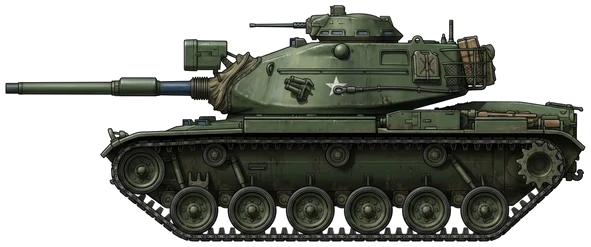
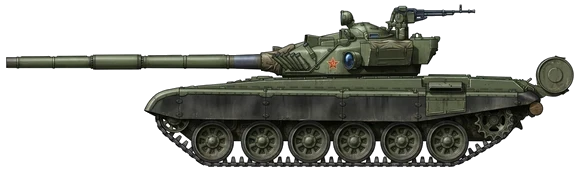
| M60A3 TTS Patton | T-72 | |
|---|---|---|
| Origin country | 🇺🇸 United States | 🇷🇺 Ex-USSR |
| Category | Main Battle Tank | Main Battle Tank |
| Type | Heavy Main Battle Tank | Medium Main Battle Tank |
| Manufacturer | Detroit Tank Plant | Malyshev HMB Plant |
| Number produced | 8,931 units | 25,000 units |
| Estimated unit price | $1.3 million | $2 million |
| Combat weight | 52.6 tons | 44.5 tons |
| Maximum speed | 48 km/h | 60 km/h |
| Operational range | 450 km | 500 km |
| Length | 9.75 m | 9.73 m |
| Width | 3.96 m | 3.59 m |
| Height | 3.84 m | 2.23 m |
| Crew | 4 | 3 (commander, gunner, driver) |
| M60A3 TTS Patton | T-72 | |
|---|---|---|
| Main armament | 1 M68 105mm rifled barrel (63 shells) gun | 125 mm 2A46M-5 smoothbore gun |
| Secondary weapon | 1 M85 12.7mm machine gun (900 rounds) | 7.62 mm PKT coax. machine gun |
| Engine | Continental AVDS 1790 Diesel Engine with 750 hp | V-92S2F (T-72B3 & T-72B3M) 1,130 hp (840 kW) |
Detailed Comparison
The 52.6-ton M60A3 TTS and the 44.5-ton T-72 emerged from opposing sides of the Iron Curtain in the 1970s, designed for a mechanized ground war in Europe. With over 25,000 T-72s and nearly 9,000 M60s built, their proliferation ensures they remain standard-issue armor for dozens of militaries unable to procure heavier main battle tanks.
Development and Design
The T-72 entered production in 1973 as a mass-producible alternative to the mechanically troubled T-64. Uralvagonzavod engineers utilized a three-man crew by integrating a carousel autoloader, reducing the internal volume and achieving a low silhouette at 2.23 meters tall. The US Army standardized the M60A3 in 1978 as a stopgap measure while developing the M1 Abrams. Standing 3.84 meters tall, the M60A3 retains a four-man crew and manual loader, requiring a larger turret that increases its visual and radar signature.
Protection and Firepower
The two tanks employ divergent approaches to lethality and survivability:
- The T-72 mounts a 125mm 2A46M smoothbore gun, outranging the M60A3’s 105mm M68 rifled gun in kinetic energy penetration.
- Early T-72s relied on cast steel, later integrating composite arrays and explosive reactive armor (ERA). The M60A3 uses conventional rolled and cast homogenous steel.
- The M60A3 TTS gained an early target acquisition advantage with the AN/VSG2 Tank Thermal Sight and M21E1 ballistic computer, allowing engagements through smoke without the active infrared spotlights used on baseline T-72s.
The T-72 autoloader stores 22 rounds in the hull floor. Combat in Chechnya, Syria, and Ukraine confirms this architecture consistently results in catastrophic turret detonations when the hull is breached.
Mobility and Logistics
Weighing 44.5 tons, the T-72 achieves 60 km/h and exerts lower ground pressure than the 52.6-ton M60A3. Modernized T-72B3s utilize the 1,130 hp V-92S2F diesel engine, yielding a power-to-weight ratio exceeding 25 hp/ton. The M60A3 is restricted to a 48 km/h top speed by its 750 hp Continental AVDS-1790 diesel and heavier chassis. The lighter weight of the T-72 facilitates rail transport and allows it to cross bridges in Eastern Europe that cannot support vehicles over 50 tons.
Deployment and Combat Record
In the 1991 Gulf War, US M60A1s and A3s destroyed Iraqi T-72M1s by leveraging thermal optics to engage targets before detection. In the Syrian Civil War, both platforms suffered losses to modern anti-tank guided missiles. The Russo-Ukrainian War has consumed thousands of T-72 variants, proving their vulnerability to top-attack munitions and drones. Upgraded M60s, like Turkey’s Sabra, have seen localized combat but lack the systemic frontline exposure the T-72 endures in Eastern Europe.
Conclusion
The T-72 is the more viable platform for modern state-on-state conflict. While the M60A3 TTS held a decisive optic advantage during the 1990s, modern T-72 upgrades have integrated thermal imagers that close the sensory gap. Combined with its 125mm gun, lower profile, and better mobility, the T-72 outclasses the M60A3. The M60's towering 3.84-meter silhouette and reliance on homogeneous steel armor make it a liability against modern anti-tank networks, whereas the T-72 chassis continues to scale effectively with reactive armor and high-output engines.