2S3 Akatsiya
Summary
| Origin country | 🇷🇺 Russia |
| Category | Self-Propelled Artillery |
| Sub-type | Self-Propelled Howitzer |
| Manufacturer | Uraltransmash |
| Number built | 4000 units |
Technical specifications
| Crew | 4-6 (commander, driver, gunner, loader, 2 ammunition bearers) personnels |
| Range | 500 km |
| Mass | 27.5 tons |
| Height | 3.05 m (10.0 ft) |
| Width | 3.25 m (10.7 ft) |
| Length | 7.765 m (25.5 ft) |
| Max. speed | 60 km/h (37 mph) |
| Engine | V-59 12-cylinder diesel, 520 hp |
| Weapon 1 | 152mm 2A33 howitzer |
| Weapon 2 | 7.62mm PKT machine gun |
| Weapon 3 | Type 902B Tucha smoke grenade launchers |
Historical operators
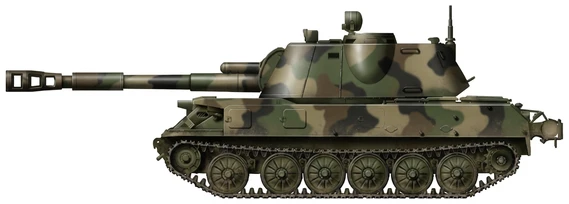
Profile of 2S3 Akatsiya
Description
The SO-152, designated 2S3 Akatsiya, is a Soviet 152.4 mm self-propelled howitzer developed beginning in 1967. It was created as a response to the American M109 howitzer following a July 1967 resolution of the Council of Ministers of the Soviet Union. Design work was conducted at Design Bureau No. 9 in Sverdlovsk, which developed the D-22 howitzer, and Uraltransmash, which developed the chassis. Prototypes were completed in late 1968, and the vehicle entered service with the Soviet Army in 1971. Mass production continued until 1993.
The 2S3 utilizes the Object 303 tracked chassis, based on the Object 123 chassis of the 2K11 Krug surface-to-air missile system. The hull is constructed of welded rolled steel armor. The internal layout places the driver and engine-transmission compartments in the front, with the fighting compartment and rotating turret located in the middle and rear. Power is provided by a V-59 12-cylinder water-cooled diesel engine paired with a mechanical two-speed transmission. Standard equipment includes an R-123 radio, R-124 intercom, and an automatic CBRN defense system with a filtration unit. The vehicle also features self-entrenching equipment for preparing defensive positions.
The primary armament is the 152.4 mm 2A33 howitzer, which features a double-baffle muzzle brake, a semi-automatic vertical wedge breechblock, and a fume extractor. It has an elevation range of -4° to +60° and a full 360° turret traverse. The system uses separate-loading ammunition, with mechanized stowage for 35 to 46 rounds depending on the variant. Compatible munitions include high-explosive fragmenting, high-explosive anti-tank (HEAT-FS), and armor-piercing (AP-T) projectiles, as well as laser-guided Krasnopol projectiles, illuminating, smoke, and nuclear rounds. Maximum firing range is 18.5 km with standard rounds and 24 km with rocket-assisted projectiles. Secondary armament consists of a remotely controlled 7.62 mm PKT machine gun on the commander’s cupola.
Modernized variants include the 2S3M with mechanized drum-type stowage and the 2S3M1 with command data acquisition equipment. The 2S3M2 variant incorporates an automated fire control system, satellite navigation, and a longer 2A33 L/39 caliber barrel.
The 2S3 was originally assigned to the artillery regiments of Soviet tank and motor rifle divisions. It has been widely exported and remains in service with numerous countries, including Russia, Ukraine, Belarus, Algeria, and Vietnam. Combat history includes the Soviet-Afghan War, the Iran-Iraq War, the Gulf War, and conflicts in Chechnya, Tajikistan, Georgia, Libya, and Syria. It is currently deployed by both sides in the Russian invasion of Ukraine.