South Sudan Military Forces
South Sudan ranks #113 of 175 militaries worldwide in 2026, with 185,000 active troops. The South Sudanese Army fields 30 main battle tanks; the Air Force flies 20 aircraft. Landlocked, South Sudan has no navy and no nuclear weapons.
Armed Forces in 2026
| Domain | Strength | Composition |
|---|---|---|
| South Sudan Air Force | 20 aircraft | 15 helicopters |
| Ground Forces | 30 tanks | |
| Personnel | 185,000 active |
ARMS Index (Aggregate Rating of Military Strength)
Full ranking →| Pillar | Weight | Score | Basis |
|---|---|---|---|
| Manpower | 15% | 71.6 | Active, reserve & paramilitary personnel |
| Ground forces | 20% | 35.3 | Tanks, armor & artillery weighted by type |
| Naval power | 20% | 0.0 | Weighted by hull type: carrier tiers, nuclear vs conventional submarines |
| Air power | 25% | 17.4 | Weighted by aircraft type and fleet age |
| Nuclear deterrent | 10% | 0.0 | No declared nuclear capability |
| Defense budget | 10% | 23.0 | Annual spending, purchasing-power adjusted |
| Readiness | modifier | ×0.80 | Budget per soldier: proxy for training, maintenance & technology |
Country File
| Population | 11.9M (2024) |
| GDP | $12.0 billion (2015) |
| GDP per capita | $1,005 |
| Military budget | $240M (2024) |
| Share of GDP | 2.0% (2024) |
| Military spending per capita | $20 (2024) |
| Inflation rate | 91.44% (2024) |
| Capital | Juba |
| Region | Africa |
| Land area | 644,329 km² |
| Land borders | 4,797 km |
| Bordering countries | 6 |
| Currency | SSP |
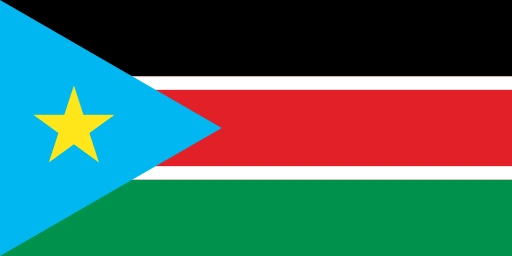
| Aspect ratio | 1:2 |
| Colors | Red, blue, green, yellow, white, black |
Strategic Overview in 2026
Strategic Position
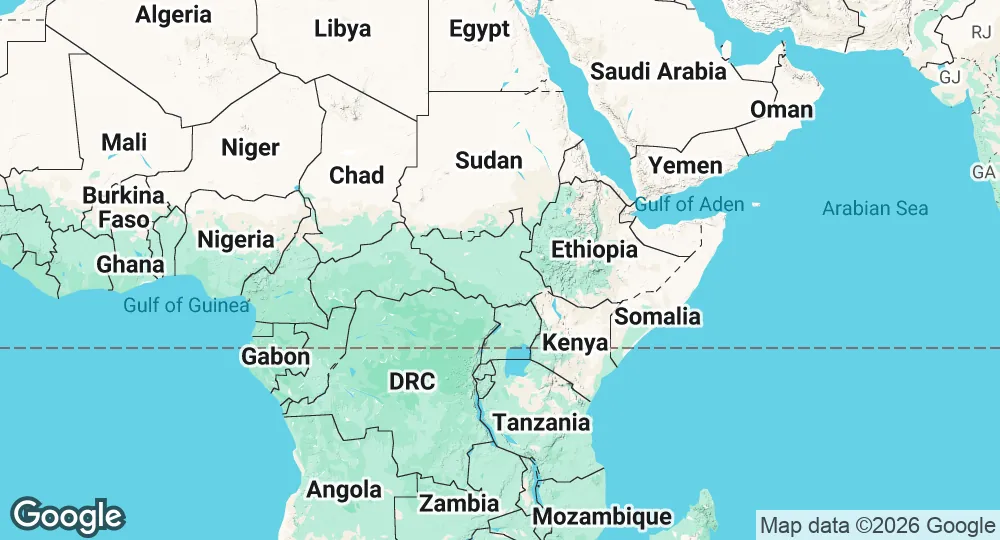
The defense posture of South Sudan is primarily oriented toward internal security, regime preservation, and the management of ethnic-based insurgencies. As a landlocked state, the country’s security is heavily influenced by the ongoing civil war in neighboring Sudan, which has disrupted critical oil export infrastructure and resulted in a continuous influx of refugees. The primary strategic framework is the 2018 Revitalized Agreement on the Resolution of the Conflict in the Republic of South Sudan (R-ARCSS), which mandates the unification of various armed factions into a single national military.
South Sudan is a member of the African Union (AU), the Intergovernmental Authority on Development (IGAD), and the East African Community (EAC). Regional security relationships are defined by a complex interdependence with Uganda, which has historically provided military support to the government in Juba, and a volatile relationship with Sudan over border demarcation and oil transit. Strategic priorities for 2025 and 2026 center on maintaining the fragile ceasefire between the government and the Sudan People's Liberation Movement-in-Opposition (SPLM-IO) ahead of national elections rescheduled for December 2026.
Military Forces
The South Sudan People’s Defence Forces (SSPDF), formerly the Sudan People's Liberation Army (SPLA), serves as the national military. The President serves as the Commander-in-Chief, with professional leadership provided by the Chief of Defence Forces. The military is organized into several branches, including the Ground Force, Air Force, Air Defense Forces, and Riverine units.
Personnel and Command The SSPDF maintains an active-duty strength estimated between 150,000 and 185,000 personnel. A significant portion of these forces consists of former rebel combatants intended for integration into the Necessary Unified Forces (NUF), a planned 83,000-strong national security body. However, as of early 2026, the integration process remains incomplete due to funding shortages and political mistrust. The Presidential Guard remains a distinct and well-equipped unit primarily tasked with the protection of the executive leadership.
Ground Forces The Ground Force is the primary combat arm and operates a variety of Soviet-era equipment. Armor capabilities include T-72 and T-55 main battle tanks. For mobility and infantry support, the army utilizes BTR-series armored personnel carriers and various mine-resistant ambush protected (MRAP) vehicles. Artillery support is provided by BM-21 Grad multiple rocket launchers and towed D-30 howitzers.
Air and Riverine Capabilities The Air Force is focused on utility and transport, maintaining a small fleet of Mi-17 and Mi-8 helicopters. Combat capabilities are centered on Mi-24 Hind attack helicopters, which have been utilized for internal security operations. Fixed-wing assets are limited to small numbers of transport aircraft, such as the An-26. The Riverine unit operates patrol boats on the White Nile to secure domestic trade routes and monitor border areas.
Strategic Trends
The SSPDF is currently undergoing a period of nominal professionalization, though the force remains deeply fragmented along ethnic and political lines. A central challenge is the implementation of security sector reform (SSR), which has stalled as the government focuses on managing localized violence and inter-communal clashes. In late 2025, a recruitment drive for approximately 4,000 new soldiers was initiated to address high desertion rates and personnel shortfalls in volatile regions like Upper Nile.
Defense spending is estimated at approximately 6% of GDP, although significant portions of the military budget are diverted to patronage networks and the maintenance of loyalist militias. Procurement is severely constrained by a United Nations arms embargo, which was renewed in 2025. This embargo limits the acquisition of modern heavy weaponry, forcing the SSPDF to rely on aging inventories and the illicit procurement of small arms and light weapons.
The military's operational focus in 2026 is the containment of "White Army" youth militias and the National Salvation Front (NAS) in the Equatoria region. Furthermore, the postponement of elections to late 2026 has increased the strategic burden on the SSPDF to prevent a total collapse of the 2018 peace deal, while the military command structure faces internal power struggles and leadership reshuffles.
Military Expenditure (latest): CIA World Factbook; historical series: information from the Stockholm International Peace Research Institute (SIPRI) Military Expenditure Database. Last updated on 4 August 2026. Suggest a change
Frequently Asked Questions
How large is South Sudan's military?
What is South Sudan's defense budget?
How does South Sudan rank militarily in the world?
Does South Sudan have nuclear weapons?
How many aircraft does South Sudan's air force have?
How many tanks does South Sudan have?
What percentage of GDP does South Sudan spend on defense?
What is South Sudan's military personnel per capita?
- AUG 42026 Updated Global Military Index updated in a site-wide editorial pass
- JUL 162026 Updated Global Military Index updated in a site-wide editorial pass
- JUN 162026 Updated Yearly statistics, military spending and 2 more fields updated
- JAN 172026 Updated Main battle tank count and Global Military Index updated
- JAN 132026 Updated Description updated