Bronco ATTC
Singaporean articulated two-unit tracked carrier in service since 2001, amphibious and designed for soft ground, used by the British Army in Afghanistan as the Warthog. Key figures: weight 10.2 t, top speed 60 km/h, built 1,200. In service with 1 army — Singapore (400).
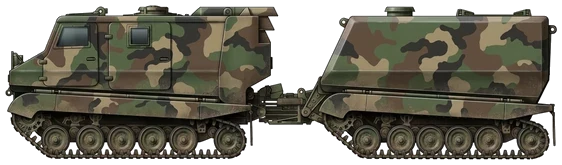
| Sub-type | Articulated all-terrain tracked carrier |
| Crew | 1 + 15 troops (5 front, 10 rear) personnels |
| Mass | 10.2 tons |
| Height | 2.3 m (7.5 ft) |
| Width | 2.2 m (7.2 ft) |
| Length | 8.6 m (28.2 ft) |
| Max. speed | 60 km/h (37 mph) |
| Engine | Caterpillar 3126B turbocharged diesel, 350 bhp |
| Weapon 1 | FN MAG 7.62 mm general-purpose machine gun |
| Weapon 2 | Ultimax 100 5.56 mm light machine gun |
| Weapon 3 | Smoke grenade launchers |
Description
The Bronco All Terrain Tracked Carrier (ATTC) is an articulated twin-chassis tracked vehicle developed jointly by ST Kinetics (now ST Engineering) and the Defence Science and Technology Agency for the Singapore Army. It entered service with the Singapore Armed Forces in 2001. Thailand became the first export customer in 2007, and the vehicle was trialled in Finland, France, Morocco, Turkey and the United States. Deliveries have exceeded a thousand vehicles across at least 20 configurations.
The design comprises two fully armoured units joined by a hydraulic articulated coupling. The all-welded steel hull protects against 7.62 mm small arms fire and shell splinters. Propulsion is by a Caterpillar 3126B turbocharged, charge air-cooled diesel driving an Allison MD3560P automatic transmission. Four-sprocket drive, fully articulated steering with optional differential lock, seamless rubber tracks and a running gear tailored to soft ground give a low ground pressure and a small turning radius. The vehicle is amphibious with minimal preparation and is air-portable in a C-130. The front unit seats six and the rear ten, including the driver; a cargo variant with drop sides and tailgate retains the amphibious capability.
Singapore fields ambulance, engineer, repair and recovery, load carrier, troop carrier and fuel resupply variants. The Mortar Tracked Carrier, developed by the SAF, DSTA and ST Kinetics, carries the 120 mm Super Rapid Advanced Mortar System with a blast diffuser and a hydro-pneumatic recoil system that limits hull reinforcement requirements. Its Automatic Fire Control System pairs a fire control unit with an inertial navigation system, permitting deployment without conventional survey, and includes a Mortar Platoon Management System networked through the Battlefield Management System.
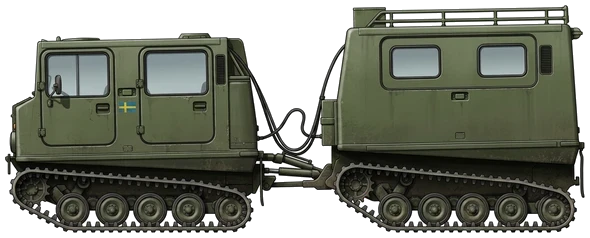
In December 2008 the British Ministry of Defence awarded ST Kinetics a £150 million single-source contract for over 100 vehicles under an Urgent Operational Requirement, designated Warthog in British service and intended to supplement the BvS 10 Viking in southern Afghanistan. Powered by a Caterpillar C7 diesel, the vehicles were fitted by Thales at Llangennech, South Wales, with Bowman radios, electronic countermeasures, bar armour and protected seating. Deliveries ran from the third quarter of 2009 to 2010, with the first vehicles reaching Afghanistan in mid-2010. Troop carrier, ambulance, command and repair and recovery variants were built. The British fleet absorbed around 30 direct IED strikes without crew fatalities. Operating within the Royal Marines Armoured Support Group but crewed by Royal Armoured Corps personnel, the Warthog served in Helmand Province until the closure of Camp Bastion; the final Warthog Group was drawn from C (the Duke of Edinburgh) Squadron, the Queen's Royal Hussars. The type was withdrawn in October 2015. Germany subsequently transferred repair and recovery, ambulance and command Warthogs to Ukraine.
ST Kinetics unveiled the Bronco 3 at DSEI 2017. Development began in 2010, aiming for Warthog-level protection within the Bronco 1 base weight class. Both modules use V-shaped hulls suspended from a stiffened chassis on four rubber isolators, allowing rear module exchange in under 30 minutes and reducing noise, vibration and harshness by half relative to the Bronco 2. The rear module has raised ground clearance and roofline, and a Mercedes-MTU TD106 engine replaces the earlier powerpack.
Sisu produces a licensed derivative, the GTT, in Finland. The civilian ExtremV has supported disaster response in Japan, the Philippines, Mexico and Thailand; an Arctic variant is to be built under licence by Roshel in Canada for the Domestic Arctic Mobility Enhancement programme.
Frequently Asked Questions
What type of vehicle is the Bronco ATTC?
What is the weight of the Bronco ATTC?
What is the maximum speed of the Bronco ATTC?
How many crew members does the Bronco ATTC require?
How many Bronco ATTC have been built?
What weapons does the Bronco ATTC carry?
- SEP 42026 Verified Weight verified against the published specifications
- AUG 292026 Created Bronco ATTC page created, covering the Singapore carrier and the British Warthog