BTR-50
The BTR-50 is a Soviet amphibious armored personnel carrier introduced in 1954, featuring a tracked chassis derived from the PT-76 light tank. Key figures: weight 16.8 t, top speed 75 km/h, range 400 km, built 6,500. In service with 6 armies — Egypt (450), Syria (450), Iran (300) and 3 others.
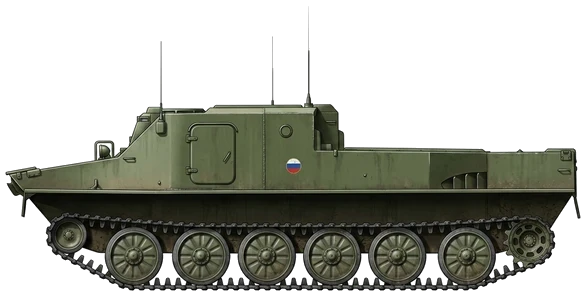
| Sub-type | Tracked Amphibious Armored Personnel Carrier |
| Crew | up to 8 personnels |
| Range | 400 km |
| Mass | 16.8 tons |
| Height | 3.085 m (10.1 ft) |
| Max. speed | 75 km/h (47 mph) |
| Engine | UTD-20 6-cylinder 4-stroke V-type water-cooled diesel engine |
| Weapon 1 | 30 mm ZTM1 or 2A72 autocannon |
| Weapon 2 | 7.62 mm KT or PKT coaxial machine gun |
| Weapon 3 | 9K113 Konkurs (AT-5 Spandrel) ATGM |
| Weapon 4 | 30 mm AGS-17 automatic grenade launcher |
Description
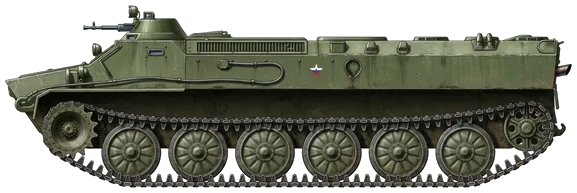
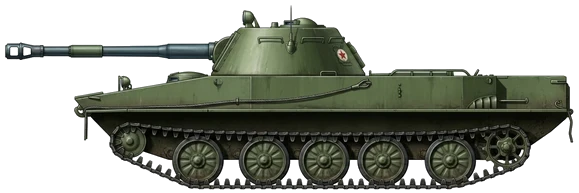
The BTR-50 (Bronetransporter) is a Soviet tracked amphibious armored personnel carrier developed in 1952. Based on the PT-76 light tank chassis, it entered service with the Soviet Army in 1954. Production in the USSR ceased in 1970, though it continued in Czechoslovakia until 1972. The vehicle shares design characteristics with the OT-62 TOPAS, a Czechoslovakian-Polish copy, and the Chinese Type 77.
The vehicle features an all-welded steel boat-shaped hull divided into a front crew compartment, a center troop compartment, and a rear engine compartment. The armor consists of homogeneous cold-rolled steel providing protection against small arms fire and small artillery fragments; however, the hull remains vulnerable to .50-caliber rounds and larger shell fragments. The platform lacks fire protection systems and, in most versions, nuclear, biological, and chemical (NBC) protection, with the exception of the BTR-50PK variant.
The BTR-50 accommodates up to 20 infantrymen who disembark by climbing over the hull sides, though the BTR-50PK variant features an armored roof with rectangular hatches. The driver occupies the center-front position, equipped with vision blocks and periscopes, including a night vision device for low-light operations. The commander is positioned to the left in a projecting bay. Mobility is provided by a torsion bar suspension with six hollow road wheels that contribute to buoyancy. The vehicle is powered by a V-6 water-cooled diesel engine and a manual shaft-type transmission. For amphibious operations, the hull is hermetically sealed and utilizes two hydrojets for propulsion, a trim vane for stability, and electric bilge pumps.
Standard armament configurations include a 7.62 mm SGMB medium machine gun or a 14.5 mm KPV heavy machine gun. Specialized variants serve as command vehicles, mine-clearing platforms, and self-propelled anti-aircraft guns.
Initially deployed within motorized rifle regiments and mechanized brigades of Soviet and East German forces, the BTR-50 was later superseded in front-line roles by the BMP-1. The vehicle has been widely exported and remains in service with several countries across Africa, Asia, and the Middle East. It saw combat during the Six-Day War and the Yom Kippur War with Egyptian, Syrian, and Israeli forces. Israel captured numerous units during these conflicts, integrating them into its inventory and later transferring some to the South Lebanon Army. During the War of Attrition, the vehicle participated in an amphibious raid across the Suez Canal. In 2023, Russia reactivated units from storage for deployment during the invasion of Ukraine, where visual evidence confirmed their use in frontline combat near Avdiivka.
Frequently Asked Questions
What type of vehicle is the BTR-50?
What is the weight of the BTR-50?
What is the maximum speed of the BTR-50?
What is the operational range of the BTR-50?
How many crew members does the BTR-50 require?
How many BTR-50 have been built?
What weapons does the BTR-50 carry?
- SEP 42026 Verified Weight verified against the published specifications
- MAR 252026 Created Page created: BTR-50