Bandvagn 206
The Bandvagn 206 (Bv 206) is a Swedish tracked, articulated all-terrain carrier introduced in 1980, primarily used for troop and cargo transport, distinguished by its amphibious two-unit articulated design. Key figures: weight 4.5 t, top speed 65 km/h, built 11,000. In service with 5 armies — Italy (300), Singapore (300), Sweden (260) and 2 others.
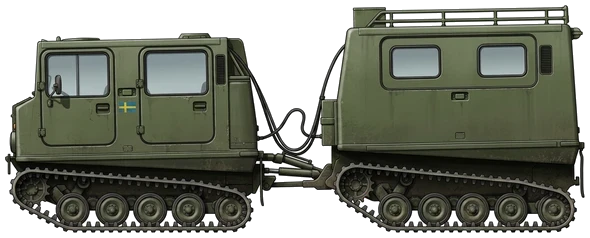
| Sub-type | Tracked articulated all-terrain carrier |
| Crew | 1 + 16 (5 front car, 11 rear car); Bv 206S: 1 + 12 personnels |
| Mass | 4.5 tons |
| Height | 2.4 m (7.9 ft) |
| Width | 1.87 m (6.1 ft) |
| Length | 6.9 m (22.6 ft) |
| Max. speed | 65 km/h (40 mph) |
| Engine | 2.8 L Ford Cologne V6, 99 kW (Bv 206S: Steyr M1, 130 kW) |
| Weapon 1 | Heavy machine gun on ring mount |
| Weapon 2 | Smoke grenade launchers |
| Weapon 3 | 90 mm Pvpj 1110 recoilless gun (PvBv 2062) |
| Weapon 4 | TOW (Rbs 55) or BILL (Rbs 56) ATGM launcher (PvBv 2063) |
Description
Development of the Bandvagn 206 began in 1974 at Hägglund & Söner in Örnsköldsvik, Sweden, as a successor to the Volvo Bv 202. The requirement called for an all-terrain carrier able to move troops and equipment across the snowfields and bogs of northern Sweden. Three batches of trial vehicles were delivered between 1976 and 1978, and the first production examples went to the Swedish Defence Administration in 1980. Hägglund & Söner's military vehicle business passed to Alvis plc in 1997, becoming Alvis Hägglunds, and then to BAE Systems in 2004 as BAE Systems Hägglunds.
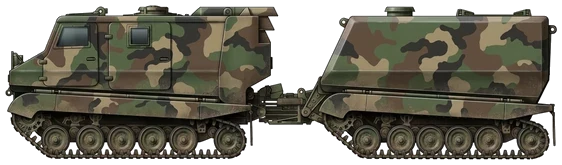
The Bv 206 is an articulated tracked carrier consisting of two units connected by a steering linkage, with all four rubber tracks driven. The front car seats six including the driver; the rear car carries eleven. Low ground pressure allows movement over snow, marsh and soft soil, and the vehicle is fully amphibious, propelled in water by its tracks. A trailer can be towed behind the rear unit. The original version used a Ford Cologne V6 petrol engine with automatic transmission; United States models are fitted with a six-cylinder Mercedes diesel and, since 1997, a non-halon fire suppression system, adopted after several front cars burned to the frame.
The baseline vehicle is unarmoured. Variants include the Bv 206A ambulance, the Bv 206F fire appliance, the RaBv 2061 command and communications vehicle, the RlBv 2068 radio relay vehicle used at Swedish brigade and divisional levels within the Telenät 2000 network, and mortar, cargo, fuel, radar and command post configurations. The PvBv 2062 is an open-topped anti-tank version with lowerable roll bars mounting the 90 mm Pvpj 1110 recoilless gun; the PvBv 2063 carries TOW (Rbs 55) or Bofors BILL (Rbs 56) missile launchers. The Bv 206S (Bandvagn 206 Skyddad) is an armoured personnel carrier variant protecting against shrapnel and small-arms fire, powered by a Steyr M1 monoblock diesel and carrying a driver and twelve equipped troops. It can be underslung beneath CH-47 Chinook and CH-53E Super Stallion helicopters or carried inside a C-130. The GAZ-3351 is a licence-built Russian version produced by the GAZ Group at the Zavolzhsky plant. The larger BvS 10, developed for the British Royal Marines as the ATV(P) Viking, uses the same articulated layout.
Produced in large numbers and exported to more than thirty countries, the Bv 206 serves with the Swedish, Norwegian, Finnish, German, French, Italian, Spanish, British, Canadian, Israeli, Singaporean, South Korean, Thai, Malaysian, Indonesian, Ukrainian and Baltic armed forces, among others. In United States service it is designated the Small Unit Support Vehicle, with the M973 carrier, M1065 tactical operations centre, M1066 ambulance and M1067 flat-bed cargo variants; users include the 86th Infantry Brigade Combat Team, brigades of the 11th Airborne Division, and the Marine Corps. Canadian troops employed the type in combat during Operation Anaconda in Afghanistan, using it to cross mountainous terrain at altitude. Greece operates it with ARTHUR counterbattery radar and Ireland with Giraffe Mk IV radar. Singapore has transferred some vehicles to its Civil Defence Force as firefighting platforms and replaced the Bv 206S with the Bronco. Antarctic research programmes, alpine and maritime search and rescue services, and commercial operators in the Canadian oil and forestry sectors also use surplus and civil-standard vehicles.
Frequently Asked Questions
What type of vehicle is the Bandvagn 206?
What is the weight of the Bandvagn 206?
What is the maximum speed of the Bandvagn 206?
How many crew members does the Bandvagn 206 require?
How many Bandvagn 206 have been built?
What weapons does the Bandvagn 206 carry?
- SEP 42026 Verified Weight verified against the published specifications
- AUG 292026 Created Bandvagn 206 page created (Bv 206 and armoured Bv 206S: specs, description, operators, related vehicles)