LAV-150
Summary
| Origin country | 🇺🇸 United States |
| Category | Light Armoured Vehicle |
| Sub-type | Light Reconnaissance Tank |
| Manufacturer | Textron Marine & Land Systems |
| Number built | None units |
Technical specifications
| Crew | 3 personnels |
| Range | 643 km |
| Mass | 9.9 tons |
| Height | 2.54 m (8.3 ft) |
| Width | 2.26 m (7.4 ft) |
| Length | 5.69 m (18.7 ft) |
| Max. speed | 89 km/h (55 mph) |
| Engine | V-504 V-8 Diesel Engine with 202 hp |
| Weapon 1 | 1 90mm rifled barrel gun |
| Weapon 2 | 1 M-240 7.62mm machine gun (4500 rounds) |
Historical operators
Profile of LAV-150
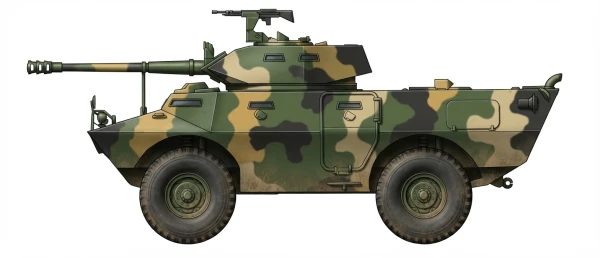
Description
The LAV-150 is an American 4x4 amphibious armored car belonging to the Cadillac Gage Commando family. Developed by the Terra-Space division of Cadillac Gage, the vehicle was designed in 1962 to fulfill a United States Military Police Corps requirement for an armed convoy escort vehicle. Following the 1963 prototype, production variants entered service in 1964. The platform was engineered to combine the roles of an armored personnel carrier and a conventional armored car.
The vehicle’s construction features a monocoque hull of Cadaloy high-hardness alloy steel. This armor provides protection against 7.62x51mm ammunition, while the hull's angles are designed to assist in deflecting fire and mine blasts. As an amphibious platform, it utilizes a waterproofed engine and a hull designed for fording deep water. Mechanical components include four-wheel drive and axles similar to the M35 truck series. While early versions used Chrysler V8 gasoline engines, later variants were produced with Cummins diesel engines and automatic transmissions. The LAV-150 incorporates heavier axles and modified suspension to support larger weapon systems compared to the earlier V-100.
Firepower configurations include turreted and open-top models. Available main armament includes the Cockerill Mk3 90mm cannon, 20mm autocannons, and 90mm smoothbore guns. Secondary armament typically consists of 7.62mm or .50 caliber machine guns, such as the M60, M2HB, or miniguns. Specialized variants carry 40mm grenade launchers or mortars. Some versions have been retrofitted with the 76mm turret from the British FV101 Scorpion.
Initial deployment occurred during the Vietnam War, where the vehicle was utilized by the U.S. Army, Air Force, and Marine Corps, as well as the Army of the Republic of Vietnam. Roles included convoy escort, base protection, and post-attack reconnaissance. Following U.S. military disengagement from Vietnam, the series was gradually replaced in American service by the M1117. The vehicle was widely exported and operates in several countries across Asia, the Middle East, and South America. Major operators include Saudi Arabia, where it has served with the National Guard, as well as Malaysia, Thailand, and the Philippines. The vehicle has seen combat in various conflicts, including the Lebanese Civil War, the Gulf War, and the Battle of Marawi. In the Philippines, crews have utilized improvised wooden armor to mitigate the effects of rocket-propelled grenades. In addition to military use, the vehicle has been employed by internal security forces and police SWAT units for tactical entries and high-risk warrant service.