M142 HIMARS
Summary
| Origin country | 🇺🇸 United States |
| Category | Multiple Launch Rocket System |
| Sub-type | Light multiple rocket launcher |
| Manufacturer | Lockheed Martin |
| Number built | 750 units |
| Est. avg unit price | $4.9 million |
Technical specifications
| Crew | 3 (commander, second in command, driver) personnels |
| Range | 480 km |
| Mass | 16.3 tons |
| Height | 3.18 m (10.4 ft) |
| Width | 2.44 m (8.0 ft) |
| Length | 6.94 m (22.8 ft) |
| Max. speed | 94 km/h (58 mph) |
| Engine | Caterpillar 3116 ATAAC 6.6L diesel, 330 hp |
| Weapon 1 | 6 x GMLRS rockets or 2 x PrSM missiles or 1 x ATACMS missile |
Historical operators
Profile of M142 HIMARS
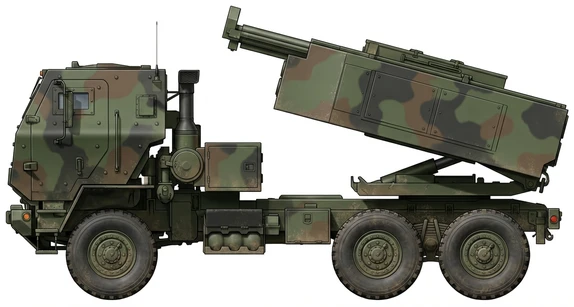
Description
The M142 High Mobility Artillery Rocket System (HIMARS) originated from a 1982 requirement for a lightweight multiple rocket launcher to serve as a counterfire asset for the 9th Infantry Division. Development was prioritized following the Gulf War, when the M270 Multiple Launch Rocket System was found to be too heavy for rapid deployment via airlift. Developed by Loral Vought Systems (now Lockheed Martin), the concept was tested in 1991 at White Sands Missile Range using a modified Honest John launcher. Lockheed Martin received a prototype contract in 1996, and the system underwent evaluation with the XVIII Airborne Corps starting in 1998. Low-rate initial production was authorized in 2003, and the system entered service in June 2005.
The HIMARS is a wheeled vehicle based on the Family of Medium Tactical Vehicles (FMTV) M1140 five-ton truck frame. It carries a single interchangeable launch pod capable of holding either six Guided Multiple Launch Rocket System (GMLRS) rockets or one Army Tactical Missile System (ATACMS) missile. The launcher is also compatible with the Precision Strike Missile (PrSM) and the Ground Launched Small Diameter Bomb (GLSDB). The vehicle features cab windows constructed of sapphire laminated with glass and polycarbonate. The system is transportable by C-130, C-17, and C-5 aircraft. Design modifications have enabled the system to fire from the decks of moving ships, and it has been tested as a unified launch system for anti-aircraft missiles. Production of the chassis transitioned from Armor Holdings to Oshkosh Corporation before being centralized at Lockheed Martin’s facility in Arkansas.
The vehicle is operated by the United States Army, Marine Corps, and National Guard, and is utilized by several countries including Singapore, Jordan, Romania, and Poland. Prototype launchers were used during the Iraq War, and the system was subsequently deployed to Afghanistan for Operation Moshtarak and targeting operations in Kandahar. HIMARS units engaged ISIL targets in Iraq and Syria starting in 2015, operating from positions in Jordan, Turkey, and local airbases such as Al Asad. In 2022, the system was provided to Ukraine, where it has been used to strike command nodes, ammunition storage, and troop concentrations. Combat reports from Ukraine include the use of wooden decoys and the impact of GPS jamming on munition precision. In 2024 and 2025, Ukrainian HIMARS targeted infrastructure and troop convoys in the Belgorod and Kursk regions. Confirmed losses have occurred due to missile strikes and first-person view drones. In March 2026, the system was observed in Bahrain conducting launches toward Iran. Other operators include Australia, Estonia, and Taiwan, with additional orders pending for several European and Middle Eastern nations.