M142 HIMARS vs M270 MLRS
M142 HIMARS vs M270 MLRS at a glance — weight 16,250 vs 25,191 kg, top speed 94 vs 72 km/h, range 480 vs 483 km, crew — vs 3.
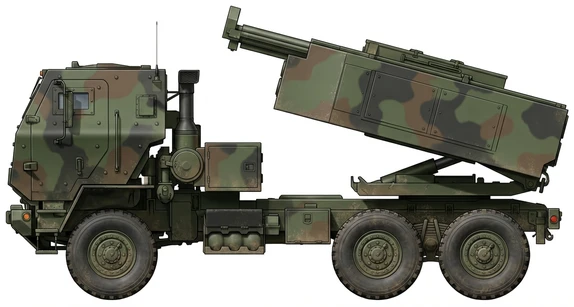
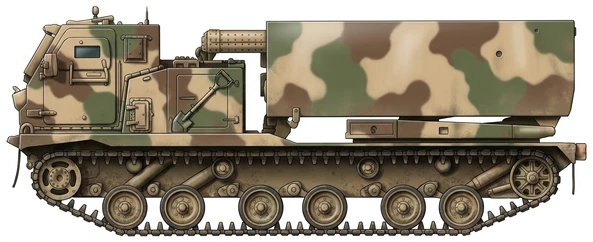
| M142 HIMARS | M270 MLRS | |
|---|---|---|
| Origin country | 🇺🇸 United States | 🇺🇸 United States |
| Category | Multiple Launch Rocket System | Multiple Launch Rocket System |
| Type | Light multiple rocket launcher | Multiple Rocket Launcher System |
| Manufacturer | Lockheed Martin | Lockheed Martin Vought Systems |
| Number produced | 750 units | 1,450 units |
| Estimated unit price | $4.9 million | $2.3 million |
| Combat weight | 16.3 tons | 25.2 tons |
| Maximum speed | 94 km/h | 72 km/h |
| Operational range | 480 km | 483 km |
| Length | 6.94 m | 6.55 m |
| Width | 2.44 m | 3.60 m |
| Height | 3.18 m | -- m |
| Crew | 3 (commander, second in command, driver) | 3 |
| M142 HIMARS | M270 MLRS | |
|---|---|---|
| Main armament | 6 x GMLRS rockets or 2 x PrSM missiles or 1 x ATACMS missile | 12 roquettes M26 227mm. avec 644 charges M77 par roquette |
| Engine | Caterpillar 3116 ATAAC 6.6L diesel, 330 hp | Cummins VTA-903T V8 Turbo-Diesel Engine with 500 hp |
Detailed Comparison
Developed to counter Soviet massed artillery, the tracked M270 MLRS provides sustained rocket fire using a dual-pod launcher. Decades later, the wheeled M142 HIMARS traded half that payload and hull armor for strategic mobility, utilizing a single pod on a 5-ton truck chassis to meet post-Cold War rapid deployment requirements.
Development and Design
The M270 originated from a 1970s NATO requirement to suppress enemy air defenses and counter-battery fire. Vought placed a dual-pod M269 launcher on a lengthened Bradley Fighting Vehicle chassis. Following the 1991 Gulf War, the U.S. Army determined the 25.19-ton M270 was too heavy for rapid airlift. Lockheed Martin developed the HIMARS to solve this logistical bottleneck, mounting a single MLRS pod on an FMTV M1140 truck frame. This reduced the combat weight to 16.25 tons, shifting the design priority from armored survivability to expeditionary agility.
Protection and Firepower
Both platforms fire identical munitions, including 227mm GMLRS rockets, ATACMS missiles, and the Precision Strike Missile (PrSM), but they differ in payload volume and crew protection:
The M270’s 5083 aluminum hull provides heavier small arms and fragmentation protection, with M270A1/A2 modernizations adding up-armored cabs. HIMARS relies on sapphire-laminated glass and polycarbonate windows, offering lighter protection. In modern counter-battery warfare, both systems depend primarily on shoot-and-scoot tactics rather than armor thickness to survive.
Mobility and Logistics
Mobility profiles dictate deployment doctrine. The wheeled HIMARS reaches 94 km/h on paved roads, enabling rapid repositioning, and is transportable by C-130 aircraft. Its Caterpillar 6.6L diesel engine and truck chassis require fewer maintenance hours per operating mile than tracked equivalents. The M270 is limited to 72 km/h and requires C-17 or C-5 transport. However, its tracked chassis and 500-hp Cummins V8 provide better off-road mobility in deep mud or snow, environments where the wheeled HIMARS is restricted to established road networks.
Deployment and Combat Record
The M270 debuted in the 1991 Gulf War, firing unguided M26 cluster munitions against Iraqi formations. HIMARS saw early action in Afghanistan and Iraq, later conducting precision strikes against ISIL in Syria. In Ukraine, both systems launched GMLRS strikes against Russian command nodes and logistics. Combat data from Ukraine indicates HIMARS is harder to target with counter-battery fire due to its high road speed, though both platforms have suffered confirmed losses to first-person view drones and missile strikes. Operations in Ukraine also demonstrate that both systems suffer degraded accuracy in dense GPS-jamming environments.
Conclusion
The M142 HIMARS holds the edge in expeditionary and fluid combat environments. Its C-130 transportability and low logistical footprint allow commanders to deploy precision fires rapidly across vast theaters like the Indo-Pacific. The M270 is the optimal choice for heavy mechanized formations in mud-heavy theaters, where off-road mobility and double the payload volume justify the track maintenance. For forces requiring deep-strike precision without the burden of heavy armored logistics, HIMARS is the definitive choice.