M198 Howitzer
Summary
| Origin country | 🇺🇸 United States |
| Category | Towed Artillery |
| Sub-type | Towed Howitzer |
| Manufacturer | Rock Island Arsenal |
| Number built | 1600 units |
Technical specifications
| Crew | nine person crew personnels |
| Range | 30 km |
| Mass | 7.3 tons |
| Weapon 1 | 155 mm howitzer |
Historical operators
Profile of M198 Howitzer
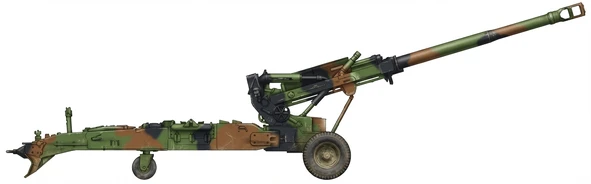
Description
The M198 is a medium-sized, towed 155 mm artillery piece developed to replace the World War II-era M114 howitzer for the United States Army and Marine Corps. Design and prototyping occurred at the Rock Island Arsenal starting in 1969, with firing trials commencing in 1970. Full-scale production began at the same facility in 1978, and the weapon system entered active service in 1979. It was produced in large numbers before being superseded in United States and Australian service by the M777 howitzer.
The howitzer is transportable via parachute or heavy-lift helicopters, including the CH-53E Super Stallion and CH-47 Chinook. For ground transport, the weapon is towed tail-first by a 5-ton truck, which also carries the nine-person crew, ammunition, and supplies. To facilitate transport, the gun tube can be rotated over the trail legs, though this configuration requires the removal of the muzzle brake. Alternatively, the tube may remain in the firing position for faster deployment. During operations, the carriage is lowered onto a baseplate rather than being anchored to the ground to allow for rapid emplacement. The breech is a manually operated screw-type mechanism situated in a low position.
The M198 utilizes separate-loading ammunition, including non-fixed and semi-fixed variants. It maintains a maximum fire rate of four rounds per minute and a sustained rate of two rounds per minute. Standard high-explosive projectiles reach an effective range of 18.1 km, while rocket-assisted projectiles and guided munitions extend this to 30 km. A 52-caliber modification allows the range to surpass 40 km. The system supports a diverse range of munitions, including high-explosive (M107 and M795), white phosphorus for incendiary or screening purposes, and illumination rounds. Specialized payloads include Dual-Purpose Improved Conventional Munitions (DPICM) containing 88 anti-armor and anti-personnel bomblets, as well as mine-laying rounds such as the Area Denial Artillery Munition System (ADAMS) and the Remote Anti Armor Mine System (RAAMS). Historically, the system employed the Copperhead laser-guided projectile and the XM454 nuclear artillery shell, the latter of which was retired in 1992.
The M198 served within separate corps- and army-level field artillery units and within the artillery battalions of light and airborne divisions. It provided fire support for Marine Air-Ground Task Force organizations until its replacement. The system has been widely exported and remains in service with several nations across the Middle East, North Africa, Southeast Asia, and the Americas, including Bahrain, Iraq, Lebanon, Pakistan, Saudi Arabia, Thailand, and Tunisia. Former operators include Australia, Somalia, and the United States. During regional conflicts, units were captured from national inventories and subsequently engaged or destroyed by air strikes.