AH-6 Little Bird vs AH-64 Apache
AH-6 Little Bird vs AH-64 Apache at a glance — top speed 282 vs 293 km/h, range 430 vs 480 km, max takeoff weight 1,610 vs 10,107 kg, built 1,420 vs 2,700 units.
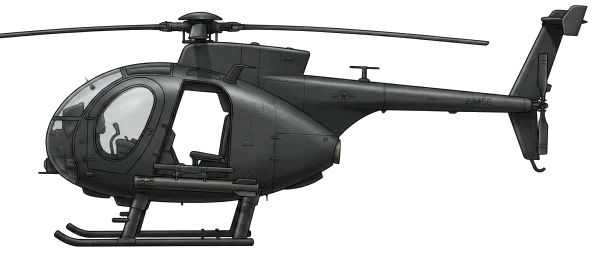
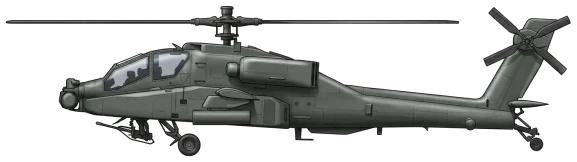
| AH-6 Little Bird | AH-64 Apache | |
|---|---|---|
| Origin country | 🇺🇸 United States | 🇺🇸 United States |
| Category | Military Helicopters | Military Helicopters |
| Manufacturer | Boeing | Boeing |
| First flight | 27 February 1963 | 30 September 1975 |
| Year introduced | 1980 | 1984 |
| Number produced | 1420 units | 2700 units |
| Average unit price | $7.5 million | $33 million |
| Wingspan | 8.4 m | 14.6 m |
| Height | 2.6 m | 5.0 m |
| Length | 9.2 m | 17.7 m |
| Maximum speed | 282 km/h | 293 km/h |
| Operational range | 430 km | 480 km |
| Service ceiling | 4,877 m | 6,096 m |
| Max. takeoff weight | 1,610 kg | 10,107 kg |
| Empty weight | 896 kg | 5,352 kg |
| Total thrust | 1 x 239 kW | 2 x 1,208 kW |
Detailed Comparison
The US Army’s attack helicopter doctrine relies on a mass-to-agility spectrum defined by the 10-ton AH-64 Apache heavy attack platform and the 1.6-ton AH-6 Little Bird light gunship. The Apache operates as an armored, networked anti-armor system built for peer-state mechanized warfare, while the Little Bird functions as a low-signature direct support asset favored by Special Operations Command (SOCOM) for urban environments.
Development and Design
Hughes Helicopters (later Boeing) developed both platforms to meet diverging post-Vietnam requirements. The AH-64, flying in 1975 to replace the AH-1 Cobra, prioritized survivability and standoff lethality. Its tandem cockpit incorporates heavy ballistic protection, subsystem redundancy, and the Longbow fire-control radar, shifting army aviation toward sensor-fused, over-the-horizon engagement. The AH-6 series evolved from the commercial MD 500. Its design discards armor and complex avionics in favor of mechanical simplicity and a compact rotor diameter. Recent iterations, such as the AH-6i and the Unmanned Little Bird (ULB), integrate glass cockpits and AMUST-D remote-control capabilities, though the airframe remains constrained by its foundational light commercial architecture.
Specifications and Performances
At 10,107 kg maximum takeoff weight, the Apache relies on twin General Electric T700-GE-701C turboshafts generating 1,208 kW each to maintain a 15.7 m/s climb rate. This mass supports a 1,200-round 30mm chain gun, up to 16 Hellfire missiles, and heavy electronic warfare suites. The AH-6 maxes out at a fraction of that mass (1,610 kg), utilizing a single 239 kW Allison T63-A5-A engine.
The performance differential dictates their tactical applications:
- The Apache operates with a service ceiling nearly 800 meters higher and carries ten times the payload.
- Both share similar top speeds (293 km/h for the AH-64; 282 km/h for the AH-6).
- The AH-6’s 8.35 m rotor diameter, compared to the Apache’s 14.63 m span, allows insertion into tight urban terrain.
Deployment and usage
The Apache destroyed Iraqi armor during Desert Storm in 1991, validating its deep-strike anti-tank doctrine. The 1999 Kosovo deployment exposed its heavy logistical footprint, and the 2003 Karbala strike in Iraq revealed vulnerabilities to massed small-arms fire in low-altitude hover profiles. In response, AH-64 tactics shifted toward networked standoff engagements. The AH-6 operates entirely within the close-in fight. Flown by the 160th SOAR, Little Birds provided visually directed minigun and rocket fire meters from friendly forces during the 1993 Battle of Mogadishu and the 2004 Battle of Fallujah. On the export market, the AH-64 leads heavy attack procurement globally (UK, Israel, India), while the AH-6i competes against armed drones, securing localized orders from Saudi Arabia and Thailand.
Conclusion
The AH-64 Apache holds the advantage in high-intensity, conventional mechanized warfare. Its sensor suite, armor, and high missile payload make it the optimal platform for neutralizing armored columns at standoff ranges. The AH-6 Little Bird has the edge exclusively in special operations and dense urban close air support. Its low logistical footprint, rapid deployability via C-130, and tight turning radius allow it to operate in street-level environments where the Apache’s 14-meter rotor span and heavy mass become fatal liabilities. For force-on-force combat, the Apache dictates the battlespace; for surgical strikes in constrained geography, the AH-6 is the required asset.

-
 United States
822
-
 Israel
48
-
 United Kingdom
47
- All 19 operators →