Beechcraft Bonanza
American light general aviation aircraft, first produced in the late 1940s, used for personal, business, and military training purposes. Key figures: range 1,326 km, service ceiling 5,639 m, max takeoff weight 1,656 kg, built 18,525. In service with 3 air forces as of 2026 — Iran (28), Spain (15), Indonesia (7).
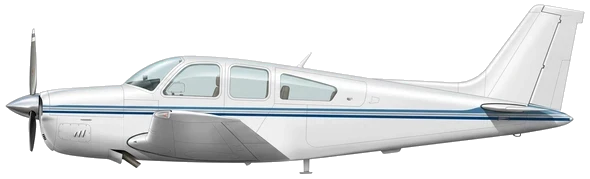
| Crew | 1 |
| Length | 8.4 m (27.5 ft) |
| Wingspan | 10.2 m (33.5 ft) |
| Height | 2.6 m (8.6 ft) |
| Wing area | 16.8 m² (181.0 sqft) |
| Empty weight | 1,141 kg (2,515 lbs) |
| Max. takeoff weight | 1,656 kg (3,651 lbs) |
| Powerplant | 1 × piston engine Continental IO-550-B 224 kW each |
| Operational range | 1,326 km (824 mi) |
| Service ceiling | 5,639 m (18,501 ft) |
| Climb rate | 6.25 m/s (20.5 ft/s) |


Description
The Beechcraft Bonanza is an American single-engine light utility aircraft built by Beech Aircraft Corporation of Wichita, Kansas. First flown on December 22, 1945 and delivered from 1947, the four-to-six-seat type was produced continuously longer than any other aircraft, with 18,525 built by the end of 2025 and more than 6,000 twin-engine derivatives. It is identified with its V-tail configuration, though conventional-tail versions accounted for most later production.
Development
Designed by a team led by Ralph Harmon, the Model 35 was an all-metal, low-wing design with retractable tricycle landing gear at a time when most light aircraft used wood-and-fabric construction and fixed tailwheel gear. The prototype flew on December 22, 1945 and received an airworthiness certificate on March 25, 1947, with production beginning that year. The first 30–40 aircraft had fabric-covered flaps and ailerons before those surfaces were changed to magnesium alloy sheet. The conventional-tail Model 33 Debonair followed in 1960 as a lower-cost variant with austere instrumentation and trim; the Debonair name was dropped with the E33 in 1968. The stretched Model 36 appeared in 1968. V-tail Model 35 production ended in 1982 and Model 33 production in 1995. Beechcraft used the Bonanza fuselage and components to create the twin-engine Travel Air, later developed into the Baron. Textron Aviation announced in November 2025 that Bonanza and Baron production would end once the order backlog was filled.
Design
The Model 35 used a low wing with NACA 23016.5 root and 23012 tip airfoils, an aspect ratio of 6.2, and a V-tail with combined elevator-rudder surfaces termed "ruddervators." Early aircraft had a castering rather than steerable nosewheel; nosewheel steering and tubular wing spars arrived with the A35. Powerplants progressed from the 165 hp Continental E-185 through the 250 hp fuel-injected IO-470-C, the 285 hp IO-520-B, and the 300 hp IO-550-B, with turbocharged TSIO-520 variants offered on the V35-TC, A36TC and B36TC. The 2011 G36 has a 33 ft 6 in span, 3,650 lb gross weight, 176 kt cruise, 716 nmi range with full passengers, an 18,500 ft ceiling, and Garmin G1000 avionics. Magnesium ruddervator skins on V-tail aircraft are prone to corrosion, and an FAA airworthiness directive following wind tunnel and flight testing in the late 1980s required tail strengthening.
Operational History
Turner Airlines (later Lake Central) began operations with three V-tail Bonanzas in 1949, and Central Airlines of Texas operated eleven before replacing them with Douglas DC-3s from 1950. Military operators included the Spanish Air Force (29 F33C, 25 F33A), the Imperial Iranian Air Force (10 F33A, 39 F33C), the Netherlands Government Flying School (16 F33C), the Mexican Air Force (10 F33C), Indonesian Naval Aviation (four G36), the Israeli Air Force (A36 "Hofit"), and the Royal Thai Navy. The derived T-34 Mentor served as the primary trainer for the USAF and US Navy. In March 1949 William Odom flew the modified Waikiki Beech 5,273 miles nonstop from Honolulu to Teterboro, New Jersey in 36 hours 1 minute.
Variants
- Model 35: Original V-tail production series, 1947–1982, culminating in the V35B.
- Model 33 Debonair/Bonanza: Conventional-tail derivative built 1960–1995, including the aerobatic F33C.
- D33: Single S35 converted as a military close-support prototype with conventional tail and six underwing hardpoints.
- Model 36: Stretched Model 33 with 10-inch fuselage extension, six seats and starboard rear double doors, introduced 1968.
- G36: Garmin G1000 glass-cockpit development of the A36, produced from 2006.
Frequently Asked Questions
What type of aircraft is the Beechcraft Bonanza?
What is the range of the Beechcraft Bonanza?
When did the Beechcraft Bonanza first fly?
How many Beechcraft Bonanza have been built?
Which countries operate the Beechcraft Bonanza?
What is the service ceiling of the Beechcraft Bonanza?
- AUG 212026 Created Added the aircraft page with its specifications and description