Commander 500
American light business aircraft, mainly used in civil and military flight training, widely deployed in the mid-20th century. Key figures: top speed 346 km/h, range 1,735 km, service ceiling 5,913 m, max takeoff weight 3,062 kg, unit price $0.26M, built 2,902. In service with 12 air forces as of 2026 — Colombia (6), Mexico (6), Argentina (3) and 9 others.
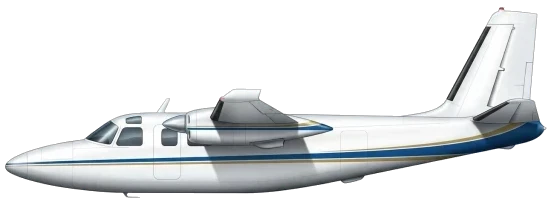
| Length | 11.2 m (36.8 ft) |
| Wingspan | 15.0 m (49.0 ft) |
| Height | 4.4 m (14.5 ft) |
| Wing area | 24 m² (258.3 sqft) |
| Empty weight | 2,102 kg (4,634 lbs) |
| Max. takeoff weight | 3,062 kg (6,751 lbs) |
| Powerplant | 2 × radial engine Lycoming IO-540-E1B5 216 kW each |
| Maximum speed | 346 km/h (215 mph) |
| Operational range | 1,735 km (1,078 mi) |
| Service ceiling | 5,913 m (19,400 ft) |
| Climb rate | 6.8 m/s (22.3 ft/s) |
-
 Colombia
6
Colombia
6
-
 Mexico
6
Mexico
6
-
 Argentina
3
Argentina
3
-
 Honduras
3
Honduras
3
-
 Iran
3
Iran
3
-
 Dominican Republic
2
Dominican Republic
2
-
 Pakistan
2
Pakistan
2
-
 Philippines
2
Philippines
2
-
 Peru
1
Peru
1
-
 South Korea
1
South Korea
1
-
 Thailand
1
Thailand
1
-
 Venezuela
1
Venezuela
1
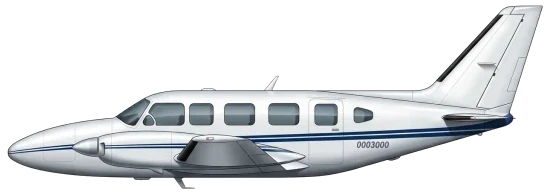
Description
The Aero Commander 500 family is a series of light twin-engined utility and business aircraft built in the United States, originally by the Aero Design and Engineering Company, renamed Aero Commander in 1950, then operated as a division of Rockwell International from 1965 and ending production in 1986 under Gulfstream Aerospace. The type served in civil business, feeder airline, freight and government roles, and in US military service as the L-26, later redesignated U-4 (USAF) and U-9 (US Army). It is known for its high-wing configuration, for a U-4B used as Dwight D. Eisenhower's presidential transport, and for Bob Hoover's single-engine and engine-out aerobatic routines in the Shrike Commander.
Development
The design originated with Ted Smith, a project engineer at Douglas Aircraft, who worked on the concept part-time during 1944 with a group of A-20 engineers; the resulting layout followed that of the A-20 bomber. Three pre-production aircraft were initially planned, reduced to a single prototype during construction. The configuration was finalised in July 1946 as the Model L3805, and the prototype, registered NX1946, first flew on 23 April 1948. Walter Beech flew the aircraft in 1949 and considered buying the project but instead developed the Beechcraft Twin Bonanza; Fairchild Aircraft evaluated the prototype at Hagerstown, Maryland. The company then leased a 26,000 sq ft factory at Bethany, near Oklahoma City, and the production Commander 520 was certified on 30 June 1950 after nearly 10,000 hours of redesign. The first 520 was rolled out in August 1951; serial number 1 served as a demonstrator before being sold in October 1952 to the Asahi Shimbun Press Company of Tokyo.
Design
The L3805 was an all-metal high-wing monoplane with retractable undercarriage using components from the Vultee BT-13 Valiant, seating up to five and powered by two Lycoming O-435-A piston engines. The production 520 used Lycoming GO-435-C2 engines with a combined 520 hp. The 500S Shrike Commander has a 36 ft 9.75 in fuselage, 49 ft 0.5 in wingspan, 255 sq ft wing area, NACA 23012 modified airfoil, and two 290 hp Lycoming IO-540-E1B5 flat-six engines, giving 215 mph at sea level, 936 nmi range and a 19,400 ft ceiling at 6,750 lb maximum takeoff weight. From June 1991 the FAA examined main wing spar fatigue; between about 1961 and 1993, 24 aircraft were lost to in-flight wing separation and 35 further cracked spars were found during inspections.
Operational History
A single 560F served the Belgian Air Force as the personal transport of King Baudouin from 1961 to 1973. Combs Aviation flew series 500 aircraft on scheduled Frontier Airlines services in Montana and Wyoming as of July 1968, while the unpressurised long-fuselage 680FL was used as a package freighter by Combs Freightair and by Suburban Air Freight, which retired its last examples in early 2024. As of 2004 Shrike Commanders remained in service with the US Customs Service, US Coast Guard and US Forest Service, and aircraft continue on cargo and fire-control contracts. Talofa Airways of Samoa is a civil operator.
Variants
- Model L3805: Single prototype of 1948, seating five, with two Lycoming O-435-A engines.
- Commander 520: First production version, seven seats, 200 mph, powered by Lycoming GO-435-C2 engines.
- 500S Shrike Commander: Improved model built after 1967 with 290 hp Lycoming IO-540-E1B5 engines.
- 680FL: Unpressurised long-fuselage variant with 380 hp supercharged engines, used for package freight.
- 695B / Jetprop 1000B: Largest turboprop version, 11 seats, 330 mph.
Frequently Asked Questions
What type of aircraft is the Commander 500?
What is the maximum speed of the Commander 500?
What is the range of the Commander 500?
When did the Commander 500 first fly?
How many Commander 500 have been built?
Which countries operate the Commander 500?
How much does a Commander 500 cost?
What is the service ceiling of the Commander 500?
- AUG 302026 Updated Description updated
- AUG 12026 Updated Manufacturer updated
- APR 72026 Updated Picture credits updated in a site-wide editorial pass
- FEB 72026 Updated Top speed added
- JAN 122026 Updated Range updated in a site-wide editorial pass