Bell 214
American medium-lift helicopter, developed in the early 1970s, utilized for military transport and search and rescue operations. Key figures: top speed 259 km/h, range 411 km, service ceiling 5,000 m, max takeoff weight 6,804 kg, built 405. In service with 3 air forces as of 2026 — Iran (24), Brunei (1), Ecuador (1).
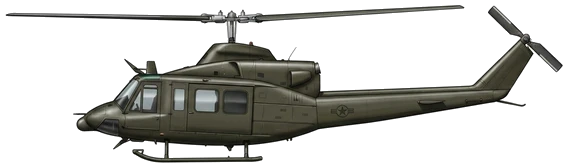
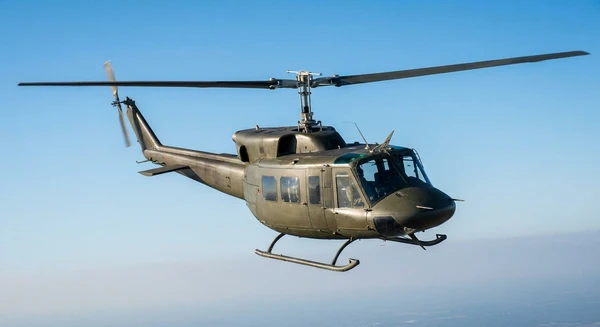
| Crew | 2 |
| Length | 14.6 m (48.0 ft) |
| Wingspan | 15 m (49.2 ft) |
| Height | 3.9 m (12.8 ft) |
| Wing area | 182.4 m² (1963.8 sqft) |
| Empty weight | 3,442 kg (7,588 lbs) |
| Max. takeoff weight | 6,804 kg (15,000 lbs) |
| Powerplant | 1 × Lycoming LTC4B-8D 2,180 kW each |
| Maximum speed | 259 km/h (161 mph) |
| Operational range | 411 km (255 mi) |
| Service ceiling | 5,000 m (16,404 ft) |


Recent Events — Bell 214
1 event →
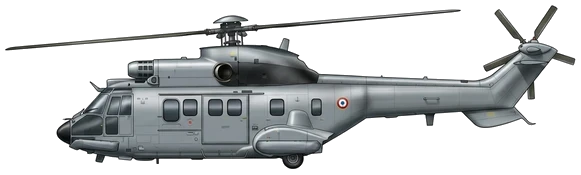
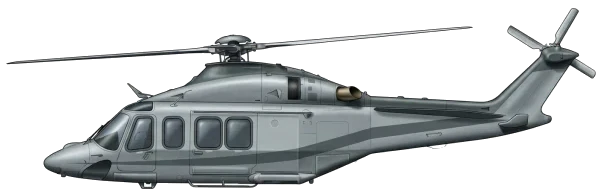
Description
The Bell 214 is a medium-lift helicopter derived from Bell Helicopter's UH-1 Huey series. Bell announced development of the Model 214 in 1970 under the name "Huey Plus." The first prototype, based on a Bell 205 airframe with a 1,900 shp Lycoming T53-L-702 engine, flew in 1970. Following the evaluation of a demonstration prototype in Iran, Bell received an order for 287 Bell 214As. Plans for Iranian production of 50 Bell 214As and 350 Bell 214STs were halted by the 1979 Iranian Revolution, though Bell delivered 296 Bell 214A and 39 Bell 214C aircraft before the conflict. Bell subsequently focused on the civilian market, certifying the Bell 214B in 1976. Production of the 214B ended in 1981. In 2015, Bell signed a licensing agreement with Erickson Inc. for aftermarket support, and sold the type certificate to Erickson in 2021.
Design
The helicopter is powered by a 2,930 shp Lycoming LTC4B-8D turboshaft engine, featuring a single large exhaust duct and wide chord rotor blades without stabilizer bars. It uses the Wortmann FX 69-H-098 blade section and a 50-foot diameter main rotor. The aircraft has a crew of two and can accommodate 14 troops, six stretchers, or a 3,880 lb internal payload. It has a maximum takeoff weight of 15,000 lb with a slung load. Performance specifications include a cruise speed of 140 knots, a service ceiling of 16,400 feet, and a range of 222 nautical miles at 16,400 feet density altitude. The civil 214B variant features an automatic flight control system with stability augmentation, commercial avionics, and an advanced rotor hub with elastomeric bearings.
Operational History
In military service, the type has been operated by Iran, the United Arab Emirates, Ecuador, Oman, and the Philippines. As of January 2012, 29 military units remained active, including 25 Bell 214As in Iran and three Bell 214Bs in the United Arab Emirates. The Philippine Air Force operated two units for search and rescue and aerial firefighting. Approximately 43 Bell 214Bs serve commercially in Australia, Canada, Singapore, and the United States, with operators such as McDermott Aviation.
Variants
- Bell 214 Huey Plus: The prototype model equipped with a 1,900 shp Lycoming T53-L-702 turboshaft that first flew in 1970.
- Bell 214A/C Isfahan: Military production models built for Iran, with the 214A serving the army and the 214C search-and-rescue variant equipped with an rescue hoist.
- Bell 214B BigLifter: A civil variant of the 214A powered by a Lycoming T5508D turboshaft engine, with 70 units constructed.
- Bell 214B-1: A variant identical to the 214B but limited to a maximum internal gross weight of 12,500 lb due to certification standards.
Frequently Asked Questions
What type of aircraft is the Bell 214?
What is the maximum speed of the Bell 214?
What is the range of the Bell 214?
When did the Bell 214 first fly?
How many Bell 214 have been built?
Which countries operate the Bell 214?
What is the service ceiling of the Bell 214?
- JUL 242026 Created Page created: Bell 214