Boeing 707 vs Boeing 747
Boeing 707 vs Boeing 747 at a glance — top speed 1,010 vs 1,014 km/h, range 5,400 vs 12,150 km, max takeoff weight 151,318 vs 377,842 kg, built 865 vs 1,574 units.
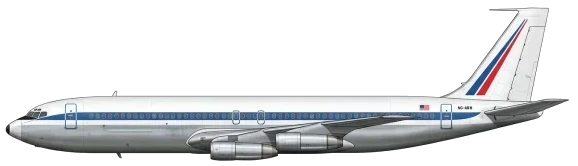
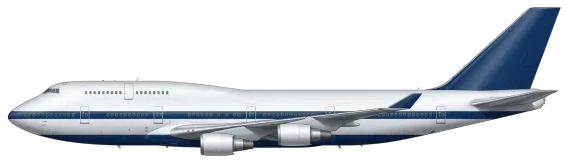
| Boeing 707 | Boeing 747 | |
|---|---|---|
| Origin country | 🇺🇸 United States | 🇺🇸 United States |
| Category | Military Special Mission Aircraft | Military Special Mission Aircraft |
| Manufacturer | Boeing | Boeing |
| First flight | 15 July 1954 | 9 February 1969 |
| Year introduced | 1958 | 1970 |
| Number produced | 865 units | 1574 units |
| Average unit price | $35 million | $285 million |
| Wing area | -- m² | 511.0 m² |
| Wingspan | 44.5 m | 59.6 m |
| Height | 13.0 m | 19.3 m |
| Length | 46.4 m | 70.6 m |
| Maximum speed | 1010 km/h | 1014 km/h |
| Operational range | 5,400 km | 12,150 km |
| Service ceiling | 13,000 m | 13,746 m |
| Max. takeoff weight | 151,318 kg | 377,842 kg |
| Empty weight | 66,406 kg | 173,726 kg |
| Total thrust | 4 x 8,618 kgf | 4 x 25,719 kgf |
Detailed Comparison
Boeing’s 707 and 747 airframes form the foundation of United States airborne command, control, and special mission architecture. While both originated as civilian airliners, their military adaptations diverge sharply based on airframe volume, power generation, and operating costs. The 707 serves as the primary platform for theater-level ISR, whereas the 747 is reserved for strategic, high-endurance command and specialized high-energy missions.
Development and Design
The 707 evolved from the privately funded Dash 80 prototype in 1954, developed parallel to the USAF requirement for a jet-powered tanker (KC-135). Its 35-degree swept wing induced Dutch roll, requiring Boeing to adapt B-47 yaw damper technology. This narrow-body design provided a baseline for straightforward radome and antenna integration. The 747, flying in 1969, was dictated by commercial demand for high-capacity long-haul transport. Its 37.5-degree wing sweep and wide-body, twin-deck architecture offered high internal volume. The 747's redundancy—four hydraulic systems and a 16-wheel main landing gear—made it structurally survivable, while its wide fuselage provided the cooling and power generation capacity required for dense electronic suites or experimental payloads.
Specifications and Performances
The scale difference dictates their deployment doctrines. The 747 has a maximum takeoff weight of 377,842 kg, more than double the 707’s 151,318 kg. This allows the 747 to carry fuel loads yielding a 12,150 km range, compared to the 707's 5,400 km baseline. Cruising at Mach 0.84 to 0.88, the 747 outpaces the 707. However, the 747 requires robust runway infrastructure. The 707’s lighter footprint permits operation from forward theater bases, and its four Pratt & Whitney JT3D-7 engines cost a fraction to operate compared to the 747’s General Electric CF6 turbofans, which produce 25,719 kgf of thrust each.
Deployment and usage
The 707 is the progenitor of modern airborne C4ISR, providing continuous theater orbits in Operation Desert Storm and Operation Allied Force. Military conversions include:
- E-3 Sentry: Provides airborne early warning and control using a rotating radome.
- E-8 JSTARS: Carries synthetic aperture radar for ground target tracking.
- E-6 Mercury: Handles submarine communication relays (TACAMO).
The military 747 is restricted to strategic roles due to its $285 million baseline cost and high fuel burn. The E-4B National Airborne Operations Center (NAOC) utilizes the 747’s volume to house nuclear C2 networks, trailing wire antennas, and 112 personnel. The 747 was also the sole viable airframe for the cancelled YAL-1, carrying megawatt-class chemical laser modules that exceeded 707 payload limits. Prior to 1979, Iran acquired four 747-100s as aerial refuelers for their F-4 fleet, but high fleet-wide operating costs prevented global adoption of the KC-747 concept.
Conclusion
The 707 has the edge in theater-level ISR and tactical battle management. Its lower procurement and operating costs, combined with lighter runway requirements, allow defense ministries to field fleets large enough to sustain continuous orbits in combat zones. The 747 has the edge in strategic, payload-heavy operations. When a mission requires hardened C2 networks, 16-hour unrefueled endurance, or the integration of directed-energy weapons, the 747’s internal volume and power output outclass the narrow-body 707.


