Supermarine Scimitar
British single-seat naval strike aircraft, developed in the 1950s and operated by the Fleet Air Arm until 1969 for low-level strike, nuclear delivery and aerial refuelling. Key figures: top speed 1,185 km/h, range 2,291 km, service ceiling 14,021 m, max takeoff weight 15,513 kg, built 76.
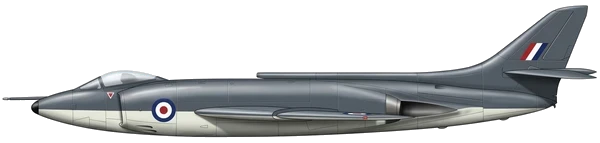
| Crew | 1 |
| Length | 16.8 m (55.2 ft) |
| Wingspan | 11.3 m (37.2 ft) |
| Height | 5.3 m (17.3 ft) |
| Wing area | 45.1 m² (485.0 sqft) |
| Empty weight | 10,869 kg (23,962 lbs) |
| Max. takeoff weight | 15,513 kg (34,200 lbs) |
| Powerplant | 2 × turbojets Rolls-Royce Avon 202 5,103 kgf each |
| Maximum speed | 1185 km/h (736 mph) |
| Operational range | 2,291 km (1,424 mi) |
| Service ceiling | 14,021 m (46,001 ft) |
| Climb rate | 34.3 m/s (112.5 ft/s) |
- Air-to-Ground AGM-12 Bullpup
- Air-to-Air Short-Range AIM-9 Sidewinder
- Unguided Bomb 1,000 lb bomb
- Nuclear Red Beard
- Rocket Pod 2-inch/3-inch unguided rockets
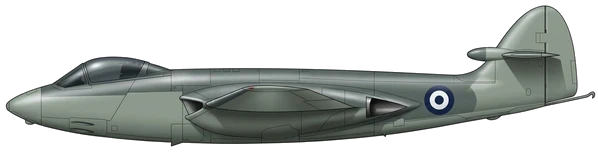
Description
The Supermarine Scimitar was a British single-seat, twin-engined naval strike aircraft operated only by the Royal Navy's Fleet Air Arm. It was the last aircraft designed and built entirely by Supermarine. Production deliveries began in 1957, and the type entered service in 1958 as the largest, heaviest and most powerful aircraft the Fleet Air Arm had yet operated. The Scimitar was armed for low-level strike, including nuclear delivery, and later served as a tanker. It lost 39 aircraft in accidents and was withdrawn in 1969.
Development
The Scimitar originated in a 1945 requirement for an undercarriage-less fighter that would land on flexible rubber decks. Supermarine's Type 505 design for this requirement had twin side-by-side engines, a V-tail and a thin straight wing, but it never flew. In 1948 the Admiralty reconsidered the concept. The design was reworked as the Type 508 with retractable nosewheel undercarriage, and its wing was thickened from seven to nine percent and enlarged. Three Type 508s had been ordered in November 1947 to Specification N.9/47.
The first Type 508 flew from RAF Boscombe Down on 31 August 1951 and began carrier trials aboard HMS Eagle by May 1952. The second aircraft, redesignated Type 529, carried cannon and had an enlarged tailcone for a proposed tail-warning radar. It first flew on 29 August 1952 and reached 607 mph (977 km/h). The third prototype became the Type 525, which had swept wings, swept tail surfaces and blown flaps. It flew on 27 April 1954 and was later lost in a crash. Its results led to the Type 544, built to Specification N.113, which first flew on 19 January 1956.
An order for 100 aircraft placed in 1952 was later reduced to 76. The requirement was also changed from fighter to low-level nuclear strike. The first production Scimitar F.1 flew on 11 January 1957.
Design
The Scimitar was powered by two Rolls-Royce Avon 202 turbojets of 11,250 lbf (50.0 kN) each, mounted side by side in the fuselage. The third Type 544 introduced a strengthened airframe for low-level flight with heavy weapon loads. To counter pitch-up at high speed and altitude, it was also given flared wingtips, wing fences and an anhedral tailplane.
The type introduced fuel flow proportioning, integral mainplane tanks and blown flying surfaces to reduce landing speed. It was also the first British naval aircraft with duplicated fully powered flight controls. Maximum speed was 640 kn (1,185 km/h) at sea level, range 1,424 mi (2,291 km), and service ceiling 46,000 ft (14,000 m). Gross weight was 34,200 lb (15,513 kg).
Armament
Fixed armament was four 30 mm ADEN cannon with 160 rounds per gun. Four hardpoints could carry the following loads:
- up to 16 two- or three-inch unguided rockets, four per pylon
- four AGM-12 Bullpup or AIM-9 Sidewinder missiles
- four 1,000 lb (454 kg) bombs
- one Red Beard nuclear bomb
Operational History
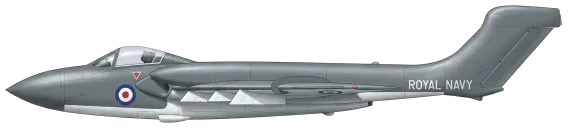
803 Naval Air Squadron began operational training at RNAS Lossiemouth in June 1958 and embarked on HMS Victorious that September. The type also flew from HMS Ark Royal, HMS Centaur and HMS Eagle, with units including 800, 803, 804 and 807 Naval Air Squadrons. Although it could operate as a fighter, the interceptor role was covered by the de Havilland Sea Venom and then the DH.110 Sea Vixen.
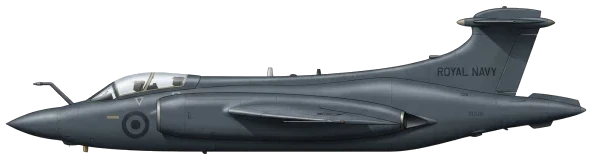
When the Blackburn Buccaneer replaced the Scimitar, the older type was retained as a tanker. Buccaneer S.1s launched with reduced fuel and refuelled from a Scimitar immediately after take-off. From 1965 to 1970, the Airwork-managed Fleet Requirements Unit flew 16 Scimitars from Bournemouth (Hurn).
The 39 aircraft lost in accidents represented 51% of production. On 25 September 1958, an arrestor wire broke as the commanding officer of 803 Naval Air Squadron landed aboard HMS Victorious; his aircraft (XD240) fell into the sea and he drowned. On 19 November 1958, a pilot died after ejecting from XD247 over the Black Isle when his parachute failed to open fully. Scimitar XD317 survives at the Fleet Air Arm Museum, Yeovilton, and XD220 at the Empire State Aerosciences Museum, New York.
Variants
- Type 508: Straight-wing, V-tailed research prototype that first flew in 1951.
- Type 529: Straight-wing research aircraft with cannon armament and an enlarged tailcone.
- Type 525: Swept-wing research aircraft with conventional swept tail surfaces and blown flaps.
- Type 544: Prototype for the production aircraft, with three built at Hursley Park.
- Scimitar F.1: Single-seat production aircraft, with 76 built by Vickers-Armstrong at South Marston.
Frequently Asked Questions
What type of aircraft is the Supermarine Scimitar?
What is the maximum speed of the Supermarine Scimitar?
What is the range of the Supermarine Scimitar?
When did the Supermarine Scimitar first fly?
How many Supermarine Scimitar have been built?
Which countries operate the Supermarine Scimitar?
What is the service ceiling of the Supermarine Scimitar?
- OCT 12026 Created Page created: Supermarine Scimitar