F-16I Sufa
Israeli two-seat multirole strike fighter, developed in the early 2000s and extensively used in regional air campaigns. Key figures: top speed 2,178 km/h, range 4,220 km, service ceiling 15,240 m, max takeoff weight 23,582 kg, unit price $45M, built 102. In service with 1 air force as of 2026 — Israel (100).
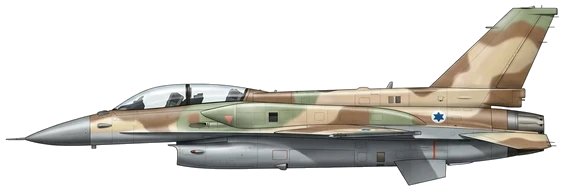
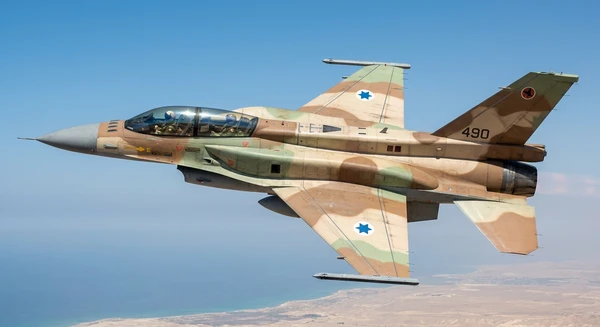
| Crew | 2 (pilot, navigator) |
| Length | 15.1 m (49.4 ft) |
| Wingspan | 10.0 m (32.7 ft) |
| Height | 4.9 m (16.0 ft) |
| Wing area | 27.9 m² (300.0 sqft) |
| Max. takeoff weight | 23,582 kg (51,989 lbs) |
| Powerplant | 1 × turbofan Pratt & Whitney F100-PW-229 13,227 kgf each |
| Maximum speed | 2178 km/h (Mach 2.1) |
| Operational range | 4,220 km (2,622 mi) |
| Service ceiling | 15,240 m (50,000 ft) |

- Air-to-Air Short-Range Rafael Python 4
- Air-to-Air Short-Range Rafael Python 5
- Air-to-Air Short-Range AIM-9 Sidewinder
- Air-to-Air Medium-Range Rafael Derby
- Air-to-Air Medium-Range AIM-120 AMRAAM
- Air-to-Surface Rafael Popeye (AGM-142 Have Nap)
- Air-to-Surface IMI Delilah
- Air-to-Surface IAI Rampage
- Air-to-Ground AGM-65 Maverick
- Anti-Radiation AGM-88 HARM
- Guided Bomb GBU-31 JDAM
- Guided Bomb GBU-39 Small Diameter Bomb
- Guided Bomb GBU-12 Paveway II
- Guided Bomb Rafael Spice 1000
- Guided Bomb Rafael Spice 2000
- Unguided Bomb Mk 82
- Unguided Bomb Mk 84
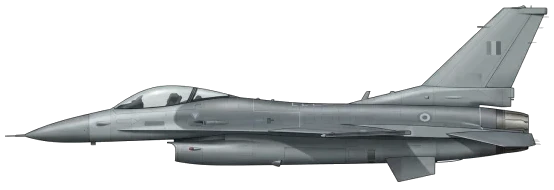
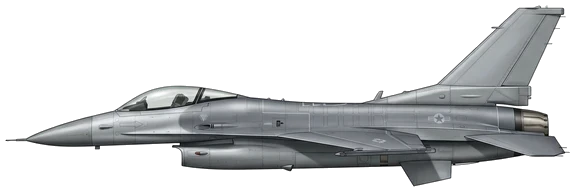
Description
The F-16I Sufa (Storm) is a two-seat multirole fighter developed by Lockheed Martin for the Israeli Air Force, derived from the F-16D Block 52 and optimised for long-range strike. It first flew on 23 December 2003 and entered service in 2004. All 102 aircraft built were delivered to Israel, which remains the sole operator; the type is identifiable by its conformal fuel tanks and enlarged dorsal avionics spine.
Development
Israel issued a requirement in September 1997 and selected the F-16 over the F-15I in July 1999. The "Peace Marble V" contract for 50 aircraft was signed on 14 January 2000, followed by an option for 52 more exercised on 19 December 2001, bringing procurement to 102. Lockheed Martin's share of the 2001 option was USD 1.3 billion of a programme valued at approximately USD 2 billion, which included coproduction of airframe and avionics components in Israel. Unit cost at delivery was reported at about USD 45 million (2004). The first aircraft was rolled out at Fort Worth on 14 November 2003 and the first two landed at Ramon Air Base on 19 February 2004; deliveries ran at roughly two per month and finished in 2009. Only one variant was produced.
Design
Every F-16I is a two-seater, the rear cockpit occupied by a navigator managing sensors, electronic warfare and stand-off weapons. Removable conformal fuel tanks built by Israel Aerospace Industries add about 1,700 litres, increasing internal fuel by roughly 50 percent and range by up to 1,000 km while leaving underwing stations free. The dorsal spine running from the cockpit to the fin base provides about 850 litres of avionics volume. Approximately 50 percent of Block 52 avionics were replaced by Israeli systems: Elbit supplies the DASH IV helmet-mounted display, wide-angle HUD, mission and display processors, colour multifunction displays and digital map; Elisra supplies the electronic warfare suite, with an Israeli aerial towed decoy replacing the ALE-50. Retained American equipment includes the Northrop Grumman AN/APG-68(V)9 radar with synthetic aperture mode and the Pratt & Whitney F100-PW-229 engine, rated at 129.7 kN with afterburner and common with the F-15I fleet. Maximum take-off weight is 23,582 kg, using strengthened landing gear.
Armament
Armament comprises one 20 mm M61A1 cannon, nine hardpoints and two wingtip rails carrying up to 7,700 kg of stores. Air-to-air weapons include Rafael Python 4 and Python 5, Derby, AIM-9 Sidewinder and AIM-120 AMRAAM. Strike weapons include Rafael Popeye/AGM-142, IMI Delilah, IAI Rampage, AGM-65 Maverick, AGM-88 HARM, GBU-31 JDAM, GBU-39 SDB, GBU-12 Paveway II, Spice 1000 and 2000, and Mk 82/Mk 84 bombs. Targeting is via Rafael Litening and LANTIRN pods.
Operational History
The type equips 107 Squadron at Hatzerim and 119, 201 and 253 Squadrons at Ramon; 253 Squadron reformed on 27 July 2003. The fleet was grounded briefly on 20 March 2008 after formaldehyde was found in cockpits, and two aircraft have been lost, on 19 July 2006 and 10 November 2010. F-16Is flew strikes in the 2006 Lebanon War, successive Gaza campaigns, and operations over Syria, Yemen and Lebanon after October 2023. During Operation Rising Lion, opened 13 June 2025, they struck hardened targets including Natanz with GBU-39 bombs. Following retirement of the last F-16C Barak in July 2024, Jane's reported 97 F-16I in service.
Frequently Asked Questions
What type of aircraft is the F-16I Sufa?
What is the maximum speed of the F-16I Sufa?
What is the range of the F-16I Sufa?
When did the F-16I Sufa first fly?
How many F-16I Sufa have been built?
Which countries operate the F-16I Sufa?
How much does a F-16I Sufa cost?
What is the service ceiling of the F-16I Sufa?
- AUG 272026 Created F-16I Sufa page created (Israeli two-seat F-16 Block 52+ derivative: specs, description, operator, related aircraft, images)