F-16 Models, Blocks and Upgrades
How to read an F-16 designation, from the model letter and production block to the upgrade programs retrofitted later, what Block 70/72 and F-16V actually mean, and who flies what in 2026.
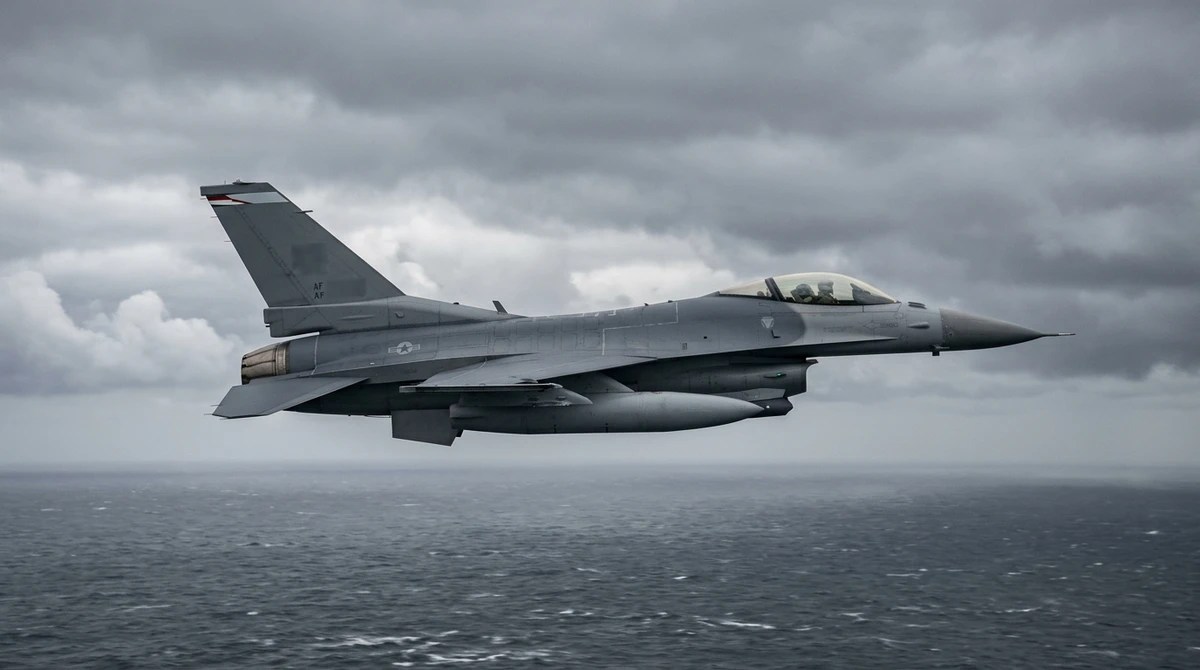
Taiwan's air force took delivery of its first two new-build F-16s on 2 October 2026, according to Focus Taiwan, which called them "F-16V Block 70". Lockheed Martin's own pages for the same aircraft say "Block 70" and never "F-16V". Poland's older jets are being upgraded "to the F-16V Block 72 standard", in The Aviationist's wording, yet they will remain Block 52+ airframes. Ukraine flies F-16AMs; Israel flies the F-16I. The F-16 Fighting Falcon has been in production since 1978.
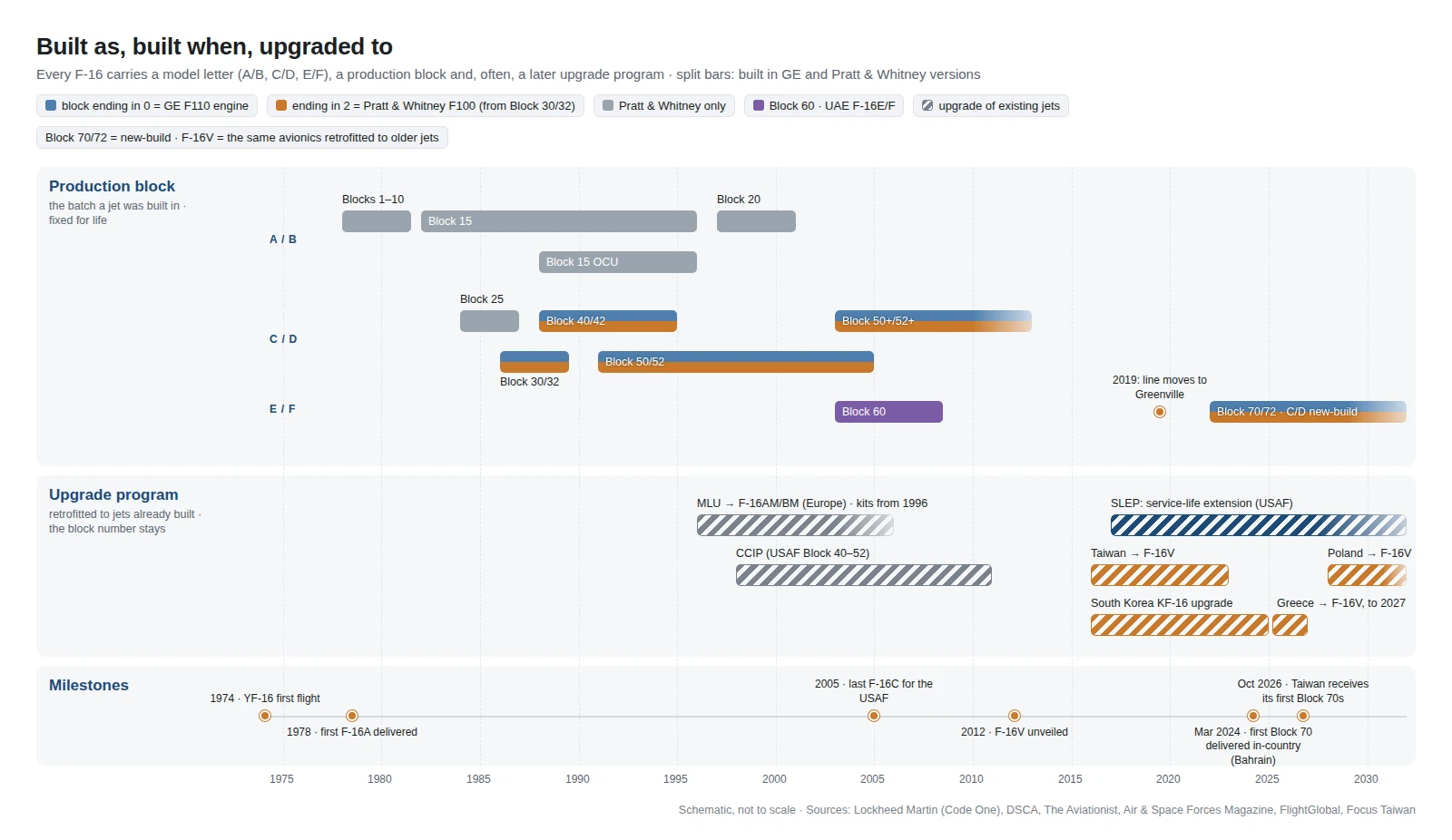
Where the Rafale carries two labels, a version and a standard, the F-16 carries three. The model letter says which airframe generation it is and how many seats it has. The block number says which production configuration it was built to, and it never changes. The upgrade program, when there is one, says what has been fitted since. The F-16V Viper name is applied both to new-build jets and to upgraded ones, which causes most of the confusion.
- Model letter: F-16A/B, C/D and E/F. The first letter of each pair is the single-seater, the second the two-seater. E/F exists only for the United Arab Emirates.
- Block: the configuration the jet left the factory in, from Block 1 to Block 70/72. From Block 30/32 on, a block ending in 0 has a General Electric engine and one ending in 2 a Pratt & Whitney engine, as Lockheed's Code One magazine explains.
- Upgrade programs: MLU (which produced the F-16AM/BM), CCIP, SLEP, PoBIT and the F-16V upgrade are kits retrofitted to existing jets. None of them changes the block.
- Block 70/72 versus F-16V: Block 70/72 is the new-build jet from Greenville, South Carolina; "F-16V" in the strict sense is an existing jet upgraded to the same avionics, though governments and outlets use the two labels loosely.
- Scale: Code One put the total built at more than 4,500 in 2014; Lockheed said in April 2026 that more than 2,800 are operating in 30 nations, and GMN's own count in August 2026 was 2,621 active aircraft with 27 air forces.
The models
The YF-16 prototype first flew on 2 February 1974. The production F-16A (single-seat) and F-16B (two-seat) followed; the first production F-16A was delivered in August 1978 to the 388th Tactical Fighter Wing at Hill Air Force Base. Belgium, Denmark, the Netherlands and Norway co-produced the A/B, and those European fleets are the ones now changing hands second-hand.
The F-16C/D arrived with Block 25 in 1984, bringing the APG-68 radar and a new cockpit. Blocks 25 through 52 and the new-build Block 70/72 are all C/D models; the US Air Force took its last new F-16C on 18 March 2005, according to The Aviationist. The export-only Block 50+/52+ added conformal fuel tank provisions, a dorsal spine on two-seaters and the APG-68(V)9 radar; Poland's first four arrived on 9 November 2006, from an order of 48.
The F-16E/F Block 60 has a single customer. The United Arab Emirates ordered 80 in early 2000 with an APG-80 active electronically scanned array (AESA) radar, conformal tanks and the 32,500 lb-thrust General Electric F110-GE-132; the first flight was on 6 December 2003, per Lockheed.
National suffixes mark customer-specific builds of a block, not new models. Israel's F-16I Sufa is a two-seat Block 52+ derivative with Israeli avionics, conformal tanks and the F100-PW-229; the first two landed at Ramon on 19 February 2004 and deliveries of the 102 aircraft ended in 2009. Iraq's F-16IQ is a Block 52 build and South Korea's KF-16 a license-built C/D. Indonesia's "Block 52ID" is not a production block but the name given to 24 ex-US Air Force Block 25s rebuilt before delivery in 2014–2017, per Air Force Materiel Command.
Several offers never became models: the F-16IN "Super Viper", eliminated when India shortlisted the Rafale and the Typhoon on 27 April 2011; the F-21, a Block 70 derivative for India unveiled on 20 February 2019; and the "F-16G" of September 2026, Lockheed's name for a proposed US Air Force variant rather than a US Air Force designation (see the last section).
| Seats | Blocks | Operators | Defining hardware | |
|---|---|---|---|---|
| F-16A / F-16B | 1 / 2 | 1, 5, 10, 15, 15 OCU, 20 | USAF, European co-producers, exports | APG-66, F100-PW-200 |
| F-16C / F-16D | 1 / 2 | 25, 30/32, 40/42, 50/52, 50+/52+, 70/72 | USAF and most export customers | APG-68APG-83 AESA on Block 70/72 |
| F-16E / F-16F | 1 / 2 | 60 | UAE only (80 built) | APG-80 AESA, F110-GE-132, conformal tanks |
| F-16I Sufa | 2 | 52+ derivative | Israel (102 built) | Israeli avionics, F100-PW-229, conformal tanks |
| F-16AM / F-16BM | 1 / 2 | 10 and 15 airframes | Belgium, Portugal; Romania, Ukraine, Argentina, Jordan second-hand | Not a new model: an A/B after the MLU retrofit |
The production blocks
A block is a production configuration. It is fixed at the factory and survives every later upgrade: a Polish jet modernized in the 2030s will still be a Block 52+. The blocks were introduced under the Multinational Staged Improvement Program.
The block number also identifies the engine. Blocks 1 through 25 had only the Pratt & Whitney F100. Block 30/32, born of the 1980s Alternative Fighter Engine competition, introduced a common engine bay and a choice of powerplant, and from then on, in Code One's words, "a major block designation ending in 0 signifies a General Electric engine; one ending in 2 signifies a Pratt & Whitney engine": GE means the F110 family, Pratt & Whitney the F100 family. The US export notifications bear this out: Taiwan's Block 70 package lists F110 engines, Morocco's Block 72 package F100-229s.
Two blocks cause most of the confusion. Block 15, produced from 1982 to 1996 with 983 aircraft, is the most numerous of all and the base for the MLU; its OCU sub-standard added the AIM-120 AMRAAM. Block 20 was a new-production A/B standard for Taiwan's 150 aircraft, and MLU retrofits are sometimes miscalled Block 20; Block 20 is a factory standard, the MLU a retrofit. On the C/D side the steps run from Block 30/32 (engine choice, AGM-88 HARM) to Block 50+/52+ (conformal tanks, dorsal spine), then to Block 70/72, the new-build Viper configuration rolled out at Greenville on 21 November 2022.
| Model | Production | What it added | |
|---|---|---|---|
| Block 1 / 5 / 10 | A/B | 1978–1981 | Initial standard; Blocks 1 and 5 raised to Block 10 under Pacer Loft (1982–1984) |
| Block 15 | A/B | 1982–1996 | Enlarged stabilators, two inlet hardpoints, APG-66(V)2983 built, the most numerous block; base for the MLU |
| Block 15 OCU | A/B | From 1988 | Wide-angle HUD, F100-PW-220, AMRAAM, Penguin and Maverick provisions |
| Block 20 | A/B | Taiwan only (150) | Modular mission computer, APG-66(V)3, Sparrow and AMRAAM, Harpoon, LANTIRNUpgraded to F-16V 2016–2023 |
| Block 25 | C/D | From 1984 | APG-68, wide-angle HUD, multifunction displays244 built |
| Block 30 / 32 | C/D | 1987–1989 | GE or P&W engine choice, AMRAAM, HARM, enlarged inlet from Block 30D733 built |
| Block 40 / 42 | C/D | 1988–1995 | LANTIRN night attack, GPS, strengthened landing gear ("Night Falcon") |
| Block 50 / 52 | C/D | 1990s; last USAF F-16C delivered 18 Mar 2005 | F110-GE-129 / F100-PW-229, HARM targeting system, ALE-47 dispensersMore than 800 by 2014 |
| Block 50+ / 52+ | C/D | 2000s, export only | Conformal fuel tanks, dorsal spine (two-seaters), APG-68(V)9, JHMCSGreece's "52+ Advanced" added Link 16 |
| Block 60 | E/F | First flight 6 Dec 2003 | APG-80 AESA, internal FLIR targeting, F110-GE-132, new EW suiteUAE only, 80 built |
| Block 70 / 72 | C/D | Rollout 21 Nov 2022, Greenville | APG-83 AESA, Center Pedestal Display, Viper Shield EW, Auto-GCAS, 12,000-hour airframe |
Upgrade programs applied to existing jets
The upgrade program is the label that changes during an aircraft's life: since the 1990s, capability growth has come from retrofit kits, each with its own name, and none of them alters the airframe's block.
MLU, CCIP and SLEP
The Mid-Life Update (MLU) brought the Belgian, Danish, Dutch and Norwegian Block 10 and 15 A/Bs, about 300 aircraft per Code One, to a cockpit and avionics standard equivalent to Block 50/52; Portugal joined later. An MLU jet is redesignated F-16AM (single-seat) or F-16BM (two-seat), and these are the aircraft now flowing to Romania, Ukraine and Argentina.
The Common Configuration Implementation Program (CCIP) did the equivalent for the US Air Force's Block 40/42 and 50/52 fleet between 1997–98 and 2011, more than 620 aircraft per Code One. The Service Life Extension Program (SLEP), authorized in April 2017 for 300 Block 40 and 52 aircraft, takes the airframe from 8,000 to 12,000 flight hours and, per Air & Space Forces Magazine, keeps them in service beyond 2048. Avionics kits add no structural life; SLEP does.
PoBIT and IVEWS
The US Air Force's current avionics modernization is the Post Block Integration Team (PoBIT) package, announced in March 2022 for 608 Block 40/42/50/52 aircraft at roughly $6.3 billion, 22 modifications per jet led by the Northrop Grumman APG-83 AESA radar, per The War Zone; the first modified aircraft reached the 8th Fighter Wing at Kunsan on 4 April 2023, Shephard reported. The US Air Force does not use the F-16V label for these jets; the "F-16C/V" seen in some inventories is shorthand, not an official designation.
Electronic warfare is moving inside the airframe. Northrop Grumman's AN/ALQ-257 IVEWS replaces the ALQ-131 and ALQ-184 centerline pods on US Air Force F-16s; flight testing began in September 2024 and production is expected in 2026 with a first tranche of 72 Block 50s, per Air & Space Forces Magazine. Export Block 70/72 aircraft carry a different system, the L3Harris AN/ALQ-254(V)1 Viper Shield; neither is EPAWSS, the F-15E and F-15EX suite.
The F-16V upgrades
Lockheed first showed the F-16V configuration in 2012 as a package that could be built into new aircraft or retrofitted to existing ones: the APG-83 AESA radar, a new mission computer and avionics architecture, and a new cockpit. The retrofit customers so far:
- Taiwan: the "Phoenix Rising" program rebuilt 141 F-16A/B Block 20s between 2016 and late December 2023 for about $4.5 billion, mostly by AIDC in Taiwan; the first operational wing stood up at Chiayi in November 2021, per The War Zone.
- South Korea: Lockheed won a $1.2 billion, nine-year contract in November 2016 to fit 134 KF-16C/Ds with the APG-83 and a Raytheon MMC 7000AH mission computer.
- Greece: Hellenic Aerospace Industry is converting 84 Block 52+ and 52+ Advanced aircraft in-country; the 42nd was delivered on 23 September 2025, the halfway point, per HAI, and the 60th on 16 September 2026, Greek City Times reported; completion is targeted around 2027.
- Poland: all 48 Block 52+ aircraft, under a $3.8 billion deal signed on 13 August 2025, with work at WZL-2 in Bydgoszcz from 2028 to 2038 covering the APG-83, a new mission computer, Viper Shield or IVEWS, and the AGM-158 JASSM. The Aviationist described this as an upgrade "to the F-16V Block 72 standard"; the airframes remain Block 52+.
- Singapore: the 60 Block 52/52+ aircraft receive the APG-83 and Link 16; upgraded jets were shown firing the Python-5 in September 2023, Defense News reported.
- Morocco: US approval in March 2019 to bring 23 Block 52+ aircraft to what DefenceWeb described as the "F-16V Block 70/72 standard", alongside 24 new Block 72s ordered in August 2020.
- Türkiye: the exception. In November 2024 Ankara dropped the 79 US Block 70 upgrade kits it had been approved for, in favor of in-country modernization of its Block 30/40/50 fleet by TUSAŞ under the Özgür program, FlightGlobal reported.
| Aircraft | Dates | Content | Changes the block? | |
|---|---|---|---|---|
| MLU | About 300 Belgian, Danish, Dutch and Norwegian Block 10/15; Portugal later | 1990s | Block 50/52-equivalent cockpit and avionics; jets redesignated F-16AM/BM | No |
| CCIP | 620+ USAF Block 40/42/50/52 | 1997–2011 | Common mission computer, color displays, Link 16, JHMCS, Sniper | No |
| SLEP | 300 USAF Block 40/52 | Authorized Apr 2017 | Airframe life 8,000 to 12,000 hours | No |
| PoBIT | 608 USAF Block 40/42/50/52 | Announced Mar 2022; first jet Apr 2023 | APG-83, center display, new mission computer, Link 16, new EW | No |
| IVEWS (ALQ-257) | USAF; first 72 Block 50s | Flight test from Sep 2024; production expected 2026 | Internal EW suite replacing centerline pods | No |
| F-16V upgrade | Taiwan 141 A/B Block 20; South Korea 134 KF-16; Greece 84; Poland 48; Singapore 60; Morocco 23 | 2016 onward; Poland 2028–2038 | APG-83 AESA, new mission computer, new cockpit; weapons vary by customer | No; a "Block 72 standard" is avionics parity, not a Block 72 airframe |
| Block 70/72 | New-build only | Rollout Nov 2022 | Same avionics plus 12,000-hour structure, Viper Shield, conformal tanks | Not an upgrade |
Block 70/72 versus the F-16V upgrade
Block 70 and Block 72 are new aircraft, built at Lockheed's Greenville, South Carolina plant since production moved there from Fort Worth in 2019. They carry the F-16V avionics plus what only a new airframe offers: a 12,000-hour structural life, about 50 percent more than earlier F-16s per Lockheed, the Viper Shield electronic warfare suite and conformal fuel tanks. An "F-16V" in the strict sense is an existing jet upgraded to the same avionics, as The Aviationist puts it: "Block 70/72 are the most advanced production Vipers, which are newly built as opposed to the F-16V which are existing aircraft upgraded to the same configuration."
Usage varies. Taiwan's defense ministry and Focus Taiwan call the new jets "F-16V Block 70"; Lockheed's Block 70 pages say only "Block 70"; the Greek, Polish, Korean and Moroccan programs are reported as upgrades to a "Block 72" or "Block 70/72" standard. The reading that survives all of these: a new-build is a Block 70 or 72, an upgraded Polish or Greek jet is a Block 52+ carrying Viper avionics, and only a new airframe or a separate structural program gives it the Block 70/72 service life. GMN's pages split the type the same way, legacy models on the F-16 Fighting Falcon page and Viper-configured aircraft on the F-16V Viper page, with a side-by-side comparison of the two.
Deliveries so far
The first Block 70 rolled out on 21 November 2022 for Bahrain, the launch customer, per Air & Space Forces Magazine. Bahrain's first three landed at Isa Air Base on 8 March 2024, and on 1 April 2026 Bahraini Block 70s claimed the type's first air-to-air kills, two drones downed with an AMRAAM and an AIM-9X, The War Zone reported. Slovakia's 14 completed production in December 2025 and the last was handed over in April 2026. Bulgaria's 16 were ordered in two tranches of eight; the first was delivered in February 2025, and the second tranche has slipped to the second quarter of 2030, according to a Lockheed notice to the Bulgarian defense ministry reported by The Defense Post in August 2026.
Taiwan's 66 Block 70s were originally due between 2023 and 2026; Taiwan's defense ministry attributed the delay to the relocation and restart of the production line and to supply-chain disruptions, Focus Taiwan reported, and FlightGlobal had reported in October 2025 that deliveries would slip into 2027. The first two landed at Chihhang Air Base in Taitung on 2 October 2026, about a month later than expected, according to Focus Taiwan.
Lockheed reported 119 Block 70/72 in backlog and 41 delivered on its second-quarter 2026 earnings call, up from 117 and 23 in February 2025, Defence Industry Europe reported. On the same call Lockheed said deliveries had stopped and then resumed in the quarter after "a new variant that we had a flight test this year didn't quite meet our expectations", requiring a redesign and a repeat flight test; the company did not name the variant.
Still in the order book: Morocco's 24 Block 72 (contract August 2020); Jordan's 12 Block 70 (ordered January 2023, first deliveries expected in 2027, per Breaking Defense); and Peru's 12 Block 70, signed on 20 April 2026 after Lima reversed a 2025 preference for the Gripen, with deliveries planned for 2029–2030, per The Aviationist, which also reported political turmoil in Peru after the signing (GMN logged the order on Lockheed's 23 April announcement). The Philippines received US approval in April 2025 for a Block 70/72 purchase but had signed no contract as of 2 October 2026. Türkiye signed a letter of offer and acceptance for 40 new Block 70s in 2024, per Janes, and Turkish Minute reported in November 2025 that pricing talks were continuing; no delivery schedule has been published.
Who flies which version
Three groups: legacy operators modernizing C/D fleets in place, Block 70/72 customers, and the second-hand MLU market.
| Models and blocks | Status | |
|---|---|---|
| United States | C/D Block 25 to 52; Navy adversary A/B | PoBIT on 608 Block 40/42/50/52; SLEP on Block 40/52; IVEWS from 2026 |
| Taiwan | A/B Block 20; 66 Block 70 on order | 141 A/Bs upgraded to F-16V (2016–2023); first two Block 70s arrived 2 Oct 2026 |
| Greece | C/D Block 30, 50, 52+, 52+ Advanced | 84 being upgraded to F-16V by HAI; 60 delivered by Sep 2026 |
| South Korea | KF-16C/D (license-built), Block 32 | 134 KF-16s contracted for the APG-83 (2016) |
| Türkiye | C/D Block 30, 40, 50, 50+ | In-country Özgür modernization; 40 Block 70 under a 2024 LOA |
| Israel | F-16I Sufa (102); C/D | F-16I deliveries completed 2009 |
| Poland | 48 C/D Block 52+ | F-16V upgrade at Bydgoszcz 2028–2038 |
| United Arab Emirates | 80 E/F Block 60 | Sole E/F operator |
| Singapore | 60 C/D Block 52/52+ | APG-83, Link 16, JHMCS fitted |
| Morocco | 23 C/D Block 52+; 24 Block 72 on order | Block 52+ upgrade approved Mar 2019; Block 72 contract Aug 2020 |
| Iraq | F-16IQ (Block 52) | National variant of the Block 52 |
| Bahrain | C/D Block 40; 16 Block 70 | Block 70 launch customer; first in-country 8 Mar 2024 |
| Slovakia | 14 Block 70 (12 C, 2 D) | All handed over by Apr 2026 |
| Bulgaria | 16 Block 70 in two tranches | First tranche delivering since Feb 2025; second to Q2 2030 per Lockheed's notice |
| Jordan | MLU A/B; 12 Block 70 on order | Block 70 deliveries expected from 2027 |
| Peru | 12 Block 70 on order (10 C, 2 D) | Signed 20 Apr 2026; deliveries 2029–2030 |
| Romania | AM/BM: 17 ex-Portuguese, 32 ex-Norwegian, 18 ex-Dutch for the training center | MLU configuration |
| Ukraine | AM/BM, ex-Dutch, ex-Danish and ex-Norwegian; Belgian jets pledged | About 39 in service, 5 lost, per The Aviationist (30 Sep 2026) |
| Argentina | 24 ex-Danish AM/BM | 12 delivered (Dec 2025 and Sep 2026) |
| Belgium, Portugal | AM/BM | Belgium transitioning to the F-35A; Portugal choosing a replacement |
| Indonesia | A/B; 24 "Block 52ID" (rebuilt ex-USAF Block 25) | Block 52ID delivered 2014–2017 |
The retired European fleets are the second-hand supply. The Netherlands retired its last F-16s on 27 September 2024, FlightGlobal reported; Norway flew its last F-16 mission on 6 January 2022, replacing 57 AM/BMs with the F-35A; Denmark decommissioned its fleet on 18 January 2026. The Netherlands completed its 24-aircraft transfer to Ukraine on 26 May 2025, Belgium is to send the first three of 30 pledged aircraft by the end of 2026, per The Aviationist, and a first Ukrainian F-16 air-to-air kill of a Russian fighter was confirmed in US testimony in July 2026. Argentina signed for 24 ex-Danish aircraft on 16 April 2024; six arrived on 5 December 2025 and six more on 29 September 2026. Portugal's MLU fleet is the subject of a replacement contest. Egypt, Pakistan, Chile, Oman, Thailand and Venezuela also operate the type.
What comes next
For the new-build line, the issue is the delivery rate. Lockheed told investors that deliveries had resumed in the second quarter of 2026 and that output would rise this year, per Defence Industry Europe's account of the call, with Taiwan, Bulgaria, Morocco, Jordan and Peru in the queue.
For the US Air Force, the open question is whether it buys new F-16s for the first time since 2005. The Aviationist reported on 17 September 2026 that the service is considering new-build F-16s, put the fighter inventory at 1,098 aircraft in May 2026 against a requirement of 1,145, and described Lockheed's pitch, reported as the "F-16G", a company name rather than a US Air Force designation, as a Block 70 with conformal tanks, an infrared search and track sensor and a drag chute. The US Air Force said it had "neither defined the precise mission requirements nor the spectrum of options".
For the upgrade customers, the calendar is set: Greece aims to finish its 84 conversions around 2027, Poland's run at Bydgoszcz lasts from 2028 to 2038, and Jordan expects its first Block 70s in 2027. The MLU jets will keep changing hands as their donors move to the F-35A, whose own variants and blocks follow a different grammar.