T-33 Shooting Star
American subsonic jet trainer, developed in the late 1940s, extensively used for advanced pilot training and light combat operations worldwide. Key figures: top speed 970 km/h, range 2,052 km, service ceiling 15,000 m, max takeoff weight 6,832 kg, built 6,557.
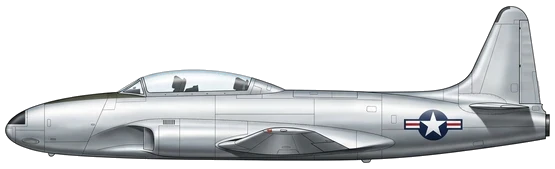
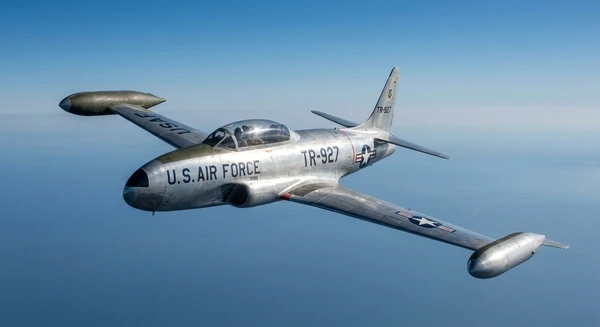
| Crew | 2 |
| Length | 11.5 m (37.8 ft) |
| Wingspan | 11.8 m (38.9 ft) |
| Height | 3.6 m (11.7 ft) |
| Wing area | 21.8 m² (234.8 sqft) |
| Empty weight | 3,794 kg (8,364 lbs) |
| Max. takeoff weight | 6,832 kg (15,062 lbs) |
| Powerplant | 1 × Allison J33-A-35 centrifugal flow turbojet 2,086 kgf each |
| Maximum speed | 970 km/h (603 mph) |
| Operational range | 2,052 km (1,275 mi) |
| Service ceiling | 15,000 m (49,213 ft) |
| Climb rate | 24.7 m/s (81.0 ft/s) |
- Unguided Bomb bombs
- Rocket Pod rockets
Description
The Lockheed T-33 Shooting Star is a subsonic jet trainer derived from the P-80/F-80 fighter. Developed to address high accident rates during early jet operations, the design involved extending a P-80C airframe by 38.5 inches to accommodate a second seat with dual controls under a lengthened clamshell canopy. The prototype, initially designated TP-80C, conducted its maiden flight on March 22, 1948. Lockheed produced 5,691 units between 1948 and 1959. Licensed production added 656 aircraft by Canadair as the Silver Star and 210 by Kawasaki, resulting in a total production of 6,557 aircraft.
Design
The aircraft is powered by an Allison J33-A-35 centrifugal-flow turbojet engine. Due to the engine design, throttle advancement at low airspeeds is performed slowly to manage exhaust gas temperatures. The cockpit features a three-panel windshield with a bulletproof center and is pressurized to a differential of 3.5 psi above 8,000 feet. Flight controls include hydraulically boosted ailerons, while the rudder and elevators are not boosted. To avoid high-altitude compressibility effects, the aircraft is typically limited to speeds below Mach 0.8. Fuel is distributed across wing, leading-edge, and fuselage tanks, with additional fuel carried in automatically balanced tip tanks. For deceleration, the T-33 utilizes two hydraulically actuated speed brakes located on the belly.
Armament
Most T-33s were delivered unarmed, though some were fitted with two machine guns for gunnery training. The AT-33A export variant includes two underwing hardpoints with a total capacity of 2,000 lb for bombs or rockets. During the 1961 Bay of Pigs Invasion, the Cuban Air Force used rocket-armed T-33s to engage B-26 bombers and ground forces. The Indonesian Air Force rearmed its T-33A fleet with machine guns, Il-28 bomber gunsights, and B-25 bomb racks for counter-insurgency strikes in 1976.
Operational History
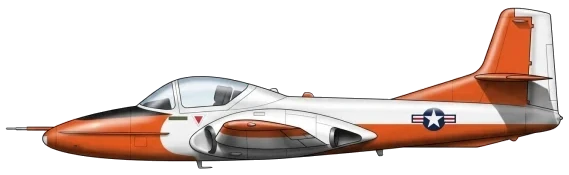
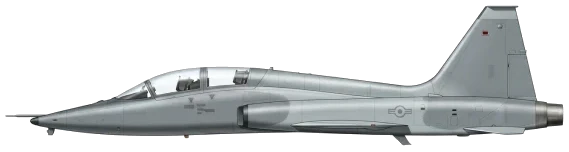
The T-33 served as the primary USAF trainer for two decades before the introduction of the Cessna T-37 and Northrop T-38. The United States Navy operated the type as the TV-2 (later T-33B) for land-based training and as a target drone director. Approximately 25 countries operated the type, including Brazil, Turkey, and Thailand. The RT-33A reconnaissance version, featuring a nose-mounted camera, was used for overflights of South Vietnam and Laos. The Bolivian Air Force was the final military operator, retiring the type in 2017. Boeing utilized the T-33 as a chase aircraft for flight testing until December 2020.
Variants
- T-33A: The primary two-seat production trainer for the United States Air Force and export customers.
- AT-33A: A close support and fighter lead-in version equipped with underwing pylons for munitions.
- RT-33A: A reconnaissance variant modified with a nose-mounted camera system and specialized rear cockpit equipment.
- TV-2 / T-33B: The designation for land-based training aircraft operated by the United States Navy and Marine Corps.
- T-33AN / CT-133 Silver Star: A variant produced under licence by Canadair for the Royal Canadian Air Force, powered by a Rolls-Royce Nene engine.
Frequently Asked Questions
What type of aircraft is the T-33 Shooting Star?
What is the maximum speed of the T-33 Shooting Star?
What is the range of the T-33 Shooting Star?
When did the T-33 Shooting Star first fly?
How many T-33 Shooting Star have been built?
Which countries operate the T-33 Shooting Star?
What is the service ceiling of the T-33 Shooting Star?
- MAY 102026 Created Page created: T-33 Shooting Star