Gulfstream II
American business jet, operational from 1960s to present, widely used for executive transport and various military applications worldwide. Key figures: top speed 935 km/h, range 7,352 km, service ceiling 13,716 m, max takeoff weight 29,710 kg, unit price $1M, built 256. In service with 3 air forces as of 2026 — Dominican Republic (1), Ecuador (1), Morocco (1).
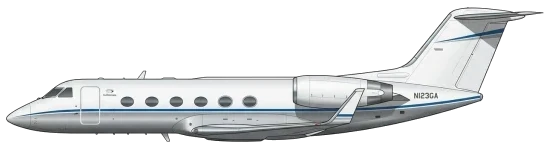
| Length | 24.1 m (79.1 ft) |
| Wingspan | 20.8 m (68.1 ft) |
| Height | 7.5 m (24.6 ft) |
| Wing area | 75.2 m² (809.6 sqft) |
| Empty weight | 16,576 kg (36,544 lbs) |
| Max. takeoff weight | 29,710 kg (65,499 lbs) |
| Powerplant | 2 × turbofans Rolls-Royce RB163 Spey Mk 511-8 5,171 kgf each |
| Maximum speed | 935 km/h (581 mph) |
| Operational range | 7,352 km (4,568 mi) |
| Service ceiling | 13,716 m (45,000 ft) |
| Climb rate | 19.3 m/s (63.3 ft/s) |



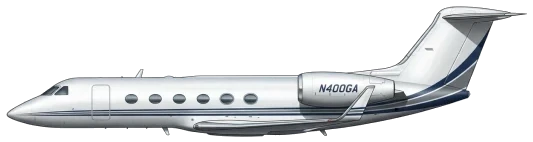
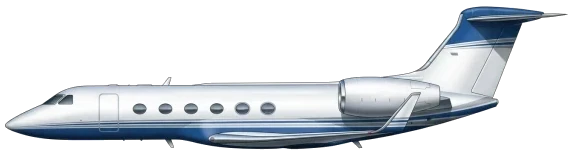
Description
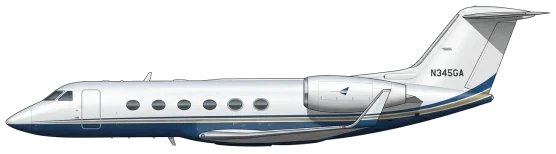
The Gulfstream II (G-1159) is an American twin-engine business jet designed and first built by Grumman, then by Grumman American and finally by Gulfstream American. It was the jet successor to the turboprop Gulfstream I and was in turn succeeded by the Gulfstream III. Powered by two aft-mounted Rolls-Royce Spey turbofans, it was produced from 1966 to 1979, with 256 aircraft built. Beyond corporate use, it served with the US Coast Guard, the US Army, NASA and the Missile Defense Agency, as well as with several air forces.
Development
By 1965 Grumman had delivered more than 150 turboprop Gulfstream Is, but the type faced competition from a new generation of business jets: the Lockheed JetStar, the Hawker Siddeley HS.125, the Dassault Falcon 20 and the North American Sabreliner. None of these could match the Gulfstream I's range and cabin comfort, but customers wanted a jet. The availability of the Rolls-Royce Spey turbofan made such an aircraft feasible, and with 30 firm orders in hand, production was given the go-ahead on 5 May 1965.
The first prototype flew from Bethpage, New York, on 2 October 1966, in a flight lasting 52 minutes. Four aircraft took part in the certification programme, and the FAA issued a type certificate on 19 October 1967, to public transport standards. Aircraft were built "green" and finished at completion centres. A new plant at Savannah, Georgia opened in 1967 and the first Savannah-built aircraft flew in December that year; Bethpage had built 40. Tip tanks were certified in March 1976 and became standard from aircraft no. 183. Production ended in December 1979 after 256 aircraft. Between 1981 and 1987, 43 aircraft were converted to Gulfstream IIB standard with Gulfstream III wings and avionics.
Design
The Gulfstream II has a swept wing and two aft-mounted Rolls-Royce Spey 511-8 turbofans, each rated at 51 kN (11,400 lbf). The wing uses airfoils similar to those of the Grumman A-6 Intruder. Vortex generators on the outer wing give a buffet boundary matching the aircraft's Mach 0.85 capability, and a single-slotted Fowler flap of 30% chord is fitted. An upper-surface fence at midspan produces a strong nose-down pitch at the stall, and a stick shaker and stick pusher limit stall penetration.
The Gulfstream IIB is flown by a crew of two and carries up to 19 passengers. It is 24.36 m long, with a span of 23.72 m and a height of 7.47 m. Maximum take-off weight is 30,935 kg (68,200 lb), with 12,837 kg of fuel. Maximum speed is Mach 0.85 and economical cruise Mach 0.77; range is 6,570 km (3,550 nmi) with eight passengers and IFR reserves. Service ceiling is 13,700 m (45,000 ft), rate of climb 19 m/s and take-off run 1,783 m.
An FAA rule effective 31 December 2015 bars jets of 34,000 kg or less that do not meet Stage 3 noise standards from operating in the 48 contiguous US states unless re-engined or hushkitted; the Gulfstream II is named explicitly in the rule.
Military and government service
In the United States the Gulfstream II served with the Coast Guard, which operated one VC-11A with upgraded communications and inertial navigation, and with the US Army, including one aircraft for the Army Corps of Engineers. NASA used four modified aircraft as Shuttle Training Aircraft, reproducing the Space Shuttle cockpit and flight characteristics so that crews could practise approaches. One of these had earlier flown, from March 1987, as the Propfan Test Assessment aircraft, with an Allison 570 turboprop driving a 2.7 m (9 ft) Hamilton Standard SR-7 propfan on the left wing.
The Missile Defense Agency used modified Gulfstream IIs as HALO sensor aircraft (HALO1 to HALO4); HALO3 served as a target for the YAL-1 Airborne Laser testbed. A Gulfstream II SP was Northrop Grumman's demonstrator in the US Navy BAMS competition.
Other military operators have included the air forces of Chad, the Dominican Republic, Ecuador, Gabon, Libya, Morocco, Nigeria, Oman, Panama and Venezuela; the Dominican Republic and Ecuador still list one aircraft each. On 3 May 1982 an Algerian government Gulfstream II was shot down by a fighter near the Iraq–Iran–Turkey border area, killing all 15 aboard, including Algeria's foreign minister.
Variants
- Gulfstream II (G-1159): initial production version.
- Gulfstream II TT: version with tip tanks, certified 13 May 1977.
- Gulfstream IIB (G-1159B): conversion with the Gulfstream III wing with winglets and instruments, certified 17 September 1981; 43 converted between 1981 and 1987.
- Gulfstream II SP: aircraft fitted with Aviation Partners winglets, from 1994.
- VC-11A: US Coast Guard designation for its single aircraft.
Frequently Asked Questions
What type of aircraft is the Gulfstream II?
What is the maximum speed of the Gulfstream II?
What is the range of the Gulfstream II?
When did the Gulfstream II first fly?
How many Gulfstream II have been built?
Which countries operate the Gulfstream II?
How much does a Gulfstream II cost?
What is the service ceiling of the Gulfstream II?
- OCT 52026 Updated Description rewritten: Grumman development, Spey design, VC-11A, NASA Shuttle Training Aircraft and military operators
- AUG 52026 Updated Climb rate added; powerplant updated
- APR 72026 Updated Sources and cross-references refreshed
- JAN 122026 Updated Gulfstream II: range added; Gulfstream II: price added