H-5
Chinese-built version of the Soviet Ilyushin Il-28, the H-5 was the PLA's standard tactical jet bomber from 1967 and remains in service only with North Korea. Key figures: top speed 902 km/h, range 2,400 km, service ceiling 12,500 m, max takeoff weight 21,200 kg, built 507.
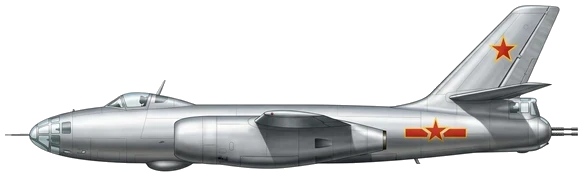
| Crew | 3 (pilot, navigator, gunner) |
| Length | 16.8 m (55.0 ft) |
| Wingspan | 21.5 m (70.4 ft) |
| Height | 6.2 m (20.3 ft) |
| Wing area | 60.8 m² (654.4 sqft) |
| Empty weight | 12,890 kg (28,418 lbs) |
| Max. takeoff weight | 21,200 kg (46,738 lbs) |
| Powerplant | 2 × turbojets Shenyang WP-5A 2,700 kgf each |
| Maximum speed | 902 km/h (560 mph) |
| Operational range | 2,400 km (1,491 mi) |
| Service ceiling | 12,500 m (41,011 ft) |
- Unguided Free-fall bombs
- Nuclear gravity bomb
- Guided Laser-guided bomb
Description
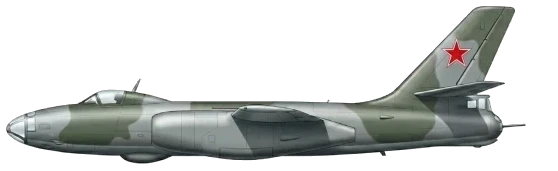
The Harbin H-5 is a three-seat tactical bomber manufactured in the People's Republic of China by the Harbin Aircraft Manufacturing Factory. It is an unlicensed Chinese derivative of the Soviet Ilyushin Il-28. The aircraft entered series production in April 1967 and operated primarily with the People's Liberation Army Air Force (PLAAF) and People's Liberation Army Naval Air Force (PLANAF).
Development
Development of the H-5 began in January 1963. The first Chinese-built aircraft made its maiden flight at Harbin on 25 September 1966, and series production commenced in April 1967. Production concluded in 1984 with 507 H-5s of all variants delivered, comprising 372 for the PLAAF, 92 for the PLANAF, and 41 for export. An additional 187 HJ-5 trainer variants were manufactured.
Design
The H-5 features a redesigned wing structure that abandons the horizontal manufacturing break of the original Soviet Il-28 design, saving 110 kg while increasing construction difficulty. It is powered by two Wopen-5A (WP-5A) centrifugal-flow turbojets, a Chinese development of the Klimov VK-1A, each providing 26.48 kN of thrust. The aircraft has a length of 16.77 meters, a wingspan of 21.45 meters, and a maximum takeoff weight of 21,200 kg. It reaches a maximum level speed of 902 km/h at 4,500 meters and has a service ceiling of 12,500 meters.
Armament
The H-5 carries a normal bomb load of 1,000 kg and a maximum load of 3,000 kg in an internal fuselage bomb bay. Forward armament consists of one fixed cannon in the nose. The tail turret, based on that of the Tupolev Tu-16, is equipped with two AM-23 cannons, providing a higher rate of fire than the weapons on the Soviet Il-28. Specialized variants were configured to carry torpedoes, laser-guided bombs, or nuclear weapons.
Operational History
The H-5 replaced the Soviet-built Il-28s that had flown China's early bomber missions in the First Taiwan Strait Crisis and the 1959 Tibetan uprising, and equipped PLAAF and naval bomber regiments from 1967 onwards. On 25 August 1985, an H-5 pilot defected by crash-landing in a South Korean rice field, resulting in the deaths of the navigator and a farmer. Pakistan operated 16 exported models designated B-56 from 1966 to 1969 before returning them to China for Shenyang F-6C fighters. Albania acquired a single H-5 in 1971, operating it until 1992, while Romania also received Chinese-built airframes. The PLAAF and PLANAF withdrew their H-5s from front-line service in the 1990s and completely retired the type by 2000. As of 2023, the North Korean Air Force remains the sole operator, maintaining a fleet of approximately 80 Il-28 and H-5 aircraft.
Variants
- H-5: Standard three-seat tactical bomber equipped with Wopen-5A engines and an H-6 derived tail turret.
- H-5A: Nuclear-capable variant that dropped a live nuclear bomb during a Chinese weapons test.
- HD-5: Electronic countermeasures and reconnaissance jamming aircraft.
- HJ-5: Trainer version with a similar layout to the Il-28U, with 187 units produced.
- HZ-5: Tactical reconnaissance aircraft finalized in 1977 and fitted with underwing drop tanks.
Frequently Asked Questions
What type of aircraft is the H-5?
What is the maximum speed of the H-5?
What is the range of the H-5?
When did the H-5 first fly?
How many H-5 have been built?
Which countries operate the H-5?
What is the service ceiling of the H-5?
- AUG 132026 Created H-5 page created: Chinese-built Il-28 derivative — specs, description, origin country, 5 operators, related aircraft, profile and photo