H-6
Chinese twin-engine jet heavy bomber, developed in the late 1950s, utilized for strategic bombing, maritime strikes, and nuclear deterrence. Key figures: top speed 1,050 km/h, range 6,000 km, service ceiling 12,800 m, max takeoff weight 95,000 kg, unit price $60M, built 231. In service with 1 air force as of 2026 — China (234).
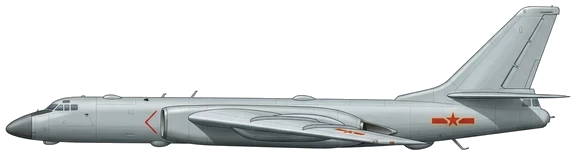
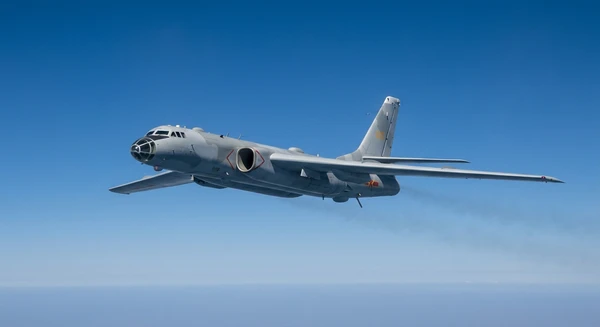
| Crew | 4 |
| Length | 34.8 m (114.2 ft) |
| Wingspan | 33 m (108.3 ft) |
| Height | 10.4 m (34.0 ft) |
| Wing area | 165 m² (1776.0 sqft) |
| Empty weight | 37,200 kg (82,012 lbs) |
| Max. takeoff weight | 95,000 kg (209,439 lbs) |
| Powerplant | 2 × Soloviev D-30KP-2 118 kN each |
| Maximum speed | 1050 km/h (652 mph) |
| Operational range | 6,000 km (3,728 mi) |
| Service ceiling | 12,800 m (41,995 ft) |

- Air-to-Surface YJ-63
- Cruise Missiles CJ-10
- Anti-Ship YJ-12
- Air-to-Surface CH-AS-X-13
- Air-to-Surface JL-1
- Anti-Ship YJ-21
- Anti-Ship C-601
- Cruise Missiles KD-20
- Cruise Missiles KD-63
- Unguided Free-fall bombs
- Guided GB6
- Guided CS/BBC5
- Guided GB2A
- Guided GB5
- Nuclear gravity bomb
Description
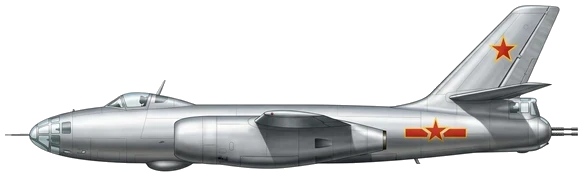
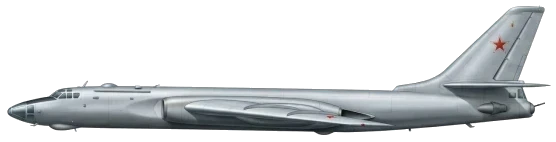
The Xi'an H-6 is a twin-engine jet heavy bomber built by the Xi'an Aircraft Industrial Corporation, a licence-built derivative of the Soviet Tupolev Tu-16. It remains the primary bomber of the People's Liberation Army Air Force and is also flown by the People's Liberation Army Naval Air Force. The type dropped nine of China's nuclear test devices at Lop Nur and, in H-6N form, is the only Chinese aircraft currently assigned nuclear weapons.
Development
The Soviet Union agreed to licence production of the Tu-16 in early 1956, with the agreement signed in September 1957. It transferred two complete aircraft, a semi-knocked-down kit, a complete knock-down kit, blanks and raw materials from Plant No. 22 in Kazan; Soviet technicians worked in China from 1959 to autumn 1960. Harbin Aircraft Factory assembled the first Chinese Tu-16 in 67 days between 28 June and 3 September 1959, and it first flew on 27 September, entering PLAAF hands in December. Production was concentrated at Xi'an from 1961, and the first fully domestically produced H-6 flew on 24 December 1968, crewed by Li Yuanyi and Xu Wenhong. The Cultural Revolution delayed the production system and caused a loss of schematics. By November 2020 the PLAAF held as many as 231 H-6s; about 120 remained in active service as of April 2025.
Design
The airframe is 34.8 m long with a 33 m span and a maximum take-off weight of 95,000 kg. Later variants use two Soloviev D-30KP-2 turbofans of 118 kN each, giving a maximum speed of 1,050 km/h, a 6,000 km range and a 12,800 m ceiling. The H-6K introduced composite structure, enlarged intakes, a glass cockpit with LCD multi-function displays, a solid nose radome replacing the glazed navigator's station, and an electro-optical targeting system under the nose. The H-6M adds terrain-following navigation; the H-6G, H-6H and H-6M delete the internal bomb bay and defensive armament. Crews number four: pilot, co-pilot, electronic warfare and communications officer, and navigator/bombardier.
Armament
Early aircraft carried six NR-23 23 mm cannon in dorsal, ventral and tail turrets, plus up to 12,000 kg of free-fall weapons. The H-6K has six underwing hardpoints for YJ-12 anti-ship cruise missiles, CJ-10A land-attack cruise missiles or YJ-63 missiles, with the tail gun position replaced by electronic equipment. The H-6N carries a single JL-1 air-launched ballistic missile (CH-AS-X-13) recessed in place of the bomb bay, and can also carry CJ-10K/KD-20 or KD-63 cruise missiles. Guided bombs include the GB6, GB2A, GB5 and CS/BBC5.
Operational History
PLAAF H-6s equip the 10th, 8th and 36th Air Divisions and the nuclear 106th and 23rd Air Brigades, based at Anqing, Luhe, Shaodong, Leiyang, Lintong, Wugong and Neixiang. JASDF fighters intercepted six H-6Ks over the Bashi Channel and Miyako Strait on 13 July 2017, and Japanese and Taiwanese F-16s intercepted two more on 25 May 2018. Joint patrols with Russian Tu-95MS bombers began in 2019, with ten flights by 2025. Iraq received four H-6D and fifty C-601 missiles in 1987, hitting fifteen tankers during the Tanker War; one was downed by an Iranian F-14 and the remaining three destroyed at Al Taqaddum in 1991. Egypt retired its H-6s in 2000.
Variants
- H-6A: First Chinese nuclear bomber, with heat-insulated bomb bay and test monitoring equipment; conducted the 14 May 1965 Lop Nur test.
- H-6D: Maritime-strike variant of the early 1980s carrying two C-601 missiles and a enlarged undernose radome.
- H-6K: Re-engined conventional bomber that first flew on 5 January 2007 and entered service in October 2009.
- H-6J: PLANAF maritime-strike derivative of the H-6K replacing the H-6G.
- H-6N: Nuclear variant with reshaped fuselage, nose refuelling probe and JL-1 ballistic missile, in service from about 2018.
Identified in 230 sorties in the official China-Taiwan Tensions activity reports between 2020 and 2023 — a floor, not a census: only sorties the source identified by type are counted, and how much it disclosed varies by year.
Frequently Asked Questions
What type of aircraft is the H-6?
What is the maximum speed of the H-6?
What is the range of the H-6?
When did the H-6 first fly?
How many H-6 have been built?
Which countries operate the H-6?
How much does a H-6 cost?
What is the service ceiling of the H-6?
- AUG 302026 Updated Description updated
- AUG 272026 Updated Unit price re-based (flyaway cost of the most-produced variant, then-year USD convention)
- JUN 262026 Updated Bombs and missiles updated
- MAY 102026 Created Page created: H-6