AV-8B Harrier II vs Harrier
AV-8B Harrier II vs Harrier at a glance — top speed 1,070 vs 1,183 km/h, range 3,300 vs 1,500 km, max takeoff weight 14,100 vs 11,500 kg, built 337 vs 380 units.
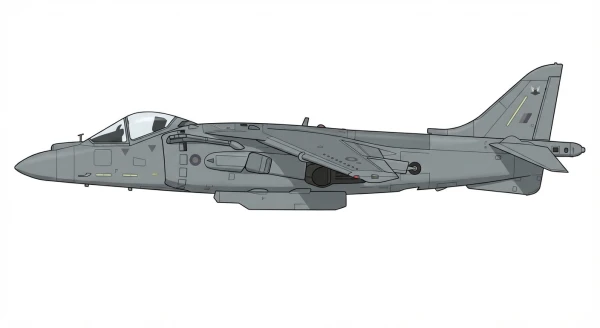
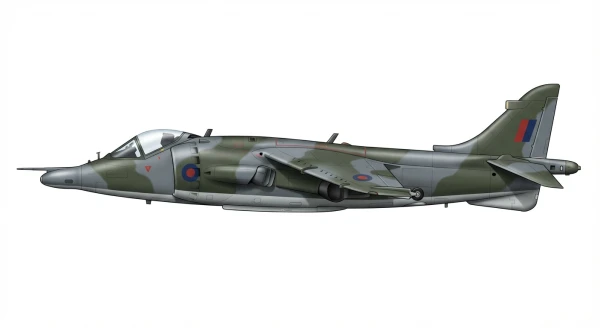
| AV-8B Harrier II | Harrier | |
|---|---|---|
| Origin country | 🇬🇧 United Kingdom🇺🇸 United States | 🇬🇧 United Kingdom |
| Category | Combat Aircraft | Combat Aircraft |
| Manufacturer | McDonnell Douglas | British Aerospace |
| First flight | 6 January 1971 | 28 December 1968 |
| Year introduced | 1983 | 1969 |
| Number produced | 337 units | 380 units |
| Average unit price | $26 million | $24 million |
| Wing area | 22.6 m² | 18.7 m² |
| Wingspan | 9.3 m | 7.7 m |
| Height | 3.6 m | 3.5 m |
| Length | 14.1 m | 13.9 m |
| Maximum speed | 1070 km/h | 1183 km/h |
| Operational range | 3,300 km | 1,500 km |
| Service ceiling | 15,240 m | 14,996 m |
| Max. takeoff weight | 14,100 kg | 11,500 kg |
| Empty weight | 6,340 kg | 5,530 kg |
| Total thrust | 1 x 10,500 kgf | 1 x 8,618 kgf |
Detailed Comparison
The McDonnell Douglas AV-8B Harrier II and the British Aerospace Harrier II emerged from the same 1970s requirement to correct the payload and range limitations of the first-generation Hawker Siddeley Harrier. While they share a core airframe and composite wing design, diverging national doctrines drove the two variants into distinct operational niches.
Development and Design
When the UK withdrew from the Pegasus 15 engine project in 1975 due to budget limits, McDonnell Douglas assumed primary development. The US design introduced a graphite epoxy composite wing with 14 percent more area, raising payload capacity by 3,035 kg over a 300-meter takeoff compared to the AV-8A.
The UK rejoined the program in 1982. British Aerospace tailored the GR.5/GR.7 series for low-level European interdiction. British-specific modifications included the ZEUS electronic countermeasures suite, stainless steel wing leading edges to withstand bird strikes at low altitudes, and an extra missile pylon forward of the outrigger gear. The structural divergence occurred with the AV-8B Harrier II Plus. McDonnell Douglas integrated the AN/APG-65 radar, giving the US Marine Corps a beyond-visual-range capability. The UK declined radar integration, keeping the GR series strictly focused on daytime and night attack.
Specifications and Performances
The integration of different powerplants dictates the performance gap between the fleets.
- The AV-8B uses the 10,500 kgf thrust Rolls-Royce F402-RR-408, yielding a 14,100 kg maximum takeoff weight.
- The UK GR series initially utilized the 8,618 kgf Pegasus 101, restricting MTOW to 11,500 kg.
While both airframes operate at high subsonic speeds near 1,070-1,180 km/h, the AV-8B achieves a 700 km range advantage (2,200 km versus 1,500 km) due to higher thrust-to-weight margins permitting heavier fuel loads. Weaponry also diverged; the UK mounted twin 25mm ADEN pods, while the USMC selected the single 25mm GAU-12 Equalizer.
Deployment and usage
USMC AV-8Bs flew directly from Tarawa- and Wasp-class amphibious assault ships during Operation Desert Storm in 1991, dropping unguided munitions. The platform later transitioned to precision strike roles in Iraq and Afghanistan using LITENING targeting pods and JDAMs.
The British Aerospace Harrier II initially deployed to RAF Germany for anti-armor interdiction. Under the Joint Force Harrier command, GR.7s and GR.9s operated from Invincible-class carriers and forward bases, executing close air support in Kosovo and Afghanistan (Operation Herrick). Facing acute budget pressures, the UK Ministry of Defence retired the entire Harrier II fleet in 2010. The USMC retained and upgraded the AV-8B to bridge the gap to the F-35B Lightning II.
Conclusion
The AV-8B Harrier II Plus holds a definitive tactical advantage in independent expeditionary operations. By integrating the APG-65 radar and AIM-120 AMRAAM, McDonnell Douglas transformed a dedicated ground-attack airframe into a self-escorting strike fighter. The British Aerospace Harrier II met the specific demands of NATO's low-level European environment, but the Ministry of Defence's refusal to integrate an air-to-air radar restricted the aircraft to permissive airspace or mandated dedicated fighter escort from Tornados or Typhoons.