J-20 Kraguj
Yugoslavian light attack aircraft, largely used in the Croatian War of Independence during the early 1990s. Key figures: top speed 295 km/h, range 800 km, service ceiling 8,000 m, max takeoff weight 1,624 kg, built 43.
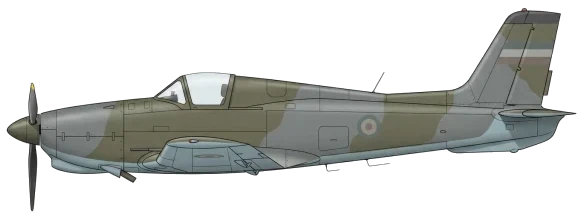
| Crew | 1 |
| Length | 7.9 m (26.0 ft) |
| Wingspan | 10.6 m (34.9 ft) |
| Height | 3 m (9.8 ft) |
| Wing area | 17 m² (183.0 sqft) |
| Empty weight | 1,130 kg (2,491 lbs) |
| Max. takeoff weight | 1,624 kg (3,580 lbs) |
| Powerplant | 1 × pistons engine Lycoming GSO-480-B1A6 254 kW each |
| Maximum speed | 295 km/h (183 mph) |
| Operational range | 800 km (497 mi) |
| Service ceiling | 8,000 m (26,247 ft) |
| Climb rate | 8.0 m/s (26.2 ft/s) |
Description
The Soko J-20 Kraguj (Serbian: крагуј, "sparrowhawk") is a single-seat, single-engine light attack aircraft of all-metal construction, designed by the VTI aeronautical institute and built by SOKO in Yugoslavia. Intended for close air support, counterinsurgency and reconnaissance, it first flew in 1962 and served with the SFR Yugoslav Air Force. It was conceived as a "Partisan aircraft", capable of operating from short unprepared strips in support of irregular forces after the loss of established airfields.
Development
Yugoslav planners, drawing on the country's Second World War experience, assumed an aggressor would neutralise the national airfield network in the opening phase of a conflict. The Kraguj was therefore specified to give guerrilla and insurgent formations a limited strike and reconnaissance capability independent of the regular air force. VTI carried out the design and SOKO undertook manufacture, with the first flight taking place in 1962. The aircraft was designed for operation from short, unprepared auxiliary fields, particularly in mountainous terrain, and could be fitted with skis.
Design
The airframe is a conventional semi-monocoque metal structure with a slightly tapered low wing using a NACA 4415 section, a span of 10.64 m and an area of 17.0 m². Span-to-chord aspect ratio is 6:1; length is 7.93 m and height 3.00 m. The pilot sits in an enclosed, heated and ventilated cockpit with an adjustable seat under a rearward-sliding canopy; windshield de-fogging and de-icing use hot air bleed. The landing gear is fixed, of tailwheel configuration, with rubber shock dampers and hydraulic wheel brakes. Power comes from a single Lycoming GSO-480-B1A6/B1J6 six-cylinder air-cooled horizontally opposed piston engine of 340 hp driving a three-blade Hartzell HC-B3Z20-1 constant-speed metal propeller of 2.44 m diameter; two ejectors augment cooling airflow. Fuel is carried in two rubber tanks of 240 L total. Electrical supply is 28 V DC from a 1.5 kW generator and a storage battery. Empty weight is 1,130 kg and maximum take-off weight 1,624 kg. Maximum speed is 295 km/h at 1,500 m, cruise 280 km/h, stall speed 88 km/h with flaps down, range 800 km and rate of climb 8.00 m/s. Take-off run to 15 m is 189 m; landing run from 15 m is 324 m.
Armament
Fixed armament consists of two wing-mounted 7.7 mm Colt–Browning Mk II machine guns with 650 rounds each, aimed with a cockpit collimator sight. Underwing pylons accept adapters allowing the load to be changed between free-fall stores and multi-tube rocket launchers, with two twelve-round 57 mm packs or six 57 mm or 127/128 mm rockets, including HVAR-5. Bomb loads include two 100 kg bombs, cluster bombs and cargo bombs. Range in the fully armed configuration is quoted as 350 nm.
Operational History
The Kraguj served with the SFR Yugoslav Air Force in the ground-attack role and was also used for basic day and night visual flying training and for advanced ground-attack training. Following the breakup of Yugoslavia, surviving aircraft passed to the Croatian Air Force and the Republika Srpska Air Force. All three operators have since retired the type.
Frequently Asked Questions
What type of aircraft is the J-20 Kraguj?
What is the maximum speed of the J-20 Kraguj?
What is the range of the J-20 Kraguj?
When did the J-20 Kraguj first fly?
How many J-20 Kraguj have been built?
Which countries operate the J-20 Kraguj?
What is the service ceiling of the J-20 Kraguj?
- AUG 302026 Updated Description updated
- AUG 12026 Updated Manufacturer updated
- APR 72026 Updated Picture credits updated in a site-wide editorial pass
- JAN 122026 Updated Range updated in a site-wide editorial pass