J-32 Lansen
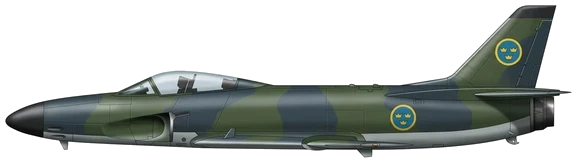
Swedish two-seat jet first flown in 1952 and built in attack, all-weather fighter and reconnaissance versions, serving the Swedish Air Force from 1956 until 1997. Key figures: top speed 1,200 km/h, range 2,000 km, service ceiling 15,000 m, max takeoff weight 13,500 kg, built 450.
| Crew | 2 (pilot, navigator) |
| Length | 14.9 m (49.0 ft) |
| Wingspan | 13 m (42.7 ft) |
| Height | 4.7 m (15.3 ft) |
| Wing area | 37.4 m² (402.6 sqft) |
| Empty weight | 7,500 kg (16,535 lbs) |
| Max. takeoff weight | 13,500 kg (29,762 lbs) |
| Powerplant | 1 × turbojet Svenska Flygmotor RM6A 6,659 kgf each |
| Maximum speed | 1200 km/h (746 mph) |
| Operational range | 2,000 km (1,243 mi) |
| Service ceiling | 15,000 m (49,213 ft) |
| Climb rate | 100.0 m/s (328.1 ft/s) |
- Air-to-Air Short-Range Rb 24 (licence-built AIM-9 Sidewinder, J 32B)
- Anti-Ship Rb 04 (A 32A)
- Rocket Pod 75 mm rocket pod (J 32B)
- Unguided Bomb up to 3 × 600 kg bombs (A 32A)
Description
The Saab 32 Lansen ("Lance") is a two-seat, transonic military aircraft designed and manufactured by Saab AB in Sweden. It was built in attack, all-weather fighter and reconnaissance versions, and the Swedish Air Force (Flygvapnet) received deliveries between 1955 and 1960. It was the service's first two-seat jet aircraft and the first with an integrated search radar. The Lansen later served as a target tug, electronic warfare platform and research aircraft, and all examples had been withdrawn from active service by April 2020.
Development
Saab began internal studies in autumn 1946 for a successor to the B 18/S 18 attack aircraft. In 1948 the Swedish Government asked Saab to develop a turbojet strike aircraft to replace the B 18/S 18, J 21R/A 21R and J 30 (de Havilland Mosquito). Saab considered several designs, including one with twin de Havilland Ghost engines, and chose a single-engine layout designated P1150. The design drew partly on Messerschmitt P.1101–P.1112 project drawings brought from Switzerland in 1945.
A design and mock-up contract followed on 20 December 1948. The requirement called for strikes anywhere along Sweden's 2,000 km coastline within one hour of launch from a central location, in any weather, day or night. Saab had planned to use the STAL Dovern engine, but timescale and technical problems led to its replacement by the licence-built Rolls-Royce Avon (RM5).
The first prototype flew on 3 November 1952. Testing led to removal of the leading-edge slot and the addition of triangular wing-root fences to improve airflow at high angles of attack. Series production began in 1953, and development totalled over 2,000,000 man-hours. The J 32B first flew on 7 January 1957 and the S 32C on 26 March 1957. Production ended in May 1960.
Design
The Lansen was the first aircraft whose skin curvature and panel joints were defined by mathematical calculation, using early computer technology to reduce drag. The low-mounted wing has a 10 per cent laminar profile and 35° sweep, which Saab tested at half scale on the Saab 202 Safir. Flight controls comprise hydraulically boosted ailerons, Fowler flaps and a powered tailplane. Four airbrakes are fitted to the rear fuselage.
The A 32A used an afterburning RM5 engine (Avon RA.3/Mk.109). The J 32B used the RM6A (Avon Mk 47A), rated at 65.3 kN with afterburner. The entire aft fuselage detaches for engine access. The pilot and navigator sat under a clamshell canopy, with a second windscreen protecting the navigator if the canopy was jettisoned. An Ericsson mapping and navigation radar had its antenna in a ventral blister. The A 32A carried a Radarvarnare F9/5 radar warning receiver and a Box-3 chaff dispenser.
Armament
The A 32A had four 20 mm Bofors m/49 cannon under flaps in the nose and three underwing hardpoints. It could carry two Rb 04 anti-ship missiles, among the earliest cruise missiles in Western service, along with rocket pods and up to three 600 kg bombs. It was also intended to deliver nuclear or chemical weapons, although Sweden's nuclear programme never produced a weapon. The J 32B carried four 30 mm ADEN cannon with 90 rounds each, Rb 24 (licence-built AIM-9 Sidewinder) missiles and 75 mm rocket pods.
Operational History
A 32A deliveries began in December 1955, which allowed the last B 18 to be retired, and the final Lansen was delivered on 2 May 1960. Sweden was the sole operator. Accidents destroyed a third of all Lansens in 25 years of service, killing 100 crew. In the 1960 Vikbo crash, an A 32A struck a farmhouse and killed seven civilians after a known drop-tank fault that had not been corrected. The Saab 37 Viggen began replacing the A 32A in June 1971. Twenty converted J 32Bs flew until the late 1990s, and in 2010 at least two were collecting high-altitude air samples, including volcanic ash, for the Swedish Radiation Safety Authority.
Variants
- A 32A: Ground-attack and maritime-strike version, with 287 built between 1955 and 1957 and retirement in 1978.
- J 32B: All-weather fighter version with the RM6A engine, with 118 production aircraft built between 1958 and 1960.
- S 32C: Reconnaissance version with PS-432/A radar and six cameras, with 45 built between 1958 and 1959.
- J 32D: Target tug conversion of six J 32Bs, retired in 1997.
- J 32E: Electronic countermeasures conversion of fourteen J 32Bs with G 24, Adrian and Petrus jammers, retired in 1997.
Frequently Asked Questions
What type of aircraft is the J-32 Lansen?
What is the maximum speed of the J-32 Lansen?
What is the range of the J-32 Lansen?
When did the J-32 Lansen first fly?
How many J-32 Lansen have been built?
Which countries operate the J-32 Lansen?
What is the service ceiling of the J-32 Lansen?
- SEP 302026 Created Page created: J-32 Lansen