JL-10
Chinese advanced trainer jet, operational since 2017, employed significantly by the People's Liberation Army Air Force. Key figures: top speed 1,715 km/h, range 2,600 km, service ceiling 16,000 m, max takeoff weight 9,500 kg, unit price $15M, built 20. In service with 3 air forces as of 2026 — China (62), United Arab Emirates (6), Zambia (6).
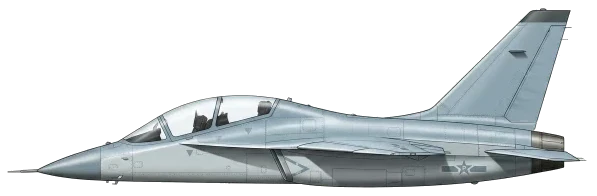
| Length | 12.6 m (41.3 ft) |
| Wingspan | 9.5 m (31.1 ft) |
| Height | 4.8 m (15.8 ft) |
| Empty weight | 4,500 kg (9,921 lbs) |
| Max. takeoff weight | 9,500 kg (20,944 lbs) |
| Powerplant | 2 × turbofans Ivchenko-Progress AI-222-25F 4,201 kgf each |
| Ejection seat | HTY-5 |
| Maximum speed | 1715 km/h (Mach 1.6) |
| Operational range | 2,600 km (1,616 mi) |
| Service ceiling | 16,000 m (52,493 ft) |
| Climb rate | 200.0 m/s (656.2 ft/s) |


- Air-to-Air Short-Range PL-5
- Air-to-Surface YJ-9
- Guided Luoyang LS-6
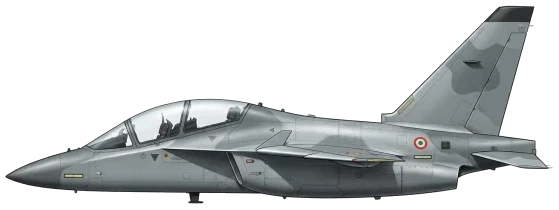
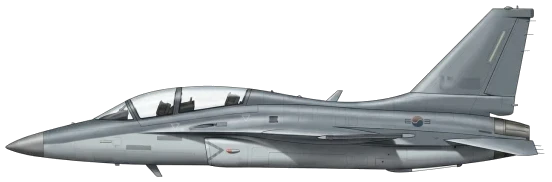
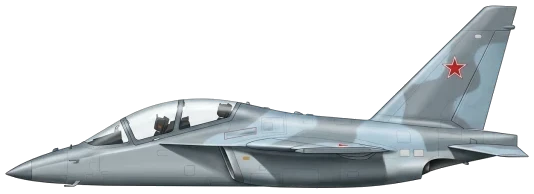
Description
The Hongdu JL-10, initially designated L-15 Falcon, is a supersonic advanced trainer and light combat aircraft developed by Hongdu Aviation Industry Corporation (HAIC) in China. It is employed by the People's Liberation Army Air Force (PLAAF) as a lead-in fighter trainer (LIFT), and by the People's Liberation Army Naval Air Force.
Development
China Aviation Industry Corporation II (AVIC II) was working on a new advanced trainer for the PLA as early as 2000; the same year, AVIC II engaged the Russian Yakovlev design bureau, designer of the Yak-130, as technical and scientific consultant to the L-15 programme. The L-15 competed with the Guizhou JL-9, developed in parallel by China Aviation Industry Corporation I. The prototype was completed in September 2005 and made its first flight on 13 March 2006. The initial variants comprised a subsonic advanced trainer and a supersonic fighter trainer. Development of the L-15B, a supersonic variant intended for LIFT, was announced in 2010; it first flew on 21 December 2017.
The China National Aero-Technology Import & Export Corporation (CATIC) ordered 12 L-15s in November 2012, without the final recipient being disclosed. The first L-15 in PLAAF colours was observed in 2016. The PLA used a few L-15s for flight testing before 2018. The PLA Naval Air Force received 12 L-15s in August 2018, and the PLAAF put the JL-10 into service for LIFT in 2019. Compared with the JL-9, the JL-10 shortens instruction and conversion time onto the PLAAF's recent aircraft.
Design
The L-15 uses fly-by-wire (FBW) flight controls and a glass cockpit. The prototypes were powered by Lotarev DV-2 turbofans. The subsonic L-15A receives Ivchenko-Progress AI-222-25s, while the supersonic fighter trainer employs the afterburning AI-222K-25. According to a Ukrainian source, 25% of the airframe is made of composite materials and the service life is 10,000 hours. The L-15B is powered by the AI-222K-25F, allowing a maximum speed of Mach 1.4, and has shorter take-off and landing distances than the L-15A. The L-15A and L-15B employ a PESA radar. The L-15B is 12.4 m long with a wingspan of 9.4 m, a maximum take-off weight of 11,600 kg and a ferry range of 2,600 km.
Armament
The L-15A has seven hardpoints; the L-15B has nine, for a capacity of 3,500 kg. Armament includes SD-10 and PL-8 air-to-air missiles as well as LS-6 satellite-guided bombs.
Operational History
Zambia ordered six advanced fighter trainers under the designation L-15Z in 2014 for $100 million, delivered in 2016 and 2017. On 23 February 2022, the United Arab Emirates announced their intention to acquire 12 L-15s, with an option for 36 additional aircraft; the amount was not disclosed, the Emirati newspaper The National indicating a unit price of $10 to 15 million. The PLAAF operates more than 50 and the PLA Naval Air Force 12.
Variants
- L-15AW: Subsonic advanced trainer version with seven hardpoints, previously marketed as the L-15A.
- L-15 advanced fighter trainer: Supersonic variant of the L-15A.
- L-15Z: Designation of the L-15 fighter trainer in service with the Zambian Air Force.
- L-15B: Supersonic light attack variant with nine hardpoints.
- JL-10J: Carrier-compatible version of the JL-10, used for catapult training and observed on the Type 003 aircraft carrier.
Frequently Asked Questions
What type of aircraft is the JL-10?
What is the maximum speed of the JL-10?
What is the range of the JL-10?
When did the JL-10 first fly?
How many JL-10 have been built?
Which countries operate the JL-10?
How much does a JL-10 cost?
What is the service ceiling of the JL-10?
- AUG 302026 Updated Description updated
- AUG 142026 Updated Per-engine thrust corrected against the engine variant the entry names
- AUG 52026 Updated Powerplant updated in a site-wide editorial pass
- APR 72026 Updated Sources and cross-references refreshed
- APR 52026 Updated Ejection seat added
- FEB 72026 Updated Top speed added
- JAN 122026 Updated Range updated in a site-wide editorial pass